art and narrative

Last Thursday, I moderated a panel discussion on the Fractal Art of Julius Horsthuis at NXT Museum. It was quite an interesting event as not only was the artist on panel, but we also had Dr. Margriet van der Heijden on panel–a physicist who specialised in particle physics at CERN. I’d never thought all that much about fractals before–I mean, if someone said the word fractal, I would understand that they’re talking about self-similar patterns which we often see in nature, but I probably wouldn’t be able to tell you what it is in-depth. For math people, talk about fractals will often lead to thinking about the Mandelbrot equation, but did you know that before Mandelbrot, there was the Julia? (Yep. I learned all these things while doing my prep.)

I also found myself thinking on the question of what makes art. What do we mean when we say a thing is a work of art? And what function do we ascribe to art? Julius Horsthuis says that his focus on Fractals lies in the fact that he hasn’t gotten bored by it yet.

For Julius, documenting or discovering the 3D worlds opened up by the input of various equations is what makes it fascinating for him. He talks about the films Baraka and Samsara which don’t follow a conventional narrative and how these films were an inspiration for the 3D films that he makes.

I certainly think that experiencing this kind of art by being in a space where you are surrounded by it is a different one from that of seeing it onscreen (on your laptop, your pc or your television). There is a mesmeric quality to it, but at the same time there is (as one of the audience said) a feeling of loneliness. Perhaps because there is an absence of characters interacting with the landscape. (Perhaps the person in the space becomes a character interacting with the landscape or could it be the maker himself?)

I watched Baraka and thought about that difference (the absence of humans in Julius’s work) and found myself thinking of how a landscape changes with the presence of humans. As Margriet said to me later on: Humans are not fractals.

I do like the concept of non-conventional narration and how it ties in with how story doesn’t have to conform in order for it to matter.

Later, Julius speaks of how the absence of narration is deliberate, although as he explores the possibilities of bringing his creations to VR, he realises that the absence of narration may not be conducive to people engaging with the art, particularly if they come to the experience for the first time.

Is story an experience? Is art an experience?

I think about these as I deliberate on my own work and process. I think of how as writers of story, there is a certain expectation arising from centuries of stories being told. What happens when story doesn’t conform to expectation? What happens when a story simply wants to show a world in the same way a documentary maker would show the world?

But is showing the world enough? We could argue that the majority of science fiction and fantasy books are about showing the world.

Piranesi, one of the books I read when I finally got my reading brain back, feels very much like that. It’s basically Susanna Clarke showing us the world Piranesi occupies. Piranesi’s voice compels us to come along and see and learn more about the world they live in. The cast of characters is barely there, but we’re seeing the world through Piranesi’s eyes and it’s beautiful and fascinating and a lot of times it is lonely. Piranesi eventually conforms to a story expectation but then not really and the feeling of fascination remains long after the book is finished.

Does Horsthuis’ art work in the same way? I can’t help but wish I had thought to ask how exploring the world of Fractals has changed or enriched the artist as a person. I’m not even sure if this is what the artist is after. Does it even matter? Should our work change us or reflect us or enrich us even? Does a work have to mean something in order for it to have value? Is fascination and sense of wonder enough?

In the light of discussions around the lives of creators, to what extent does the character and life of a creator influence our engagement with the work that they create? And can we separate things made from the people who make them? (Probably something for another post…my brain tends to wander off in tangents and this is my blog. πŸ™‚ )

I think there is room in the world for different kinds of artmaking because every form of creation will find its own audience and will speak to audiences in different ways. Thursday’s event reminded me of that. It reminded me of the beauty of physics, the endless mystery of the world we live in and that joyful feeling that arises when people come together with a desire to create bridges of understanding and knowledge.

If you’re in Amsterdam, I would recommend checking out NXT Museum (check out what’s on exhibit first as it varies). Not only is Julius Horsthuis’s Fractal Art on display, but they also have a fascinating exhibition by the postdigital art group Random International.

Blessings and peace to you who read this. Daghang salamat for passing by.

The joy of LIMBO

On Sunday, we marked the close of this season with LIMBO and the close of our partnership with FramerFramed. Framer Framed has been home to LIMBO since the first workshop took place in 2022. When we start up again in September, it will be at a new place.

Sunday was a celebration with food, music, dance and presentations from different participants in the group. As part of the celebration, we put together a mini-exhibition to show off what we had done together during the LIMBO sessions.

Looking back at the season, I am thankful to be part of this space. Bearing witness to how participants take ownership of the space, makes me feel incredibly happy. We had a mini-workshop on self-defense (more practical than I had imagined), a workshop on Iranian dance, and a small open stage with a q&a with one of LIMBO’s budding artists, as well as sharing of poetry from a budding writer, and also a sharing of journey reflections.

Sahar, who is a friend of LIMBO, made a wonderful comforting dish called Ash Reshte. I am googling recipes to see if we can try to make it home ourselves.

When I see how participants are flourishing, it makes my heart expand. I think of one of LIMBO’s participants sharing with us how they’d forgotten what they had in their self, until they came to LIMBO. They remembered that they were an artist, that they had this capacity and capability not just to make art, but also to share it with others.

In conversation with some visitors who expressed a wish to create a space like LIMBO, we talked about what it means to establish such a space and how we need to change the way we look at organising and leadership. How at the beginning, we need to change our mindset from: I am helping you to I want to serve and understand your needs and I want to discover how to support you so you can see the power that you already have inside you. To say: “this space is created by all of us together and belongs to all of us together and my voice doesn’t carry more weight than yours, but all our voices are equal in weight”. That also requires a different kind of seeing and a different kind of discipline.

Spaces like LIMBO allow us to be vulnerable. In such a space where we don’t need to fear being judged, where we don’t have to be perfect, we can become as we were meant to be. No pressure. No “you must be”, but simply free.

We break bread together, we share our joys and sorrows, we laugh and we dance, and we give thanks even as we acknowledge that life is challenging and hard.

Blessings and peace to you who read this. Agyamanac Unay for stopping by.

On my mind today

One of the marks of a good leader, my father said, was the capacity to encourage others to make full use of their talents and to make others grow into their gifts. It’s not about having the loudest voice or being the most visible, it’s about thinking on how we can help others discover and become their best selves.

My Mom also used to tell me that the sign of being a good teacher was when your student outgrows you and no longer needs you.

I think about these things because one of the writers who came to attend the six week workshop I gave for Other Futures (and who I’ve been mentoring a bit since then), was accepted to the Clarion Workshop. It is quite a milestone moment and I feel like a proud mama bird watching a fledgling spread their wings.

Last Saturday, I got to do one of the things that brings me joy. I got to work with young people again. This is a thank you to Lana Jelenjev and the Neurodiversity Foundation for inviting me to give a workshop to young people between the ages of 11-17 as part of celebrating Neurodiversity pride day.

There’s something about the way young people approach the act of creating together that makes me so hopeful. I saw the will to encourage one another, the willingness to compromise and make space for each other, and the readiness to help when the other person gets stuck. As Lana’s husband said afterwards, we could all learn a lot just by watching the kids work together.

It makes me think of how we all have that capacity to create and work together within us. Maybe it’s just that some of us didn’t know that we could just go about it, or we’ve been so programmed with this idea of individualism (mine is mine and yours is yours), we’ve been trained to think so much in boxes that we forget the joy of collaborating. And then, there is this soul-killing thing which I’ve sometimes observed in the grown up world where people think the important thing is to be better than someone else, win the most awards, have the most fans, make the most money, sell the most books…that sort of thing.

Life and art and the creation of story are not a competition. It’s not about having the best words or the coolest ideas, it’s about feeling safe enough to share what you love that make life and art and creation beautiful. What I loved about Saturday’s workshop was how I got to see young people bounce ideas off of one another in a space where they feel safe from being judged or found wanting, they just went ahead and talked about things they loved or were passionate about and they made space for each other to include those things in the worlds they were creating.

This method of creating together is a practice not only in worldbuilding but also a practice in bridge-building, in compromise and collaboration.

We could certainly do with more bridge-building and collaborating in these turbulent times, because it often feels like we have forgotten concepts like meeting each other halfway and compromise. We think we have waited a long time for change to happen and we would really like for change to have happened yesterday. The problem is, we live in a world that’s run by systems and systems are slow and resistant to change. As a good friend said to me: “you think maybe by being in the system, you can change the system, but it’s such a complex thing because by being in the system, you somehow become part of it.” I really don’t know what the answer is. We can only do what we can to the best of our abilities and hope that the little that we do will create some change no matter how small.

This week, I was in conversation with a dear friend, we also talked about this same thing. She told me about how she learned to think in terms of “good enough”. Perhaps it’s not the ideal change, perhaps it’s not the big change that we wanted, but maybe it’s good enough for now. How change happens in increments of time, by checking in and finding out whether a recalibration is needed. Maybe we can move forward a little bit more or it could be that we have to just be satisfied with good enough until the next check in moment.

I think about the words “good enough” when I have the conversation with my oncologist later in the day. I ask my questions and she patiently explains her interpretation of the data. It’s not yet where we want to be, but it’s good enough for now. And while the ideal would be to be completely rid of all the tumors, nodules, lesions and bad cells floating around, a stable or chronic state for a long period of time would be good enough.

It may sound like a strange comparison but I make these jumps in my head because that’s how the brain works. I think: it’s okay to not achieve the ideal all in one go. It’s okay to take it step by step. The important thing is to remain open and curious, interested and ready to look into options and points of compromise. Yep. I’m making the body and world parallel again.

Today, I’m speaking to my body. I’m thankful because I have a strong and sturdy body that has withstood a massive operation and all the treatments so well. I am thankful that I am able to work at regaining the strength and fitness that I had before it all started. I am thankful for the spirit that lives in me, that reminds me to take it one day at a time. I am thankful for today. Thankful that I can hug my son and tell him how proud I am of him (he’s having a bit of a tough time atm). I am thankful for friends who have reached out to me, for loved ones and for people from surprising places who tell me they are sending healing thoughts or praying for me. There’s always something to be thankful and joyful about.

As long as we have life in us, we are not without purpose. We are here to make as much of a difference as we can make. Sharing our stories, passing on our experience, strengthening and encouraging others to spread their wings and fly–discovering things, making memories (all those other things) remind us we are alive. As long as we are in the world, we can make every moment count.

Agyamanac Unay for stopping by. Blessings and peace to you who read these words.
the cancer update

It’s been a really hard week for us as we received news that the hormone therapy that had been keeping cancer cells from spreading was no longer doing it’s optimum work. I now have two nodules in my left lung. It’s not yet life-threatening (my oncologist makes sure I understand this). On the scan, you can see that compared to the mass of my lung, the nodules are pretty tiny. But those tiny things, if not contained, can spread and so to stay ahead of it, my oncologist suggested that we take part in a new study for a monotherapy which combines a protein and a chemotherapy targeting the cancer cell. For homework, we were given a bunch of papers to read so we would understand all the risks involved.

For the first time since diagnosis, I find myself struggling. Uncertain about which direction to go. I wonder if going through another round of chemotherapy will help. When I went through it the first time, we ended up having to postpone treatment three times because my leukocytes were tanking. It got so bad at one point that I had to have a blood transfusion. Weirdly, I was still quite energetic and healthy. A puzzle for my oncologist who thought it was strange that I wasn’t more tired. Looking at my values today, I noticed how hormone therapy did lessen disease activity drastically. However, the scans say the hormone therapy is no longer as effective as it was at first. Hence why we are considering this idea of going through chemo again.

I think that when we’re facing something for the first time, when we don’t really know what’s going to happen, we just go through things trusting that all will be well, but having gone through it and knowing what to expect, we start to weigh things a bit more. Do I really want this? And if there are other options on the table, maybe it’s worth looking at them again before making a final commitment to this trial? My doctor says that the length of effectivity from our existing options are a bit uncertain compared to this new treatment that she’s hoping I will get. But then, again, the trial is a lottery. So, I still have a lot of questions for when we next meet and I think it’s okay and it’s important to ask those questions.

By itself, the infusions don’t hurt. I made it through chemotherapy quite well, except for the final two sessions when I lost all my hair, including my eyelashes and my skin turned slightly grey. I kept teaching throughout treatment (except for days when I felt really sick), I still got to play with the band, and I made art. (And oh yeah, I wrote my first Dutch language SF story.)

I think of how in my work, I’ve sometimes used the body as a metaphor. Here, the body is a world. An anomaly has appeared in this world, it’s one that holds the possibility of taking over the world and consuming it. You just don’t know what needs to be done or how to go about it. Is burning it all down the right approach? Are there gentler and kinder approaches that will allow the body to find equilibrium and balance? What approaches will allow me to contain this anomaly so it doesn’t spread and kill everything else that’s healthy? How do you keep the systems that are healthy in that state of health? (Because I am clearly quite healthy except for existing nodules and small tumors.)

Yesterday, we had a visit from a friend who told us that maybe we have to let go of the hope of a cure. That I may be hoping so much for a cure that I forget that life is more important than the cure. And it had me thinking: if the doctors tell you they only hope to keep the disease chronic for as long as possible, what does that mean? Is it like having high blood pressure and having to take pills for the rest of your days? I don’t mind taking pills. It’s just that I never liked needles and I have developed a sort of traumatic response to being pricked by one. It doesn’t hurt, but I still cry. I say to the nurses: it’s the body that can’t help crying.

A part of me rebels against the thought of letting go of hope of a cure. Like: hello. There are advances being made everyday and all these new studies coming out. But at the same time, I also understand that nothing about this disease is predictable and what works for one patient may not work all that well for another. I understand the gravity of the situation and why I have to take it seriously. Which I do, except I get easily distracted by other things…like how all of what’s going on is great research. And I am still working on this novel draft and I am close to 70k. And hopefully I can finish this draft so by the time treatment starts, I don’t have to worry about the details but can focus on the rearrangement of certain things and filling in blanks like place names and character names.

According to studies, someone spontaneously getting healed from cancer without any treatment happens once in 100,000 cases. We still can’t explain why it happens or how, but it does happen. I’m not thinking of ditching treatment, btw. I just can’t help thinking about this fact that none of us knows just how long or how short our lives will be and none of us can predict what happens next.

We often think life is ours for the saying–we look at the future and it seems to stretch on into forever and we think we’ll just keep on going and doing and planning and racing from one moment to the next until we are faced with the truth of how life is ephemeral and we are ephemera. So, what does it mean to live and what do we mean when we choose life? What kind of marks are we making in the spaces we occupy?

I’m not yet sure what path of treatment we’ll take, but I do know that I would like to still be here on earth for a good while for the sake of my boys who have already lost so much. At times, I think that it just isn’t fair. And then, I think but we were never promised fairness in life. What we were promised is strength for the journey ahead.

Agyamanac Unay for stopping by. Blessings and peace be with you.

how it’s going

I’ve been going to physical therapy with a group of oncology patients for a couple of weeks now and have noticed that while mornings are often much better in terms of energy, afternoons are now improving. I’m not as tired as I was during the first afternoon training. I take this to be a good sign.

Upon my return home from Gladstones, the eldest son told me that I could transform his former bedroom into a writing space. Something I hadn’t even thought of doing because it was always his room, a lot of his things are still in it, and perhaps it’s that mother thought in my head that held the space for him just in case. But, as I was reminded, it’s been a year since he moved out. Birds spread their wings, they leave the nest, and go discover the sky.

So finally, after more than twenty years of writing at the dining table and having to move my mess when it’s time to eat, I have this space where the books I am reading can be left as they are. Where my pens and pencils don’t have to be tidied up and where when I am done for the day, I can close the door and let the projects I’m working on percolate.

I can’t help but think again about Virginia Woolf talking about a room of our own and how women who write need this kind of space.

Before I went to Wales, I downloaded a book by Joanna Penn. In the past, I’ve read books on writing that made me go: Oh, that’s nice. But it doesn’t work for me. Joanna Penn’s “How to Write A Novel” is perhaps the first book on novel writing that’s made me stop and say: I recognize that. For one, Joanna Penn calls herself a discovery writer. She talks about how overwhelming the process of writing a novel can be when you’re like her(like me). It was like a letter from a friend saying: look, I get it. Now tell me why you’re not finishing that novel. For me the greatest thing was a sense of overwhelm. I’d get bogged down in the details and before I knew it, I was lost. (I have a bunch of novels with great beginnings where the middles and ends are all squashed together because I got caught in a tide of overwhelm and couldn’t see where things were going anymore.)

But here I am. It is the beginning of the week. I have returned from my therapy class feeling energized and thinking: you know, you’ve come this far. Look at the horizon. Can you see where this story is going? Can you see how it’s going to end? Can you see what the story is about? Coming on close to 50,000 words, it’s really getting there. (Alarming thought.)

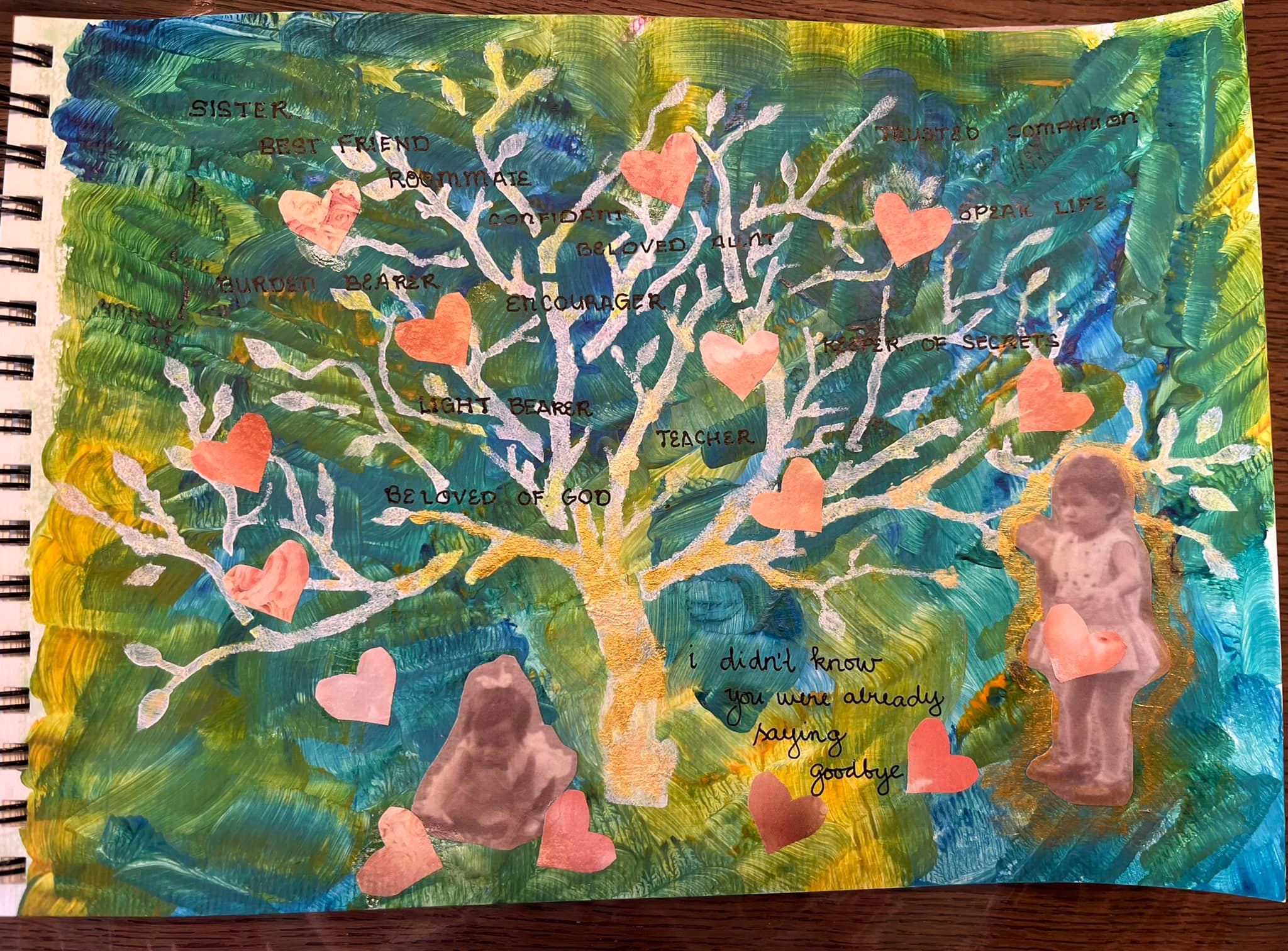
I think of how my sister would tell me to write whatever I wanted to write and to never give up. If my sister were still here, this is the novel I would give her. I would tell her, this is the novel I wrote because of all the conversations we’ve had and which we continue to have in my head. There are moments I just wish I could turn to her and say: what do you think about this?

What’s kept me from finishing novels in the past? At the heart of it has always been fear. Fear I wouldn’t have the right words. Fear I wasn’t up to the task. Fear I would screw up.

It’s funny how my sister’s legacy continues in the words she used to speak to me. My youngest son has had some difficult moments at school (understandable in the light of everything) but I’ve said these words my sister used to say to me: “It’s your dream, do something about it.”

Since I got this room, I’ve been coming up everyday to write words because when we see each other again, my sister will probably ask me what I did about my dreams and I don’t want to say that I was too scared or too overwhelmed to do something about it.

Blessings and peace to you who read this. Agyamanac Unay for stopping by.

End of our week at Gladstones Library

It’s hard to believe that it’s Friday. I can hear the tolling of the church bell from the church that’s right beside the library and it’s just finished bonging out the 10th hour of the evening. Ah. It really is the last evening of our final day at Gladstones Library.

Being here has been a wonderful and enervating time for me. Being among the books reminded me too of my family and how books played such a huge part of our growing up years. My sister and I spent so much time in books, and much later, when we were older, we found ourselves discussing books and arguing or agreeing on the virtues or the failures of particular novels or stories. When my sister went for her Masters in Theology, we had long discussions about theology and politics and I do miss my sister’s outspokenness over matters patriarchal as well as the wrong interpretation of scripture.

‘Where does it say that in the Bible?’ She would say, when someone was inclined to lay down some ancient patriarchal thing as word of God when it really wasn’t. When I discovered myself sitting between stacks on theology and philosophy, I couldn’t help thinking of how much my sister would have loved it here. What kinds of conversations would we have had about Reinhold Niebuhr or Kierkegaard? (I confess to feeling quite learned right now. I mean, my sister probably would know who Niebuhr was, but I read him here for the first time. Kierkegaard is a familiar name, but I hadn’t read him until I was sitting next to a stack with a number of shelves with books by or about him. I admit something Kierkegaard says did give me an idea for a horror story. So….I don’t know that my sister would count me as learned, considering how I have this tendency to turn serious things silly.)

Here at Gladstones, I have been well fed. Not just with the books and with the writing, but also with rich conversations around the dining table. Milford writers are just the best and it seemed to me as if the words spoken and the knowledge shared–all the conversations and all the warmth and kindness worked to open up a portal to that realm where the good words dwell.

I think of this time with so much thankfulness. Who would have imagined that I would be able to fly and travel on my own again? Or that I would write so many words in the space of week. Or that I would finally get around to properly organising the novel.

At tea with friends, I shared how it felt to me like I was waking up from a long amnesia and it was like I was remembering to write what I love to write the most. Worlds and worlds and the undying hope for change and a better future.

Follow where your heart takes you. If you’ve tended it well, your heart won’t lead you astray. You’ll always end up exactly where you are meant to be.

Blessings and Peace and Agyamanac Unay for stopping by.

At work in Gladstones

Here I am in Gladstones Library in Wales for a week of writing at the Milford Writer’s Writing Retreat. It has been a while since I’ve done something like this and I had quite forgotten just how enervating taking time out to write can be. It’s more than carving out time during the regular day, but just being here among so many books with other writers and just focusing on the work of writing has proven to be quite helpful in my process.

Before the diagnosis in 2022, I had been working on a couple of projects which I quite forgot all throughout treatment, so finding them again early in 2024 made me realise that I actually still liked these projects and they were stories that deserved to be finished. But coming to the Milford week, I was still torn on which project to work on.

In the end, I found myself drawn quite strongly to what I call the En story. I had been avoiding finishing it because the scale felt just so large. I realised that I have to acknowledge that it really is a novel. Not a novella, not a long short story, but a novel. It also means that writing in Gladstones works perfectly. I am in the process of putting together all the bits and pieces which I feel belong in this work and there it was staring me in the face…climate change. And what joy to be able to look through the library catalogue, head to the stacks, take all the books you think will be helpful and find exactly what you need for the huge thing you have been terrified about. It also helps a lot that one of my writer friends is a geophysicist and so I could send her a message saying: “uh…I have a question, help”.

It’s interesting to me too that the desk I’m seated at right now is located between two stacks of philosophers.

There is something about the moment and place of creation and how tapping into the source will bring you to the places/people/sources that you need in order to keep moving.

Working on the En story, I understand what it is about this work that terrified me. Now that I have the proper focus, I see how the world has always been comprised of opposing forces. Forces at a constant push and pull and forces that threaten to overwhelm each other. There is the nature that uses up worlds without thought or without care. It’s the kind of nature that discards without thought because when something is used up, there will always be another to take its place. It is the assumption born of privilege. There is another nature at place here too. It’s the nature of lifegiving and restoration and nurturing. Because the second nature is not brutal in nature, it’s often trampled on or made little of. But without the second nature, what would happen to our earth? What would happen to humankind? There is another nature somewhere in there and this is one wherein I hope balance takes place. I am working on it and my head is constantly busy with it.

A little while ago, I had a conversation with one of my Dutch friends. We talked about the balance between the realm of the spirit and the real world and how it’s easy to get caught up and lost in the spiritual, but we need to remember that we are also here in the real. It is the same with writing. My first drafts tend to be vague and starry eyed and not too grounded…more floaty and slippery than solid.

I started writing again in 2024 and it feels to me like I am learning all these things all over again. But what a joy to be able to do so. To be able to write and tell the stories I want to tell. Isn’t that a blessing?

Blessings and peace to you who read this. Agyamanac Unay for stopping by.

Challenges

So, I decided to take the challenge and keep on writing in Dutch. When Liang de Beer asked me if I would like to take a shot at writing something for Modelverhalen, I thought–let’s say yes. How hard can it be?

Well. I am here to tell you that writing in Dutch is hard and challenging. Dutch isn’t an easy language and I actually caught myself turning English words into Dutch by changing the spelling. I know. Thank goodness for the native Dutch speakers who live in my house and who are pretty tough when it comes to my use of the Dutch language.

Even if my story doesn’t make it into the anthology, I have learned so much from the process of being edited by Liang. From fuzzy first draft, through tangled experimental versions, to the draft that I ended up submitting today, I can see the process the story has gone through and how the draft I ended up submitting tells a more cohesive story than the draft I submitted first. (Plus, I also feel like I learned to use the language better than before.)

Writing in Dutch also made me realise that while I may still have a journey ahead of me, I actually do enjoy writing in Dutch. I like the rhythm and the sound of the language and I want do discover how to use it to tell the stories I want to tell.

I think about life and how life is a journey and a process and learning to write in Dutch is for me part of my journey and part of my process of becoming a better inhabitant of the Earth. I am learning too to be more patient with myself because process cannot be rushed and neither can you rush the journey. Perhaps this is why it takes about 100,000 words.

I’m thinking about process and journey as I also recently took another step in the journey towards becoming stronger. I recently signed up for a physiotherapy class which is focused primarily on cancer patients and the needs of cancer patients.

Back before my diagnosis and all the treatments that followed, I pushed my body to the limit and I could lift and carry and do a lot of things which my body can’t do as well as it used to. What’s often frustrated me is how I seem to just run out of energy even when my brain tells me: we have lots of things to do.

During the intake my physiotherapist gave me the word “doseren”. In translation, the goal is to learn how to budget and make use of my energy so I don’t end up constantly with a deficit. Not giving your body time to recover energy results in a constant deficit until you are no longer capable of doing anything. The objective of physiotherapy is to make sure that your energy level eventually gets back to the point it was before all the traumatic stuff happened to your body.

I learned this lesson during my second class. I had had a broken rest and wasn’t feeling in tiptop shape, but I still came to class. My physiotherapist observed that my energy was low and told me not to make use of the weighted vests. When I insisted that I could, she said: remember what I told you about doseren?

It was a humbling moment. I had to admit to myself that in that moment, if I took the weighted vest, I might be able to finish the class, but at the end of the class, I would not be able to do anything else. Acknowledging the limits of my energy, allowed me to recover well and the day after class, instead of taking my usual quickstep one hour walk, I decided to take a gentle half hour stroll.

I think of how we’re often focused on the goal–on getting there–on achieving something–on becoming whatever it is that we want to become. But I am learning that process is important. Maybe even more important than the goal.

I have this tendency to be so focused on getting somewhere, that I forget to pay attention to the things that matter most. Being rooted in now. Focusing on what my body is telling me. These are things that are easy to forget when life is going at its usual pace. In a manner of speaking, it’s a blessing to be taught to slow down.

I am in the process and I am learning and what I am learning is all helpful. Nothing in life is ever wasted.

Blessings and peace to you who read this and don’t forget to take time to be in the moment.

What does it mean to flow without borders?

I have had in my mind this thought which I came back to me and seems to become more concrete as I try to put it into practice: what do we mean when we talk about a world without borders? Or what do we want to see? Or how might that experience be like if there were only superficial restrictions in place and if we could — as Glissant expressed it, move through to taste the atmosphere of a place. I have to go back to reading Glissant because a lot of things are mixed up in my memory (chemobrain) but this definitely stuck and remained with me and I was reminded of it again when in one of our latest LIMBO meetings, some of the participants asked why is it that we have to put borders in place? Why all these restrictions? Doesn’t the world belong to all of us?

I went home thinking about borders. How do we see borders? Are they protection? Who is protected by these borders? And who are we protecting ourselves from? And why do we need to keep others out in order to feel protected or safe? What do we mean by safety? What do we mean by security?

I asked these questions of myself because I live in a country to which people from other countries migrate to or flee towards to ask for asylum. I live in a country in which the discussion around migrants and asylumseekers is so fraught that one actually risks losing friendships in the process.

I don’t have the power to make change happen on a big scale and I don’t have the power to go out into the large arena and make discussions happen but I thought on how to bring that practice of flowing through borders into a very small space.

For this month’s LIMBO, I thought of asking participants to work together to fill up white space with writing or drawings, with lines or curves or symbols, with whatever they can think about to express their presence in the world. The invitation being this: if someone puts down a mark, how will you interact with it? How will you cross the borders? How do you enter space where you didn’t put a mark first?

It’s an exercise that I find myself wanting to repeat with others. Without our realising it, we have our own concept of borders, even on something as small and simple as a piece of paper. Creating on a space reserved and marked yours feels different from creating in a space that says–this is for all of us. Leave your marks, interact with other marks, there is no one artist, no one author, no one creator, it belongs to all of us.

There are questions that arise from this exercise that I also want to think about and which I find myself curious about: how does it feel to cross over into another space? What changes once you make that decision to leave a mark there? To interact with something that’s there? How does it change the way you perceive the work?

I didn’t get to ask this of the group, but I find myself wondering: How do exercises of collaborative creation change the way we see the world and the way we interact with one another?

In talking about this with a dear friend who is a fellow artist, activist and also a writer in the field, I expressed a vision of a room that becomes filled with doodles and maps and words and drawings. And how, it would be interesting to discover how willing we are to layer on top of what is already there and how that space would not be a work attributed to any one person but it would be attributed to all who collaborated whether the person is invited or comes upon it by happenstance, where those making marks can also be living creatures that we take care of.

Writing this, I realise that I am writing about the world we live in. We are all in the process of creating or re-creating, making or re-making, building or re-building–perhaps we layer over what is already there–we bear witness. We see how systems put in place have shaky foundations and how those who benefit from these systems try to prop them up. We bear witness, we offer criticque. But is offering criticque enough?

Marking the empty page to make something together can involve some risk. Stepping out into the world, making a decision to make or leave a mark involves much deeper and more thoughtful movement. What kind of mark do I want to leave? How will the mark that I leave affect those whose spaces or whose lives I live a mark on?

In any case, for me, the question strikes closer to home and makes me think that if I have marked my children with love and care and the ability to be thoughtful and considerate of others, then some of what I am meant to do has been done.

I wish I could share the picture of our collaboration, but it belongs to the group. But perhaps it’s an exercise some of you who read this blog might want to try on your own. Just take the step. Make the invitation and see where it takes you.

Agyamanac Unay for stopping by. Blessings and peace to you who read this.

memorials

Today is my elder sister’s death anniversary. I considered posting about it on FaceBook which is the social media thing for a lot of Filipinos, but something in me rebels at the thought of remembering my Ate and having people put likes on the post. I know the intention is always good, but my insides just don’t feel in tune with doing that. (But still I’m writing this post because I didn’t want this day to pass without remembering her in some way.)

For a long while, I blamed myself for my sister’s passing. I thought: how could I not have seen it? She was here with me in the months after my husband died. How could I not have seen it? I blamed myself for being so preoccupied with my life and my sorrows at that time–if I hadn’t been so self-absorbed, I might have been able to do something. I don’t know what I blamed myself for not seeing. She spent three months with us and one month after she arrived back in The Philippines, I got a phone call telling me she was gone.

It wasn’t until about a year ago that I had the courage to ask my brother what the diagnosis was. It turns out my sister had sepsis. Something had entered her bloodstream and poisoned her. Sepsis goes so quickly that by the time it manifests, it can be too late.

The cancer I was diagnosed with is also something that doesn’t manifest. It doesn’t show up on blood tests unless you’re looking for it, and because I was pre-menopausal, what might have been warning signs could just as easily be pre-menopausal stuff. That it was found came about because I remembered my sister had a non-cancerous fibroid that was causing her some trouble and I wondered if that might be the same for me. When we sent the test away, we were perfectly confident it would be nothing–but it was something after all. A part of me wonders if it was still my Ate, looking out for me.

We measure grief in moments of time. How many days has it been? How many years? We light candles or we carry out rites of remembrance. We post pictures on social media, we try to find words for our grief.

And yet, for all that she’s no longer physically here, my sister is with me. When I am on the verge of giving up, it’s her voice I hear scolding me. She was really strict with me about not giving up. Ano ka ba? She would say. Okay, if that’s how you want to end up as. (The implication being that if I give up, it’s not her fault if I get called someone who gave up.) Even though she’s no longer here, she still remains my number one cheerleader.

Losing my sister was painful because of how sudden it was. It was painful because there was so much still left unspoken and undone. (We were still going to Paris. We were going to travel together. We were going to grow old and talk about all the books we had read.)

Sister relations are never simple. My relationship with my sister was complex. We were at times adversaries. I remember her banging on our shared bedroom door while I listened to Queen or to David Bowie–and I remember her telling on me. ‘Mom, Rochita’s listening to rock music again.’

But even so, she was also my staunchest ally and my most trusted friend.

Grief softens with time (they say). And it’s true, it does. The sharp edges are gentled. But the missing remains. When I think of my sister, I no longer feel as if I am held fast in that dark moment where the world has lost all meaning or context. I think of how she would want me to walk forward and to take on life and live it as ferociously as I can with as much courage as I can.

Today, as I remember my Ate, I make the decision once again to keep embracing life. Everyday, I make the choice to embrace life and live life. I am present here and I am present now. Now is when I can do what I need to do. Tomorrow will take care of itself.

Blessings and peace to you who read this. Agyamanac Unay for passing by.