Reflecting on what was and what is now

Today, I think of my father standing in the only hospital in Banaue, right after an armed conflict between the government forces and the NPA. (This incident took place during the martial law period when my dad was the only doctor in the mountains.) I think of him being made to choose: Doctor, if you treat one of theirs, we will shoot you. And my father, who was the only doctor in the mountains at that time said to these men: I don’t see government military or NPA, all I see are wounded in need of care. You can shoot me, if you want, but who will take care of your wounded?

And he took care of all the wounded, and in that space of time when he was taking care of their wounded, while they were waiting for him to do his work, the hospital compound became neutral ground.

We are grieving. We grieve for the ones who suffer the consequences of war. We grieve for those who are lost, for those who suffer, for those who have lost. We grieve for what is broken. We grieve for the innocent and for the loss of innocence. We grieve for the brokenness that is in the world.

I think of these things as I prepare for LIMBO, and I think of how we keep spaces safe and how we hold space for those who are vulnerable and need this space. I don’t have much power but I have now and I can ask: What do you need now? What do you need today? How can I help or facilitate or support in such a way that this need is met in this moment that I am with you?

From this point of beginning, I can think in possibilities. I think of mapping the world we dream about, of making visible what is strong and resilient and hopeful and beautiful inside each one of us. I think of how, in a world where conflict has become the norm, liminal spaces are necessary spaces.

Of course, we knew that when they left the hospital, some of my father’s patients continued on with their conflict. We heard their guns in the distance and we knew there were places where it was not safe. But for a moment, when they were in the hospital compound, there was peace.

I want to walk in my father’s footsteps. To say: I am here to serve. If you leave this space feeling stronger, feeling more hopeful, feeling a little more able to face what life throws at you, feeling more connected than disconnected, then that’s good enough for me. I wish I had the power to right all the wrongs in the world, to heal the pains and the illnesses, to bind up what is broken. I don’t have that power, but I can say: I am here in this now. I am also here for you.

This post is more of a personal reflection than one that offers solutions. Because all things in life are connected, because art and life flow seamlessly into and through one another, it becomes inevitable that this too makes its way into my own work.

May lovingkindness surround you and may peace be with you who read these words.

*Having written this, I am thinking of how my father’s stance was an act of resistance. In choosing not to take a side but to address the problem, he opened a path to neutral ground.
Titles are a challenge

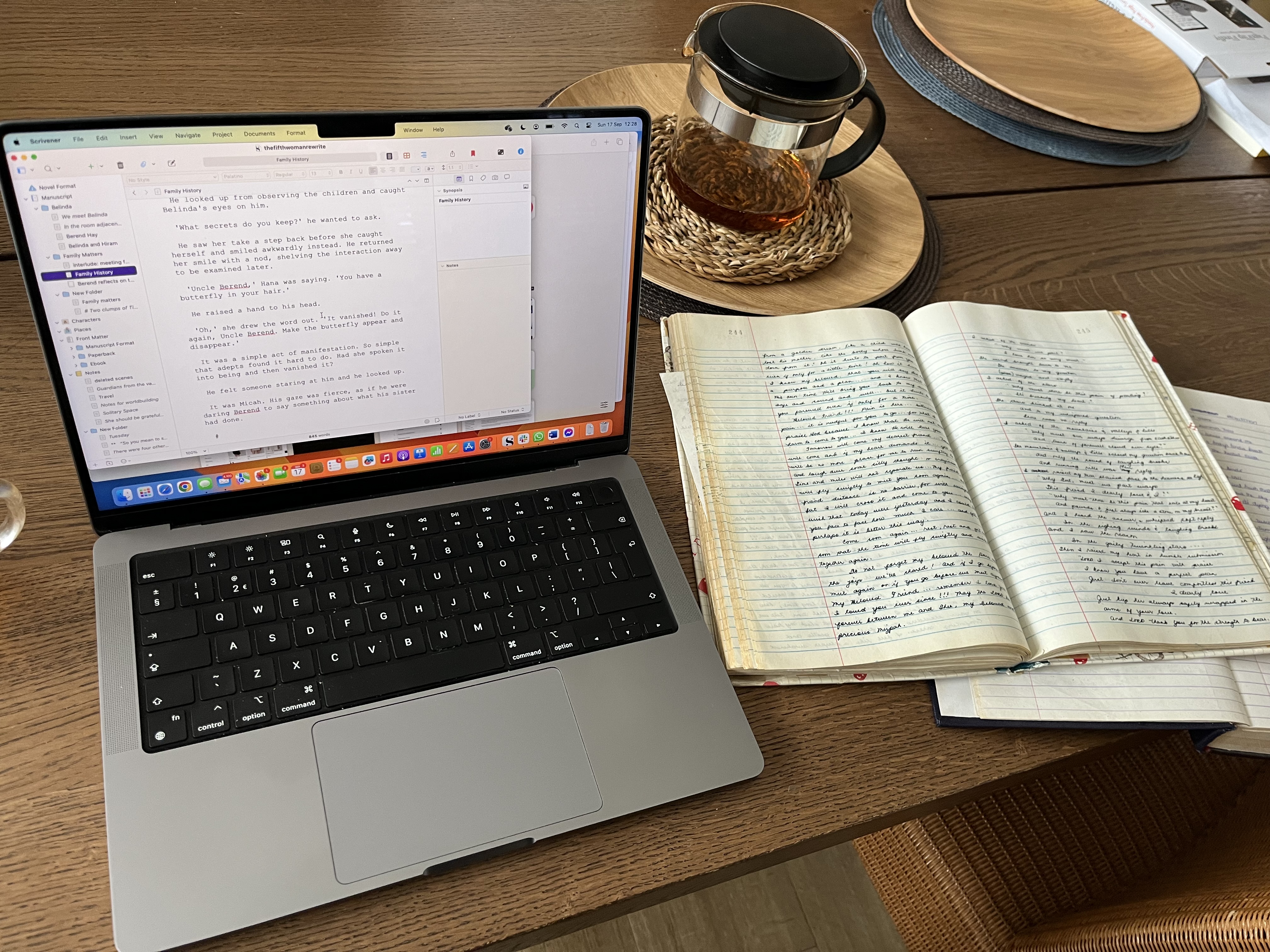
Titles are not my strong point. I am currently working on the second draft of a novel titled The Fifth Woman. Don’t ask me why…it probably just felt cool at that time or maybe I was just like: whatever. Let’s just call it this as a sort of jumpstart. So far, I haven’t found anything in the draft that talks about a fifth woman. It’s a pretty amazing feeling though to have been writing consistently everyday for the past two months as prior to that time, my brain often felt like a jumble of words and there was not enough quiet to properly focus on fiction. To my surprise, I have passed 15k on second draft and it looks like it’s still going.

Before I found The Fifth Woman, I had been writing away at The Cartographer novel which I’ve left stranded at 85k because the world was getting so big and unwieldy I had to step back from its noise for a bit.

Finding The Fifth Woman (first draft from end of 2021 before cancer struck) was like finding a gift because there was enough distance for me to appreciate and see where I’d gone off the rails with it ( characters with names like ‘this person’s dad’ and lazy shorthand place names ‘let’s just call this place wherever’ and I’ll call this form of transport something unpronounceable). Clearly, I was just in a rush to finish first draft. When I read it for the first time after regaining my focus, I thought it was someone else’s work, until I got to some place names and memory hit me…oh right. I wrote this while doing the Munabol online workshop for BIPOC kids. And then…Oh. This thing is long. It’s super-long. What is it? Is it a novel? Is it finished? (Yes. It was indeed a first draft clocked in at a little above 65k.) That was two weeks ago.

My current writing speed is an average of 1000 words a day (sometimes 1500), but at the end of a writing session my brain refuses to focus and I just want to go watch Formula one or something mindless for a while. (I have become quite the Formula One and bike racing addict. Tour de France, the Giro, Vuelta, and then there are the classics. Cobblestones! I can hardly watch but I still do anyway.)

I’ve noticed that there is a lot of messiness in my head the closer I get to the appointments for my bloodtest and immunotherapy. As I said to people closest to me, it’s quite weird because it doesn’t hurt, but I have an increasing aversion to being stuck with needles. It melts away once the bloodtest and immunotherapy week have passed and for most of the time I forget that I am under treatment. My oncologist tells me we are on this road for two more years and then we’ll see. It’s an interesting space to be in because no one really knows and I think that’s okay.

Just a little while ago, I bumped into an acquaintance who I hadn’t seen in a long while. Upon hearing about my diagnosis and about all the treatment things, she went: But you’re too young… (I won’t insert what was implied here because it took me aback). It’s one of those really odd responses that makes me want to laugh out loud. I know it’s well-intentioned and well-meant, but I remind people that I am not dead and I have no intention of dying anytime soon. I am completely in the land of the living and I believe I’ll still be here for as long as I am meant to be here. It’s the thought that comes to me when anxiety strikes: Peace. I remind myself. As my mother said to me at the start: you go ask God what he wants to do with you because until He’s done with you, you’re not done doing.

My mother, a cancer survivor, was diagnosed with metastasised cancer when she was 46. It had spread to her bones and she was given one year to live. Today, she’s 85. She laughs talking about it: ‘Actually,’ she says. ‘I decided I wouldn’t die because I didn’t want your Dad marrying someone else.’

There’s this thing about coming face to face with mortality. You come to understand what it means to be alive. I think about one of the participants to the workshop saying: this is my now.

It’s a pretty radical thing to say and to do. To be present in the now. To rest in this moment. To give as well as to take pleasure, to share in what is funny, what makes you laugh, what makes you cry, what warms your heart, what melts you–to choose to be here in now is such a powerful and radical act because it is the essence of being alive.

It’s easy to get pulled into the rat race. To think: I’ll make time for what matters and what makes me happy when I have more time. Time is an ephemera. It’s an illusion we create for ourselves. Time that matters is now. What am I doing now? How am I being present now? What am I sharing of myself now? What kind of memories and legacies am I putting in place now? It’s in this now moment that we are doing and creating and making and establishing connections and as I said to someone precious to me: humans and relationships are more important than things. Wealth, status and possessions you can replace. Connections, relationships and humans you cannot.

Perhaps it’s why I’ve become so invested in The Fifth Woman. Because it’s a messy novel about messy relationships. It’s about the now space versus the could be space. It’s about family and relationships and all the pressures that are exerted upon that precious space of simply being. It could be fantasy, but it could also be science fiction. I really do not know. I’m just writing it. In the now.

Blessings and Peace and Agyamanac Unay for reading.

A new season

Perhaps the most surprising thing is coming back to life. In the season when cancer was very much at the forefront of our lives, I made the choice to just let go of everything and focus on doing what needed to be done in the moment. Get through surgery, recover from surgery, go through radiotherapy, recover from radiotherapy, go through chemo, survive and recover from chemo. We are in a post-chemo period as my oncologist has determined that chemo is more harmful to me than helpful and so I have been taking immunotherapy once every four weeks for the past two months and will continue to follow this schedule of treatment for the next two years.

I think of how there are reasons for all circumstances that we encounter in life. We won’t always find ourselves in pleasant places. Finding ourselves in the midst of adversity, having to combat things like financial uncertainty, loss, uprootment, illness whether it be of ourselves or someone we love–what we make of that adversity can determine the story of our lives.

I said to my oncologist at the start of this entire trajectory: my life is not cancer and I do not want my life to be about cancer. My life is more than cancer and because I can, I determined in my heart that I would just keep living and being alive. (Also, my surgeon said: actually, except for those tumors, you’re super-healthy.)

Where I am now offers me the chance to reflect on how I want to continue living. I lost words and stories while going through treatment. For a good while, I couldn’t even remember the names of characters or the titles of stories or even the words to describe a thing. I couldn’t piece words together to make a proper story even. But in that season, I learned to make pictures. To draw, to paint, to collage, to work with different mediums–something I’d never thought I could possibly do when I was so focused on writing words. I learned there are no boundaries in art-making and story making and the only thing that keeps us from making is because we think we can’t or we’re afraid we’ll make a mistake (or someone told us we aren’t talented or good enough at it).

This coming season, I will be taking part in LIMBO which is a wonderful life-giving project under the hat of the beautiful Fabian Holle. I can’t think of an adjective that fits them more than that word. Because Fabian is Fabian, it doesn’t surprise me that LIMBO has become this space that is also wonderfully life-giving and inspiring. Working together with my good friend, Lana Jelenjev, we hope to contribute, plant and water seeds, speak life and hope as we facilitate this season with LIMBO.

I’m thinking about all these processes as I prepare for a season with LIMBO. Thinking too about all the different things I’ve learned in the various seasons of my life and thinking of how story isn’t just about words you write on a page. Story is intertwined with life and art and making and sharing and composting and living. It’s crying and laughing and howling with rage and shaping a space in the world for what you have to share.

There are no borders between the different ways of telling or working through or sharing. There is no right or wrong way to go about sharing what has lived and lives and what you hope will continue to live inside and outside of you. There are no limits–not even the space to share is limited because there is enough space for everyone and if we think there isn’t, then we just have to enlarge our circles and make more space. We are limited only as we allow ourselves to be limited.

And yes, we live in a world that’s polarized, where hatred and malice abound. But we can expand the circles filled with light and kindness and love until there’s no more room for hate.

LIMBO occupies a special place in my heart and I invite anyone reading to visit the following links.

Framer Framed Presentation: LIMBO – queer exilic narratives (definitely read Fabian’s beautiful speech as well as the interview with LIMBO co-creators

May lovingkindness always surround you. Agyamanac Unay.

Last Night in Rotterdam

Last night I was on a panel celebrating the launch of De Komeet. It was a lovely evening hosted by The Base Bookspace and Bosch and De Jong in the Fenix Food Factory in Rotterdam. I’m mentioning the location specifically, because when I got to the place, I was just blown away by how cool it is to find a bookshop in a Food place. I wish I’d remembered to take pictures, but Trip Advisor has cool pics of the location in case you want to get an impression of what it’s like. I love that there is this independent bookshop in a space where people meet to have a bite and I totally made an agreement with writing friends to meet up at that place and do some writing together. ( I also had some amazing oesterzwam bitterballen so I am definitely going back for that too.)

She may not read it, but I want to send a shout-out to Lianne from The Base Bookspace for an amazing job as moderator. I think the space itself contributed a lot to that feeling of warmth and energy and safety. On panel were Vamba Sharif and Martijn Lindeboom who were both editors and contributors to the anthology, Shiantie Singh, Weegbree, and myself. We discussed SFF, what editors Vamba Sharif and Martijn Lindeboom hoped to achieve with this anthology, and also what our experience and hopes were as contributors to this anthology. My dream, as I shared it with those who’d come to the panel, was that we would in the future see a blurring of borders between genres so we move away from thinking in terms of labels.

I now find myself reflecting on how labels are more harmful than we think they are and how wanting to put labels on creative work is an outward expression of humanity’s need to be in control. We can’t always label or control creative expression, and this is why work that moves out of the expected or work that refuses to conform or submit to a particular label can be viewed by some as threatening. There’s a lot to unpack around how the fear of losing control and our discomfort with not being able to predict or control an outcome contributes to the increased polarisation we see in today’s society, but there are a lot of folks way smarter than I am who can do that. My job as a creative person engaging in different forms of art making and creation is simply to tell the story of how refusing to be bound to labels frees us to discover what’s truly joyful, what is truly kind, what it is that heals us where it matters the most and what can give us hope when the world brings hard things our way.

In the meantime, I have resumed writing again (thanks to my precious friend, Marielle). I admit that at one point I told her, I probably won’t write ever again because my sff brain seems to have gone with the chemo. But Marielle just kept on speaking out her hope that I would pick up the writing again and so I am writing again and Marielle is keeping me honest and writing. She may or may not read this blog as she’s pretty analogue, but I just wanted to put this out there.

I want to say thank you to the lovely people who showed up for the book panel. I may show up at a future panel for De Komeet, it all depends on proximity and energy. But in the meantime, I will try to update this blog as much as I can with thoughts on writing, art, reading and life.

Blessings and peace to all who read. Agyamanac Unay for reading.

to be unconstrained

I’m thinking of borders and permeability in relation to art and writing, in relation to making and to being in the world and I also find myself looking at nature, looking at what the various sciences also tell us about how nature and the universe works.

Related to this, I have to think about various conversations I’ve had with friends and journey mates. One thing I wanted to share was this thought that the borders between practices are permeable and as beings whose strength lies in our ability to imagine, there are or should be no borders.

Glissant, writing about borders advocates for permeability–for moving past seeing borders as a means of defending or preventing, but rather as a way to mark that one is crossing from one country to another.

Translating that into the practice of making, it makes me think of how I am not bound to only one form or genre of practice. It also means that the doors to various genres and forms of making need to be permeable and to my mind, we also need to make the threshold less imposing and more inviting. (Open the door, break down the barriers or walls and say welcome.)

I’ve often had people tell me that they’re not really writers because they’ve never been published or because they’re just starting to express themselves in writing. I’ve also spoken with people who practice art but don’t dare call themselves artists because ‘well, there’s a study you have to do for that’ and also ‘my work isn’t as good as’ or my work isn’t worth it because I don’t have the right background’. (Did the first cave painter have the right background, I wonder.)

As humans, we tend to be fond of creating labels. We say: you are a writer, you are a visual artist, you are a painter, you are this, you are that. Even when it comes to being in the world, we like to employ these definitive and concrete labels and breaking away from those definitive and concrete labels is often viewed as strange or weird. (Actually, it’s often brushed aside or denied because it doesn’t fit into how people like to see things.)

But we can’t put limits or borders around the creative mind and we can’t put borders or limits around being in the world.

I articulated some of my thoughts in this message to the guerilla writers. I wrote: I feel that as beings we are fluid by nature–maybe born with certain body parts, but that doesn’t mean we are limited to those parts. Those parts don’t define us or speak of who we really are and to my mind remembering that fluidity, remembering that freedom to just be–while it can be scary at first, it is most certainly a source of joy and hopefulness.

One of the writers asked me if I could share my experience of this and so I talked about how I slowly came to recognise and embrace this fluidity for myself as well as my thinking on it. It was for me, the first time I was able to say to someone that I was born in a body that I’ve often felt awkward in, but which I embrace as being part of me. To put to words that feeling that the self that lives inside the body, that pure self is one that’s not bound to societal parameters or social constructs, it was scary but also freeing. Having done that, I found myself better able to say that I am simply as I am–a being in the world. Unbound, undefined, but very much joyful for having embraced this knowledge.

To you who are on the journey, I wish you love and the joyful embrace of self and work that isn’t constrained by borders.

In a time of pandemic

Last year, I was on a panel where we talked about the pandemic. We were in lockdown, but there was still this feeling that vaccines would be developed and the virus would be defeated. The reality is we’re still in the midst of a raging pandemic and while there are vaccines, the virus has undergone a number of mutations and there’s no way of predicting the path of a virus. It’s a natural phenomenon–like a storm that must rage until it’s done raging. There’s no reasoning with it, there’s no negotiating with it, there’s just understanding that we are living in a time when we must rethink the way we live our lives and do things.

This Sunday, I’ll be on a BonFiyah panel titled: Frail But Hard to Kill:Hope in a Time of Pandemic. The panel will be hosted by the most excellent Cristina Jurado and I’ll be on it alongside Alyssa Cole, Bogi Takács and Eve Shi. It’s probably the first proper SF related event that I’ll be appearing on since I don’t remember when, but the subject matter of the panel speaks to the need of the time we are in, so I hope I can offer something helpful.

The pandemic broke at a time when I was getting back on my feet and feeling strong enough again to pursue new ventures. For a short while, it was like coming to a full stop and feeling quite stymied about what happens next. But what helped me most was being in the rhythm of conducting a workshop that had to be moved online. Having to adapt the method and the practice to one that was more personal and having to take more time to think about the needs of the students. At the close of that period, I felt as if I had learned a lot and it helped me go back to the drawing board, to rethink how such workshops are conducted and to think about ways that are more nurturing and communal.

It also had me reflecting on the radicalised nature of various discussions and on what could be done to shift the direction of conversations so that instead of shouting from opposite ends of the table, we could move towards finding common ground, building bridges, and having productive discussions.

How can we as beings who are writers, practitioners of craft, artists and thinkers help create or shape the environment for these kinds of discussions?

I don’t think a blogpost offers enough room to think aloud on that matter, but I am taking it with me as I continue on my journey.

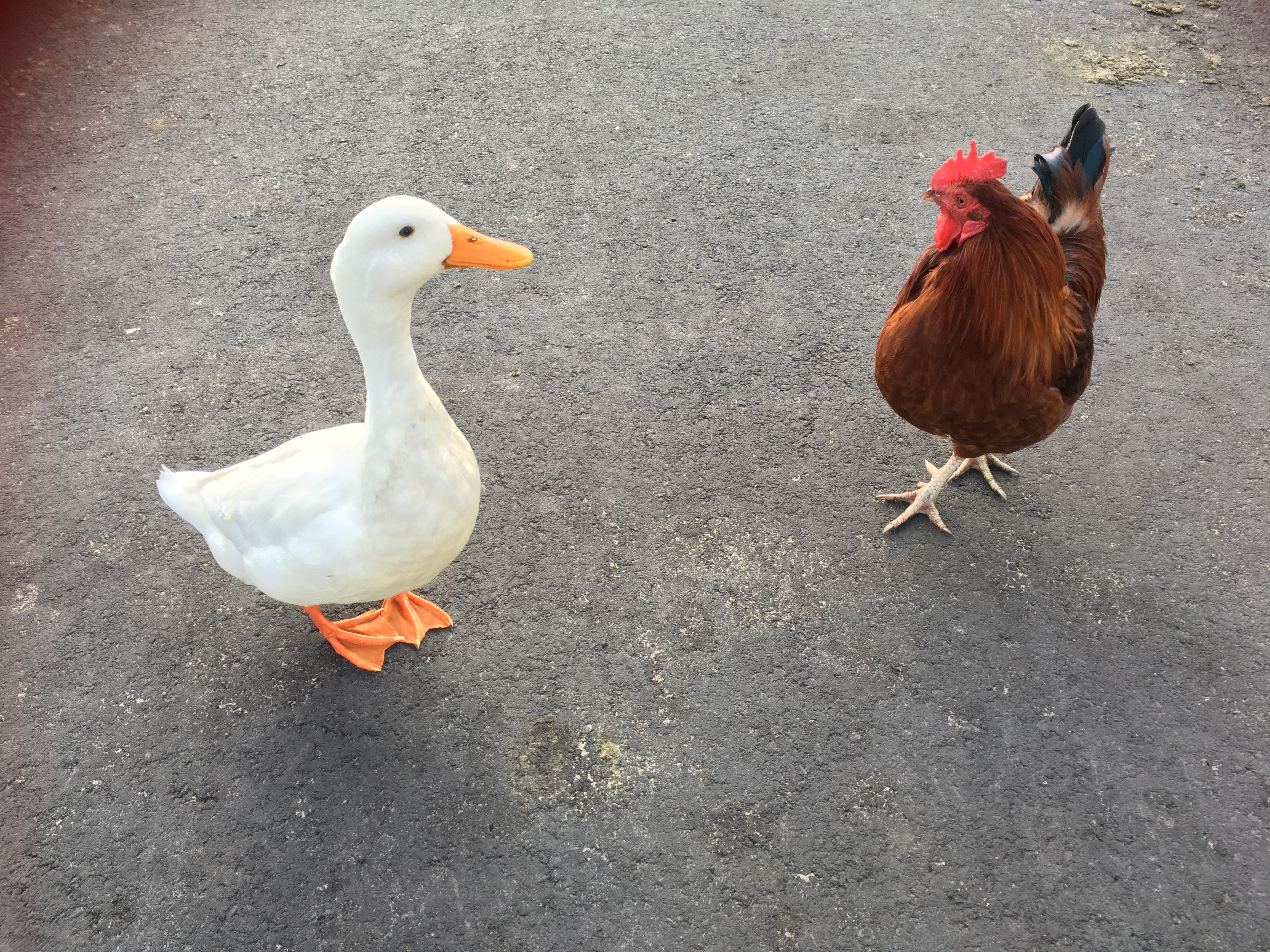
In the meantime, I wanted to share an image taken during one of my afternoon walks. I’ve included the caption I invented for it as I shared it with my friends. May we also recognise that there are other dwellers and travellers on this earth.

Upon observing a third species attempting to capture their meeting, the two species say to each other: ignore the third species. We’re still going to have our afternoon hangout, right?

May we travel with love and with wisdom.

Where I am at and dear God, but living is painful

Liz Williams sent me a note asking me how I was doing. It came at a time when I was in the absolute pits, thinking there was really no point anymore and I just can’t do anything right, can I? That short note was like a jolt of lightning.

How can I think of giving up on life when I have been constantly lifted up these past two years?

There is a point—I don’t know what it is. Is it grief? Is it mourning? Is it guilt? I don’t know what it is, but there is a point when giving up seems like the only thing left to do.

Just let me lie down and wallow in my grief. Just go away and leave me to be miserable and lost and chaotic and forgotten. Don’t look at me because what has overcome me feels so terrible that it might touch you too.

I was like that.

For a while, I decided I wasn’t good for anyone…even for my children. I thought, if I can just make sure that my kids are in a stable and safe place, then it will be all right.

This moment of despair came in part because no matter how I tried, I just couldn’t write properly anymore. (Still can’t, btw.)

When I write, it seems my words keep turning back to sorrow. I cry. My body aches. I read the words and the words turn into tears.

That is what writing has been like for a good long while.

There is this thing about grief and loss. It’s okay to talk about it for a while, but as time passes, we start to tell ourselves this story—

“You’re grown up. You’re an adult. You’re a strong person. You can do this.”

I also started to tell myself this story:

“Your grief is so heavy and burdensome. You shouldn’t be a burden to others. You mustn’t burden those around you with your grief.“

And so, it goes like that. That story I kept telling myself.

I guess, we all need just that one person to make us face the truth of how much bullshit that story is.

Grief strikes anywhere at anytime. Sorrow has no respect for passing time.

So what if a year has passed or two years or five or even ten?

It doesn’t make loss insignificant.

Just because I still feel the pain of loss doesn’t mean I am no longer intent on living and just because I am intent on living doesn’t mean I no longer feel the pain.

*with apologies to Liz for mentioning her note without permission and for my failure to reply in any way at all.