Perhaps a magic carpet

For tomorrow’s workshop with LIMBO, I thought of making use of textile as a medium for storytelling. I thought of how using canvas can sometimes be confronting and how facing a blank page can freeze us instead of invite us into the act of creation. So, I went back to my one of the first dummies I made and thought of how the use of simple unbleached cotton can be so freeing. Some of my favorite pieces are in that first dummy and are made from mixing different textiles and textures and coming to a point of joyful release. The thing I love about artmaking is the conversation that takes place between the medium and materials used and the person who is engaged in the act of making. (At least, this is how it works for me.)

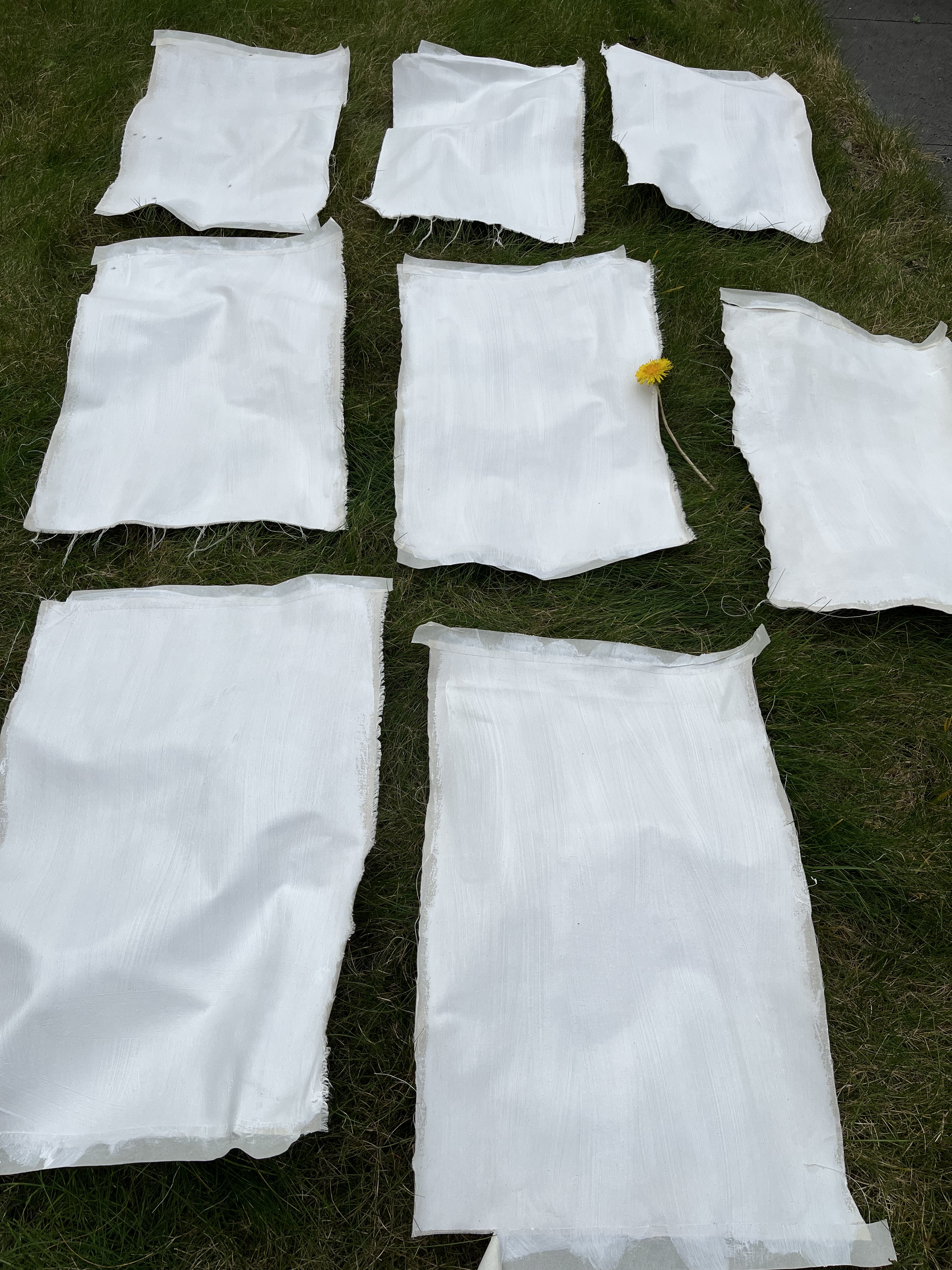
I love the intentional act of preparation which includes me engaging with the material first. It’s like this conversation I have for instance with this piece of cloth. Measuring them out, cutting them up, applying a layer of gesson, and laying them out to dry, had me thinking of how the participants are now part of my preparation. I may not know who shows up, I may not have spoken to them yet, but in this process of preparing they are already in my mind.

So why choose textile? Laying these pieces out on the grass to dry, I thought of Aladdin inviting Jasmin to climb onto the magic carpet and it made me think of how Jasmin might later have told this story to her descendants. Disney gives us a romantic version of the tale, but I wonder if the carpet was as intricate or as ornate as in the fairytale. It also makes me think of a princess confined in a seeming state of limbo and what it must mean to someone in that state to be invited to climb aboard a magic carpet. How did the teller of Aladdin come to this story? And what’s the real story? Is it about the genie? Is it about Aladdin? Or is it about the possibilities that unfold when we choose to climb onto the magic carpet?

This thinking lead me somehow to thinking about AI and creativity and the complex and necessary conversations that need to be had around theft of intellectual property and the indiscriminate use of it. It also had me thinking about what it means to make art and what makes art valuable to us and how the true value of art lies beyond monetary value.

All these thoughts pass through my mind as I prepare these pieces of cloth. What is useful to me as an artist? What is useful to me as a writer? What is useful to me as a person occupying a world that seems to grow more complex as time passes (or maybe I’m just getting older–haha.)

My thoughts on art and what makes something art are complicated because I tend to rebel against formal definitions. I like the idea of life as art which means an artist is someone who makes deliberate choices in the way they step out into life. The form–whether it is painting or sewing or sculpting or writing or cooking–the form is not important. What’s important is the artist’s choice to be deliberate. Perhaps I am making something for tomorrow, but I am present in this moment deliberately thinking on what I am making. It doesn’t matter what medium one uses, it is the deliberate action that goes into choosing that medium that differentiates the artist from the machine.

Thinking on this brings me to thinking about care which was presented to us by my LIMBO partner, Lana Jelenjev. An artist approaches and deliberates with care. Can a machine duplicate that approach and that care? Can another artist reproduce the same deliberation and care to the letter?

It’s a lot of thinking through. It’s all mulch and fertiliser for future work and clearly I still have lots of thinking to do. So, I decide to focus on the now and what I am preparing for.

I go back to the magic carpet and I think of how vehicles like the magic carpet are useful for people who may be going through periods of uncertainty. The magic carpet is an invitation to leave behind what binds you and keeps you from moving forward. It is an invitation to discover and remember and from that discovery and that remembering, create and hopefully in doing so, find your strength.

To you who reads this, go find your magic carpet. Climb aboard and discover for yourself where it takes you.

Blessings and peace. Agyamanac Unay.

A new season

Perhaps the most surprising thing is coming back to life. In the season when cancer was very much at the forefront of our lives, I made the choice to just let go of everything and focus on doing what needed to be done in the moment. Get through surgery, recover from surgery, go through radiotherapy, recover from radiotherapy, go through chemo, survive and recover from chemo. We are in a post-chemo period as my oncologist has determined that chemo is more harmful to me than helpful and so I have been taking immunotherapy once every four weeks for the past two months and will continue to follow this schedule of treatment for the next two years.

I think of how there are reasons for all circumstances that we encounter in life. We won’t always find ourselves in pleasant places. Finding ourselves in the midst of adversity, having to combat things like financial uncertainty, loss, uprootment, illness whether it be of ourselves or someone we love–what we make of that adversity can determine the story of our lives.

I said to my oncologist at the start of this entire trajectory: my life is not cancer and I do not want my life to be about cancer. My life is more than cancer and because I can, I determined in my heart that I would just keep living and being alive. (Also, my surgeon said: actually, except for those tumors, you’re super-healthy.)

Where I am now offers me the chance to reflect on how I want to continue living. I lost words and stories while going through treatment. For a good while, I couldn’t even remember the names of characters or the titles of stories or even the words to describe a thing. I couldn’t piece words together to make a proper story even. But in that season, I learned to make pictures. To draw, to paint, to collage, to work with different mediums–something I’d never thought I could possibly do when I was so focused on writing words. I learned there are no boundaries in art-making and story making and the only thing that keeps us from making is because we think we can’t or we’re afraid we’ll make a mistake (or someone told us we aren’t talented or good enough at it).

This coming season, I will be taking part in LIMBO which is a wonderful life-giving project under the hat of the beautiful Fabian Holle. I can’t think of an adjective that fits them more than that word. Because Fabian is Fabian, it doesn’t surprise me that LIMBO has become this space that is also wonderfully life-giving and inspiring. Working together with my good friend, Lana Jelenjev, we hope to contribute, plant and water seeds, speak life and hope as we facilitate this season with LIMBO.

I’m thinking about all these processes as I prepare for a season with LIMBO. Thinking too about all the different things I’ve learned in the various seasons of my life and thinking of how story isn’t just about words you write on a page. Story is intertwined with life and art and making and sharing and composting and living. It’s crying and laughing and howling with rage and shaping a space in the world for what you have to share.

There are no borders between the different ways of telling or working through or sharing. There is no right or wrong way to go about sharing what has lived and lives and what you hope will continue to live inside and outside of you. There are no limits–not even the space to share is limited because there is enough space for everyone and if we think there isn’t, then we just have to enlarge our circles and make more space. We are limited only as we allow ourselves to be limited.

And yes, we live in a world that’s polarized, where hatred and malice abound. But we can expand the circles filled with light and kindness and love until there’s no more room for hate.

LIMBO occupies a special place in my heart and I invite anyone reading to visit the following links.

Framer Framed Presentation: LIMBO – queer exilic narratives (definitely read Fabian’s beautiful speech as well as the interview with LIMBO co-creators

May lovingkindness always surround you. Agyamanac Unay.

I dreamed

I dreamed that it was possible to invite people into a space and invite them to dream the past, the present, and the future. I dreamed it was possible to bring people of color from migrant groups in The Netherlands into this space and it would be possible to see their dreams enter the world. When I shared this dream, I didn’t know how it would happen or even what it would look like. I only had a vague idea of how to create that kind of setting and that kind of space.

I think back to the final day of the workshop and I think of the work coming from the hands of the writers around the table, and I find myself completely blown away. On the morning of the final day, when I asked participants to think about a story connected with personal items they’d brought with them, I did not expect that they would all write. After all, throughout the workshop, we’d used all kinds of different methods of story making. But this third day, they were all writing.

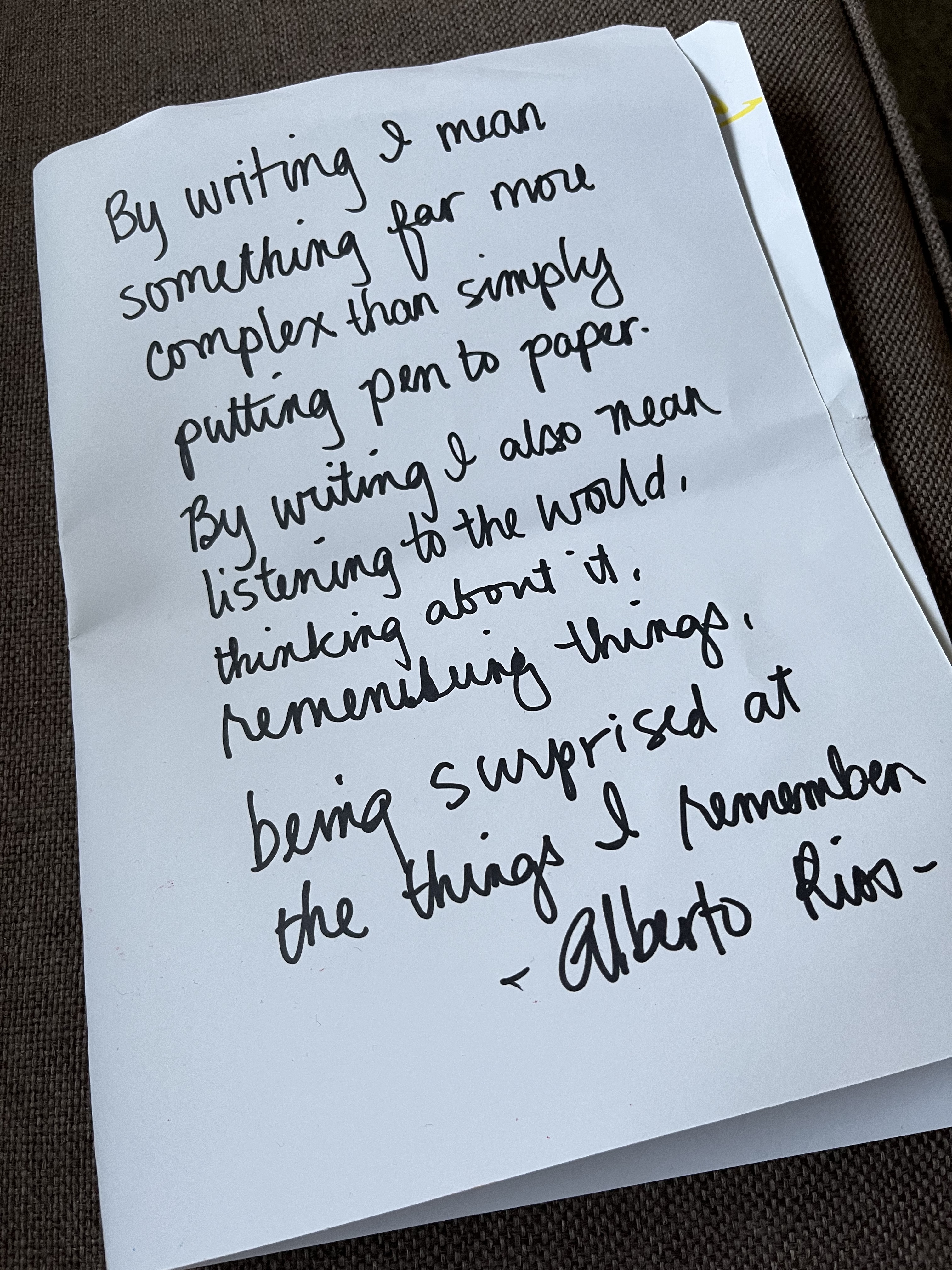
Before we did the first exercise, we read the Bridge Poem together. Hearing it read in chorus was just so powerful. It was like a presence entered that space and made it possible for us to reach that place where stories were waiting to be told. I’d brought along that quote from Alberto Rios and shared it with the writers after the first exercise.

“What surprised you?” I asked. “What did you discover?”

We were all in a thoughtful mood because the stories from that first exercise were so personal and moving.

“I didn’t know I had this story inside me,” one of the participants said.

“I didn’t realise that I remembered so much,” another replied.

Writing is also about remembering. Writing is also about being surprised by what you remember.

“What is it that you worry about and that keeps you from making or sharing your stories,” I ask.

“I worry about grammar,” someone says. “Because I want to post my stories on Facebook but when I do, people tell me right away that my grammar is wrong or what’s with your punctuation.”

I think about this thing–this grammar thing–the way in which the world can be so hung up on using perfect language and perfect punctuation as if that were the heart of what makes story. I think of all the things we forget when we jump on someone who is trying to share their story but tells it in a way that doesn’t align with how we think it’s supposed to be told. I think of how we are quick to say: your characters are wrong, your theme is wrong, your story is too bloated, your words don’t match. You are just wrong.

When we do that, we forget the most important thing. Someone who has taken the courage to share their story is someone who’s taken a risk. To tell a story is to come out of the shadows. To put your voice out into the world is to become visible. We forget that story often comes from vulnerable places. That it takes courage to share what’s vulnerable and painful and for writers coming from the margins, becoming vulnerable is risk.

I think about this as I reflect on the workshop. I think about the final exercise of the day. There I was saying: “this final exercise is optional. If you don’t feel like doing it, then you don’t have to.”

I had a moment of doubt where I wondered if I should ask writers to share and so I left it there in the middle until one of the participants raised their hand.

“I want to read my work,” they said.

And after that another one did. And another. And another. Until the circle was round.

These amazing writers who’d never attempted fiction before this workshop, they blew my socks off.

We shape the space in which stories are told. How we receive another person’s story determines the world into which the stories take their place. If we’re really serious about wanting to see more voices coming from the margins, we also need to think seriously about how we receive those voices.

Stand still. Respect the courage it takes to be visible. Speak your story into the world. In your response to the work, tread lightly.

workshop prep

Saturday will be the third and final session for the first iteration of the Invitation to Dreaming series. I am in the midst of preparing what’s called a draaiboek for Saturday. This is a useful tool that I highly recommend for people planning workshops. Basically, what I’ve done is create two different scripts for the day. One that’s detailed and one that’s bare bones. The barebones script is an approximate time schedule with lunch and breaks figured out while the detailed script includes notes and reminders to myself with highlighted notes on what it is that I want participants to take away with them. I’ve also written out my lesson plan so that I hear the words I want to say in my head. They may undergo transformation in the telling as I don’t do the workshop with a script in my hand, but the gist of it remains the same.

For this final day, I want participants to reflect on how the exercises we’ve used during the first two sessions are useful when we think of planning out a longer work and working over a longer period of time on a particular project.

Because not all of my participants may end up embracing a writing project, I want to emphasize that while they might not think of story making in terms of publishing professionally, they can also think of writing or creating and sharing stories as a form of legacy related to their journey as BIPOC and as members of a migrant community. We can never underestimate how valuable such sharings are for the younger generation or for the generations that follow. I am still very grateful that my Dad wrote lengthy letters to his children and that he decided to try and write a little about his personal history before he died. Knowing that I have that record that I can look back on now that he’s no longer here gives me this feeling of still being connected.

I have participants who are very interested in embracing writing or storytelling in some form. Some might want to embrace doing roleplay or theater type performances together, while others may go on to write their memoirs or continue to explore other kinds of fiction writing and that’s definitely something I want to encourage. These different types of making are beautiful and magical and transformative in power.

I feel very privileged indeed to be witnessing such flowerings and also to hear people say that they’d never imagined that writing a story was a possibility for them (even if they’d always wanted to)–well, that’s the reason why I felt and do feel it’s important to bring this workshop to communities.

During the communal worldbuilding exercise, one of the women said that it was hard to imagine in a science fiction way and that it was hard for them to envision a future world without thinking of politics. (Imagine me doing mental squee.) And then, this woman went on to share a story that was so damned good, I was like: what do you mean you can’t write science fiction?

In its naked self, story is about writing, sharing, telling what you see, what you envision and what it means to you. And the best stories are the ones that come from that place of feeling safe enough to be vulnerable. I have heard so much joy and laughter among the participants during the first two sessions and I want to continue to remind them that this is the joy you hang onto when you’re in that space facing your story.

I know there are many other things that go into stories, but on the journey, joy is one thing we need to take along with us. Hope, joy, and love, and also community.

Day Two

It’s the end of the second day of the workshop series. I’m thankful that we’ll have a few days before the third and final session as these two days have been quite intense. We had a number of new participants join the workshop today and so I had to think a bit on how to introduce them into the workshop without making the session feel repetitive for participants who’d attended yesterday.

Here’s what I learned: given a space where people feel safe and accepted, they will share amazing stories. By creating a safe space for others to tell their stories, I’ve created a space that feels safe and warm and loving for myself and created a space to which participants tell me they want to return to.

Removing the mystery around story creation and throwing out the myth of talent or giftedness opens the door for those who’ve felt uncertain about writing or telling their stories. The realisation that story can be as simple as taking a walk around the block and noticing things and talking about them is enough to free participants from uncertainty and the fear of even attempting story.

At the heart of today’s session was a moment of history making. I’d prepared a science fictional scenario. In it, I asked participants to create a history of that future world from the perspective of five groups of people who are often overlooked. It was a risky exercise since I was asking participants who had never engaged with science fiction before, to imagine or envision in a science fictional way. But just as yesterday, the workshop participants blew me away.

Next week, we’ll be holding the final session of this workshop series. I know I am being ambitious yet again. Who in their right mind gives fledgling writers and storytellers only 30 minutes to build a world and create a story?

The thing is…when you tell people to just have fun, they will take you at your word. There will be laughter, there will be lots of chatter, but in the end, they will blow your socks off and to me, that’s just magic.

It’s finally happening

I sit here on the eve before the first day of a workshop series I’ve been working on for quite some time. Thanks to the WereldMuseum Rotterdam and to Dona Daria, the workshop I’ve been dreaming of will finally become a reality. Tomorrow, will be the first day of a three-day workshop for BIPOC participants in Rotterdam and I am looking forward to it with anticipation.

In preparing the final schedule for the workshop days, I’ve had to refine and narrow down exercises. Creating exercises that will be doable for participants who are a mix of people who might have done some writing before and people who have always thought of creating stories as being something not for them for innumerable reasons, has been a challenge. And I am really thankful for my partner, Hodan, who’s given me such great feedback and encouragement throughout the process of putting the workshop and the schedule together.

I still don’t know what the class will look like exactly, but the programme includes a mix of individual and communal work, and a mix of spoken, written and visually expressed work. I’ve used different elements of this workshop in different environments with different groups and now I’m eager to see what will happen when these elements are used and applied together over the span of three days. Perhaps the most challenging aspect of this workshop is the multi-lingual aspect, but I will cross that bridge when I get to it.

Most important to me is to let the participants experience how much fun it can be to engage with story on their own terms. That is what I’m keeping in mind as I wind down for the night.

I just had to quickly write about it because it’s finally happening.

Oh yes. We will have fun.

Lesson Plan preparation

In preparing the lesson plan for three intensive workshop days, I’m putting in the work that I’ve thought about and used in various iterations leading up to these series. I think about this as I finally arrange the lesson plans in the order that I have in mind.

When I first told Hodan Warsame that I wanted to create a space for BIPOC people to write and engage with story, I didn’t know at the time that it would lead to me creating a different way of giving a workshop. But it has led me here and I find myself feeling grateful for the opportunity to share this with the participants who will come to the workshop.

I think about the initial response in the small groups where I’ve tried out some of the things that are going into this workshop and I can’t help but feel excited (although I will admit it is also scary). The thing is, until the workshop happens, there’s really no way of knowing how a particular group will respond and how certain exercises will work. Will the time we’ve planned for each activity be enough? Will it be too much? Have I paced the rhythm of the workshop right so participants don’t fall asleep? Will we be able to shape the space in such a way that it feels welcoming and inviting?

And then, I also have to face up to my own unpredictable stage fright. I know I have to be prepared and so I’m writing as much detail as I can because I am aware that I have moments when I suddenly freeze and my brain just blanks. Not something you want to happen when you’re doing a workshop as that tends to lead to awkward silences or to me just mumbling about unrelated stuff or rifling through my mental notebook.

But I’m learning too to remind myself that it’s okay to have those uncomfortable and awkward moments and it’s okay to tell participants that ‘my brain got stranded for a bit’. In my sharing with the guerrilla writers, as I talk about my own struggles with my work, I realised that doing this, being open about how I don’t know or how I am uncertain or unsure about how to say things also helps fledgling writers as it removes the ‘mystery’ often associated with writing.

I may be a bit farther in the journey, I may have written and done a lot of things, but it doesn’t mean that I am the expert. I think of it this way: my role is to share what I know. But the experts are the participants. Because each one comes to the workshop with their life experience, with their personal history, with the sound and rhythm of their own language, their songs, their dance, with the embodiment of culture, they are the experts. But what I can do is share what I know and gently encourage them to launch out on their own journey. If we can built a support network while we’re at it, that would be fantastic. At the very least, I want to take this opportunity to let participants know that they’re not alone in their journey.

I’m smiling as I think of how we had lesson plan preparation included in curriculum at the conservatory. Back then, I really didn’t know what they would be useful for. Now, I’m putting that knowledge to good use. I can’t help but think of this line right now: Everything you need, you already have with you or you will acquire it during the journey. (I think my son who loves doing those quest games would appreciate that line. 😆)

If you’re reading this, I wish you inspiration as you continue on the journey.

An invitation . . .

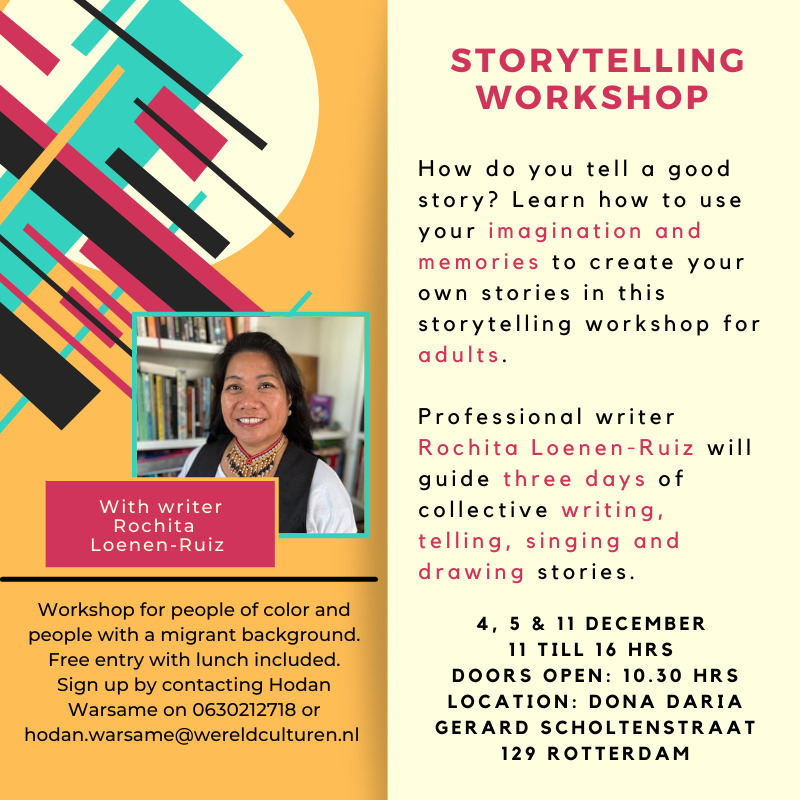
Posting the flyer for a mixed media story creation workshop that I’ve been working on and developing with the migrant BIPOC community in mind. Thanks to the lobbying efforts of Hodan Warsame, we will be able to share this workshop with the people we had in mind when we launched our efforts a year ago. This is a project that’s come about through the Wereldmuseum Rotterdam and in collaboration with Dona Daria. There are still places available, so do send your application to Hodan. All that’s needed is an email or a text message. I do want to emphasise that this iteration is specifically for the migrant and BIPOC community.

History and myth-making

I’ve been thinking a lot about history and myth-making as I work on another piece. Edouard Glissant’s work inspires me a lot and it feels like the universe is working to bring various readings across my path that are in conversation with the work of Glissant.

Rolando Vazquez’s Vistas of Modernity enriches my engagement with Glissant’s work and vice versa and I can’t recommend Vistas of Modernity enough. While I was reading Vistas of Modernity, I found myself moving back to some passages from Glissant and then returning again to Vistas. In my head, it felt like there was this rich conversation going on between these two thinkers. There’s a lot to process and a lot to think about and I feel like rushing to make a post on it would not do any justice to the work. But definitely, anyone who’s interested or who is engaged in decolonial work would benefit a lot from looking up Glissant’s work and Vazquez’s Vistas of Modernity.

While reflecting on these two works, and while working on the new short piece, I found myself thinking about the relation between music and mathematics: about algorithms and improvisations: about waveforms and spacetime. A lot of times, I feel like a chicken scratching at the surface of concepts where comprehension lies just beyond my reach–like that word that you know is waiting to be uttered at the tip of your tongue, but you just can’t vocalise it yet.

The new piece is me working on concepts that intrigue me. It’s also influenced by the idea of history, re-membering (as Rolando writes it) and myth-making.

All these thoughts tumble together to inform the practice I am developing when it comes to the workshop practice. The idea of employing various mediums and ways of creating or re-membering or un-remembering history….these are things that I feel are key to the work and are necessary to what we want to achieve with the Invitation to Dreaming.

The hungry mind led me to Epistrophies: Jazz and the Literary Imagination by Brent Hayes Edwards. I’ve only cracked the book open, but in the introduction there’s a passage that captured my imagination. Here, the author writes that: “Oral history’s importance lies not in adherence to fact, but in its departure from it, as imagination, symbolism and desire emerge.”

I think on how we can sometimes get stranded or blocked by the idea of story not aligning with empirical data and I’ve been thinking too about how a lot of history is told from the viewpoint of the conqueror or the coloniser.

Anyway, this is because I find myself rather obsessed with the question of the use of speculative fiction in the work of decolonisation.

A beloved friend of mine spoke of this kind of writing as a form of exorcism and the more I think on it, the more I love how this resonates with the idea of myth-making and how important it is for us to recognise that the myths we create are not subordinate or less important but are rather of equal value and equal importance. Do we even need to explain why it is important to us? Do we even need to make everything comprehensible or transparent?

Glissant in Poetics of Relation writes this: “For more than two centuries whole populations have had to assert their identity in opposition to the processes of identification or annihilation triggered by these invaders. Whereas the Western nation is first of all an “opposite” for colonised peoples, identity will be primarily “opposed to” — that is a limitation from the very beginning. Decoloniality will have done its real work when it goes beyond this limit.”

I think then to myself that the capacity to think beyond data and to think outside the box, to imagine beyond what is presented as “these are the facts” are tools which help in the work of decoloniality. Myth-making, the de-linking of the personal and the empirical, the creation of tangents and speculations, the ability to think outside of time.

My mind works away and picks at process and about how to bring these ideas into the workshop practice. How to encourage new and aspiring artists to bring this kinds of concepts with them into their core work.

Again, I find myself thinking of points of origin and how starting from the self, meeting the artists at where they are in that moment is an essential part of the work. Histories, stories, songs and other creations which are personal to us are also linked to the wider world. Family stories are where myth-making starts. Family histories are part of our personal myth-makings too. Beyond the personal portraits, beyond the familial, we see the world as a backdrop. How is that family myth set within the world around it? How do we create myths that originate from our selves? What’s important is that these myths come from us. From creators whose voices have often been elided–the sound you miss or skip over–like jazz creators, we must improvise. We create and bounce off each other’s words and worlds, we mix and play to create myths that sound like and belong to the self. They don’t have to adhere to an existing narrative, they belong to their selves, just as we belong to our selves.

There is a lot to think and reflect on as I think of this and as I consider on how to bring that into my practice.

To you who are on the journey, sing your songs, write your myths, dance your dances.

She’d always known space had shape and form of its own. It wasn’t always visible, but it was there. Now, its patterns and undulations were visible to her. She could see it curving around to accommodate her sire; could see it flowing and moving to accommodate static instruments, to accommodate her/self/; and now, she could see too how it lent itself to shadows that took on a form of their own as they came to stand beside her sire. 

-From To the Tune of the Wild Ones-

literary tradition

Small chapbook is happening. I wish I had thought to do this when she was still here. I miss you, big sis. But even though I can’t see you anymore, I know you’re somewhere smiling because I also believe you do see this.

Included in this book: Decolonizing as an SF writer, Dancing in the Shadow of the Once and the English version of the first Dutch story I’ve ever written. In English it’s titled: Hymn to Life.

In lieu of a CV, I thought I would just share a small book with my work in it.