There is a house on an island and there is a garden around the house and in that garden are the graves of three little girls.
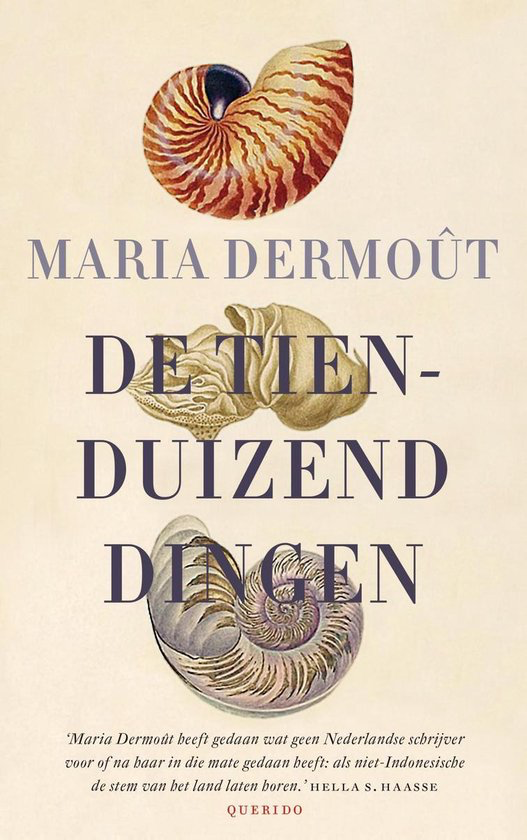
I read Maria Dermout’s De Tien Duizend Dingen in Dutch, so the above sentence is as close as I can get to summing up the opening of this Dermout’s beautifully immersive novel.
What captivated me the most about this novel was the intentional use of language and how through language Maria Dermout pulls the reader into the rhythm of a time and a place. It’s beautifully evocative and not only does the writer make us see the house, but we also see the garden, the leviathan who lives near the edge of the water that is in the garden, and then we are made aware of the graves and the possible ghosts of the three dead girls.
There is also the history of a place and of the first Mevrouw Kleyntjes who lived in this house and the second Mevrouw Kleyntjes who still lives in this house. There is the history of these women and the stories of the lives of the people who have interacted with and lived in relation to the house and around them is the history of place.
Somewhere halfway through De Tien Duizend Dingen, I sent a message to the friend who told me about this book. I told her that it made me think of Virginia Woolf. It’s been quite a long time since I read Virginia Woolf, but I remember a similar mesmerising almost hypnotic use of language in The Waves.
We are immersed in the world Maria Dermout writes about. We are transported to a period in time when the then Dutch East Indies (now Indonesia) is heading towards–an upheaval that will lead to a complete social-political change. Through the manner of telling, we can feel the simmering undertone of imminent change. Something is about to happen. What is about to happen is faintly present at the opening of the novel, but as the novel progresses, so does the sense of danger and precariousness–it is enough to make us recognise that at this point in time, the people in this place are no longer willing to simply accept the authority of Dutch masters. In this world, the woman, the house, the garden and its ghosts are relics of a past that will soon be nothing more than a dream.
De Tien Duizend Dingen was published in 1955 by Querido publishing house. It’s also available in English as The Ten Thousand Things.
 From the Beloved Country
You must be logged in to post a comment.