What I have read and what I am reading

Now that I’ve regained enough focus to read whole novels, I find myself missing the conversations I used to have with my sister. A lot of our conversations used to revolve around books we’d read and what we thought about the story or how the writer managed to do something well or not well enough. I think my sister was the original bookworm in our family and I simply followed in her footsteps because whatever my sister read, I had to read too. Anyway, I’ve started reading the books I downloaded onto my reader and I thought I would write a little bit about the one I’ve just started reading as well as the one that I just finished reading. I thought I’d switch between fiction and non-fiction. Non-fiction often takes me longer as I like to reflect on what I’ve just read.

Fiction Read:

I’ve just finished Tade Thompson’s excellent Far From the Light of Heaven. I’m pretty sure Tade has written and published a bunch of novels since this one, but I just got around to reading again and the title of Tade’s excellent murder mystery called to me. It took me a week and a half to finish reading (this is my current reading speed for novels) but I never once lost track of the thread of the story. I’m also glad that I decided to get a tablet because it’s made it easier for me to just open a book and read when I’m on the train or when I remember that I am in the midst of reading a book.

I understand the importance of titles now because for some reason, that title just kept jumping out at me each time I clicked on my reader and I decided that once I had enough focus I would read that novel first. Far From the Light of Heaven makes use of elements of space opera and science fiction but at the heart of it, Far From the Light of Heaven is a murder mystery. The stakes are high and I liked how the characters feel real. I have to admit a fondness for Shell Campion’s Uncle Larry. I could relate to that feeling of wanting to protect someone younger who you consider part of your family. I found myself quite intrigued by the Lambers as a race and I want to know more about them. Reading this book, I also had to think about conversations around AI and the use of AI. I like how Tade doesn’t take sides on that, but tries to show how AI can be useful but also how it has its vulnerabilities and can be subverted in a way that it becomes a danger. I don’t know if this was intentional, but it felt very much so.

One of the things I loved about this novel is how we get to see how what happens on and to Ragtime affects the world the characters live in. It’s a reminder of how actions taken reverberate in the world. The question becomes this: do those actions lead to understanding that brings lasting change or do those actions lead to polarisation and division in the society around us? I may very well be putting my own interpretation on it, but this is something I thought about when I got to that part. Another memorable scene for me is the communal rite of grief/processing trauma.

I won’t say anymore as I might spoil the book for those who haven’t read it yet, but if you enjoy murder mysteries that are more than just murder mysteries, this might be just the book for you. Highly recommended.

I have a rather lengthy TBR list and I think I would like to try and write about as many of them as I can. I’m pretty sure there are things I’ve read in the past three years and a half that I forgot to write about.

Current Non-Fiction reads:

As I tend to dip into multiple non-fiction books at one time, I might write about my impressions from those books every now and then.

I’ve started on Karen Barad’s Meeting the Universe Halfway. I don’t even know who recommended this book or why I decided to buy it, but I’m pretty sure the person who recommended it made an impression on me. Anyway, I’ve just started reading it and there’s a line in the preface that just resonates so much with me. In the preface, the author writes about entanglements and how to be entangled is not simply being intertwined but it’s more than that. It’s a really great preface and if you’re interested in quantum physics, it does look like an engaging read.

A recent book I’ve recommended and gifted to fellow community workers is Aminata Cairo’s Holding Space. Aminata was one of the guest facilitators for LIMBO and the workshop she gave was joyful and beautiful and one that opened up space for stories to be shared and told. In this book, Aminata talks not just about holding space, but shares her own journey towards holding space. It’s a book that calls for reading and re-reading and for dipping back into when you feel the need.

Just yesterday, I had a lovely conversation with a friend who shared this line with me from a conversation she had with an older Dutchwoman. In that conversation, the Dutchwoman spoke of her husband, not as passed away or dead, but as someone who had stepped out of this timeline. I rather liked that phrase and it makes me think that entries like these are like missives sent to where my sister now lives–in a timeline that is outside of this timeline. It’s a lovely, lovely thought.

What are you reading now and what from those readings do you choose to keep with you?
art and narrative

Last Thursday, I moderated a panel discussion on the Fractal Art of Julius Horsthuis at NXT Museum. It was quite an interesting event as not only was the artist on panel, but we also had Dr. Margriet van der Heijden on panel–a physicist who specialised in particle physics at CERN. I’d never thought all that much about fractals before–I mean, if someone said the word fractal, I would understand that they’re talking about self-similar patterns which we often see in nature, but I probably wouldn’t be able to tell you what it is in-depth. For math people, talk about fractals will often lead to thinking about the Mandelbrot equation, but did you know that before Mandelbrot, there was the Julia? (Yep. I learned all these things while doing my prep.)

I also found myself thinking on the question of what makes art. What do we mean when we say a thing is a work of art? And what function do we ascribe to art? Julius Horsthuis says that his focus on Fractals lies in the fact that he hasn’t gotten bored by it yet.

For Julius, documenting or discovering the 3D worlds opened up by the input of various equations is what makes it fascinating for him. He talks about the films Baraka and Samsara which don’t follow a conventional narrative and how these films were an inspiration for the 3D films that he makes.

I certainly think that experiencing this kind of art by being in a space where you are surrounded by it is a different one from that of seeing it onscreen (on your laptop, your pc or your television). There is a mesmeric quality to it, but at the same time there is (as one of the audience said) a feeling of loneliness. Perhaps because there is an absence of characters interacting with the landscape. (Perhaps the person in the space becomes a character interacting with the landscape or could it be the maker himself?)

I watched Baraka and thought about that difference (the absence of humans in Julius’s work) and found myself thinking of how a landscape changes with the presence of humans. As Margriet said to me later on: Humans are not fractals.

I do like the concept of non-conventional narration and how it ties in with how story doesn’t have to conform in order for it to matter.

Later, Julius speaks of how the absence of narration is deliberate, although as he explores the possibilities of bringing his creations to VR, he realises that the absence of narration may not be conducive to people engaging with the art, particularly if they come to the experience for the first time.

Is story an experience? Is art an experience?

I think about these as I deliberate on my own work and process. I think of how as writers of story, there is a certain expectation arising from centuries of stories being told. What happens when story doesn’t conform to expectation? What happens when a story simply wants to show a world in the same way a documentary maker would show the world?

But is showing the world enough? We could argue that the majority of science fiction and fantasy books are about showing the world.

Piranesi, one of the books I read when I finally got my reading brain back, feels very much like that. It’s basically Susanna Clarke showing us the world Piranesi occupies. Piranesi’s voice compels us to come along and see and learn more about the world they live in. The cast of characters is barely there, but we’re seeing the world through Piranesi’s eyes and it’s beautiful and fascinating and a lot of times it is lonely. Piranesi eventually conforms to a story expectation but then not really and the feeling of fascination remains long after the book is finished.

Does Horsthuis’ art work in the same way? I can’t help but wish I had thought to ask how exploring the world of Fractals has changed or enriched the artist as a person. I’m not even sure if this is what the artist is after. Does it even matter? Should our work change us or reflect us or enrich us even? Does a work have to mean something in order for it to have value? Is fascination and sense of wonder enough?

In the light of discussions around the lives of creators, to what extent does the character and life of a creator influence our engagement with the work that they create? And can we separate things made from the people who make them? (Probably something for another post…my brain tends to wander off in tangents and this is my blog. πŸ™‚ )

I think there is room in the world for different kinds of artmaking because every form of creation will find its own audience and will speak to audiences in different ways. Thursday’s event reminded me of that. It reminded me of the beauty of physics, the endless mystery of the world we live in and that joyful feeling that arises when people come together with a desire to create bridges of understanding and knowledge.

If you’re in Amsterdam, I would recommend checking out NXT Museum (check out what’s on exhibit first as it varies). Not only is Julius Horsthuis’s Fractal Art on display, but they also have a fascinating exhibition by the postdigital art group Random International.

Blessings and peace to you who read this. Daghang salamat for passing by.

End of our week at Gladstones Library

It’s hard to believe that it’s Friday. I can hear the tolling of the church bell from the church that’s right beside the library and it’s just finished bonging out the 10th hour of the evening. Ah. It really is the last evening of our final day at Gladstones Library.

Being here has been a wonderful and enervating time for me. Being among the books reminded me too of my family and how books played such a huge part of our growing up years. My sister and I spent so much time in books, and much later, when we were older, we found ourselves discussing books and arguing or agreeing on the virtues or the failures of particular novels or stories. When my sister went for her Masters in Theology, we had long discussions about theology and politics and I do miss my sister’s outspokenness over matters patriarchal as well as the wrong interpretation of scripture.

‘Where does it say that in the Bible?’ She would say, when someone was inclined to lay down some ancient patriarchal thing as word of God when it really wasn’t. When I discovered myself sitting between stacks on theology and philosophy, I couldn’t help thinking of how much my sister would have loved it here. What kinds of conversations would we have had about Reinhold Niebuhr or Kierkegaard? (I confess to feeling quite learned right now. I mean, my sister probably would know who Niebuhr was, but I read him here for the first time. Kierkegaard is a familiar name, but I hadn’t read him until I was sitting next to a stack with a number of shelves with books by or about him. I admit something Kierkegaard says did give me an idea for a horror story. So….I don’t know that my sister would count me as learned, considering how I have this tendency to turn serious things silly.)

Here at Gladstones, I have been well fed. Not just with the books and with the writing, but also with rich conversations around the dining table. Milford writers are just the best and it seemed to me as if the words spoken and the knowledge shared–all the conversations and all the warmth and kindness worked to open up a portal to that realm where the good words dwell.

I think of this time with so much thankfulness. Who would have imagined that I would be able to fly and travel on my own again? Or that I would write so many words in the space of week. Or that I would finally get around to properly organising the novel.

At tea with friends, I shared how it felt to me like I was waking up from a long amnesia and it was like I was remembering to write what I love to write the most. Worlds and worlds and the undying hope for change and a better future.

Follow where your heart takes you. If you’ve tended it well, your heart won’t lead you astray. You’ll always end up exactly where you are meant to be.

Blessings and Peace and Agyamanac Unay for stopping by.

What does it mean to flow without borders?

I have had in my mind this thought which I came back to me and seems to become more concrete as I try to put it into practice: what do we mean when we talk about a world without borders? Or what do we want to see? Or how might that experience be like if there were only superficial restrictions in place and if we could — as Glissant expressed it, move through to taste the atmosphere of a place. I have to go back to reading Glissant because a lot of things are mixed up in my memory (chemobrain) but this definitely stuck and remained with me and I was reminded of it again when in one of our latest LIMBO meetings, some of the participants asked why is it that we have to put borders in place? Why all these restrictions? Doesn’t the world belong to all of us?

I went home thinking about borders. How do we see borders? Are they protection? Who is protected by these borders? And who are we protecting ourselves from? And why do we need to keep others out in order to feel protected or safe? What do we mean by safety? What do we mean by security?

I asked these questions of myself because I live in a country to which people from other countries migrate to or flee towards to ask for asylum. I live in a country in which the discussion around migrants and asylumseekers is so fraught that one actually risks losing friendships in the process.

I don’t have the power to make change happen on a big scale and I don’t have the power to go out into the large arena and make discussions happen but I thought on how to bring that practice of flowing through borders into a very small space.

For this month’s LIMBO, I thought of asking participants to work together to fill up white space with writing or drawings, with lines or curves or symbols, with whatever they can think about to express their presence in the world. The invitation being this: if someone puts down a mark, how will you interact with it? How will you cross the borders? How do you enter space where you didn’t put a mark first?

It’s an exercise that I find myself wanting to repeat with others. Without our realising it, we have our own concept of borders, even on something as small and simple as a piece of paper. Creating on a space reserved and marked yours feels different from creating in a space that says–this is for all of us. Leave your marks, interact with other marks, there is no one artist, no one author, no one creator, it belongs to all of us.

There are questions that arise from this exercise that I also want to think about and which I find myself curious about: how does it feel to cross over into another space? What changes once you make that decision to leave a mark there? To interact with something that’s there? How does it change the way you perceive the work?

I didn’t get to ask this of the group, but I find myself wondering: How do exercises of collaborative creation change the way we see the world and the way we interact with one another?

In talking about this with a dear friend who is a fellow artist, activist and also a writer in the field, I expressed a vision of a room that becomes filled with doodles and maps and words and drawings. And how, it would be interesting to discover how willing we are to layer on top of what is already there and how that space would not be a work attributed to any one person but it would be attributed to all who collaborated whether the person is invited or comes upon it by happenstance, where those making marks can also be living creatures that we take care of.

Writing this, I realise that I am writing about the world we live in. We are all in the process of creating or re-creating, making or re-making, building or re-building–perhaps we layer over what is already there–we bear witness. We see how systems put in place have shaky foundations and how those who benefit from these systems try to prop them up. We bear witness, we offer criticque. But is offering criticque enough?

Marking the empty page to make something together can involve some risk. Stepping out into the world, making a decision to make or leave a mark involves much deeper and more thoughtful movement. What kind of mark do I want to leave? How will the mark that I leave affect those whose spaces or whose lives I live a mark on?

In any case, for me, the question strikes closer to home and makes me think that if I have marked my children with love and care and the ability to be thoughtful and considerate of others, then some of what I am meant to do has been done.

I wish I could share the picture of our collaboration, but it belongs to the group. But perhaps it’s an exercise some of you who read this blog might want to try on your own. Just take the step. Make the invitation and see where it takes you.

Agyamanac Unay for stopping by. Blessings and peace to you who read this.

thinking about language again

I’ve been writing in Dutch and this has me thinking about language again and how it relates to taking up space in the world (or making space) and how gatekeeping in language and use of language relates to the question around permissions. Why do we need borders when the world belongs to all of us? Why do we need permissions to cross from one place to another? And why do we as societies feel this need to create perimeters and conditions keeping people from traveling or moving into spaces we have labeled as “ours”?

I have a complex relationship with language. Perhaps this explains my fascination with it. I am also something of a geek and language and the conversations around language have also fascinated me.

Small as the Dutch publishing landscape may be (compared to the US or the UK), it’s still predominantly comprised of white native Dutch speakers. I made a decision to at least attempt to write and publish in Dutch because I believe it’s important to make space not just for my work, but for the work of those who like me were not born or raised in The Netherlands, but have come here from non-western countries.

In 2021, when Martijn Lindeboom and Vamba Sharif asked me to participate in De Komeet, a specfic anthology from diverse writers in NL released by a De Geus, I said an immediate yes. When the anthology was published, some people I know who read my story said that they were at first a bit hesitant because of the use of nb pronouns, but were quite surprised to find it wasn’t preachy as they feared (yay). It was also favourably reviewed in De Telegraaf which is a major Dutch newspaper (so Yay again). The comment I do get from people I know (who’ve read it) is how the reader can tell that I’m not a native Dutch speaker because of my use of language. Here’s where I admit that I did have an editor and first readers who tried to tell me to rewrite some sentences but the rhythm and the off-center use of language made me happy, so I kept them.

I can’t pass for a native Dutch speaker and to be honest, I don’t even want to. It’s the same as I don’t pass as a UK or US raised English speaker, and I don’t want to. The way I use language reflects how I have acquired the language, it reflects the rhythms by which I have learned to speak it or write it. It may seem like a minor thing, but there is a deliberate reasoning behind this. I understand the importance of the rules of language–grammar and such. But as one reader said to me: the use of language in an alien setting by alien characters, reminded me that my characters are aliens and the emotion came across because of the way “the language was used in a way I am not used to”. (That kind of made me go: yep. That was the intention.) (Of course, I have no doubt there were readers who were just irritated and went “another outsider who wants to write in Dutch”. Lol.)

There are different ways of using language and by opening ourselves to these differences, we expand our borders and our perimeters.

Mind you, I’m not advocating for using wrong grammar. I am advocating for knowing and having a grasp of language and at the same time remaining faithful to the rhythm that echoes in your inner ear. (I did adapt a lot of suggested edits because I am aware that while I may be proficient in Dutch, I tend to be more English in my grammar use. But there were definitely one or two sentences where I just said to the editors–this just feels right to me. It conveys an emotion that I want to convey.) So, I am perfectly okay when faced with the criticism that the language use isn’t perfectly Dutch or Dutch as it’s meant to be. It is not meant to perfect, it’s not meant to conform. (Sorry not sorry for being a rebel.)

When we engage in writing in LIMBO, I like to encourage participants to write in the language they are most comfortable in. Perhaps a majority will opt to write in English, but I have discovered that when someone chooses to write in the language closest to them, while we may not understand the words, we are often able to hear the movement of the writer’s heart in the movement of the language they use.

It’s this kind of rhythm and this kind of movement that we want to capture when we decide to write in an acquired language. Maybe it’s not perfect. Maybe the grammer is not 100%. But all these things are cosmetic. They can be fixed in edits, they can be discussed.

We are a multicultural society and when traveling through the city, I hear a rich tapestry of sounds and voices–different languages, different accents, different ways of using language. Dutch interspersed with Middle Eastern languages, Filipino mingled with Dutch and interestingly too–Dutchies who bend Dutch words to make them sound somewhat like English. Language, like society, like culture, doesn’t remain static. It’s never standing still and every year new words are added to our ever-changing vocabulary–not all these words are rooted in the Dutch language.

Yep. I can keep going about language. But I’ll stop here as I have a bunch of things on my to-do list. I am interested in comparing notes though. How do you write in an acquired language and how does the language you’re most skilled at using influence the way you write in another language? And if you’re writing in an acquired language, what made you decide to write in it?

Blessings and peace to you who read this and Agyamanac Unay for dropping by.

some thoughts on boundaries and flow

Yesterday, I attended a workshop called Envisioning 2024 which was organised and led by my LIMBO partner, Lana Jelenjev. I didn’t make the first part of the session as I have students to teach but I was able to join the second half of the workshop in which we were led to think on what Flow and Boundaries mean to us and what kind of response thinking about Flow and Boundaries produces in our bodies.

Thinking on boundaries, I was surprised to discover how my feelings towards boundaries had shifted and changed and how I’d come to see boundaries like an embrace that keeps me from using up all that I am. Boundaries are there to protect and not restrict and so when someone tells me where their boundaries are, it also makes me see that this isn’t a rejection of myself, but it is the other person asking me to recognise what I can do to take care of them too.

I think of boundaries in terms of the culture that exists within the Filipino community where there is often a tendency to cross over and push beyond boundaries set by a person. ‘Sige na’, we tend to say or ‘kahit saglit lang’. It’s harder when the person pushing is an older person because respect for our elders is so ingrained in us that sticking to our boundaries can be made to feel like disrespect. I want to say here that it is not disrespect to say “these are my limitations”. And saying yes to every ask or crossing our own boundaries can be more harmful than helpful to us and to others.

During the course of my treatment, I’ve had someone ask me to be present at gatherings and in response to my “no”, I’ve sometimes been told that just showing my face should be enough and I should remember this is my community. It’s a response that isn’t worth an answer because it tells me enough about the person saying it. I do not always have to be present and if my absence means I am no longer part of the community, then perhaps the community never considered me part of it. It may sound harsh saying it like that, but my community and my family are those who understand why I can’t always be there. Why I can’t always say yes. Why retreating into my shell is necessary for me and how not being present is also part of my healing.

There is a beauty about the way in which the community I am in, right now, approaches this. An offer is made and it is up to the person who needs to come up and say: now, I need. Or now, I want to be present. Or now, I am ready to speak or to be in the group. It’s not that you are forgotten when you don’t speak or are not present–people do check-in from time to time just to ask how are you today. But the beauty of this is how it is absent of pressure that often leads to stress.

Thinking on this, my thoughts circle back to LIMBO and how much being in this space has enriched my understanding of the kinds of worlds that are possible if we allow ourselves to let go of existing learned systems. I think of communities where care is central–not just care for another but care for the self.

You don’t always have to have the answer. You don’t always have to solve the problem. You don’t always have to be present. You can always say: I hear you. I acknowledge your need. But in this moment, I need to not be present. In this moment, I don’t have the answer. I don’t know. I don’t have the answer. And maybe not knowing or not having the answer or not being able to do anything makes us feel vulnerable, but maybe this kind of honesty opens the door to the other so they too can be vulnerable and free.

Blessings and peace to you who read this and Agyamanac Unay for stopping by.

Bucketlist

There was a time when I was a struggling university student that I used to go with a girlfriend to one of the high-end shops in Ayala. My girlfriend was tiny and fair-skinned and looked like a princess and while she had to make do with her allowance (just like I had to) it was quite obvious that she was from a well-to-do family. In the Philippines, fairness is associated with wealth and my darker complexion as well as my non-fairylike appearance made that people tended to associate me as coming from a lower economic bracket. Not that I cared. But well…anyway…my girlfriend liked window-shopping and so we would window-shop at those high-end stores.

We had a planned dialogue, my girlfriend and I. She would try something on, come out of the changing room and ask me what I thought and I was supposed to say that I wasn’t quite sure if it was really her thing. Of course, she would later on squee about how much she liked it but as we were struggling students, just being able to see what it looked like on her was just as good as buying things.

During one of these outings, she proposed making a list of things to buy. She showed me her list and said I should write one too. To humor her, I also made a list of things which included a watch from some upscale brand. We later parted ways and as tends to happen, we lost touch.

I have to laugh today because I just sat down to write a bucket list (entirely different from the list of things to buy…but it had me thinking of her). She had a pretty long list by the end of one year and I never found out if she went back to buy anything.

The bucket list I’m making seems to keep on growing and I find myself wondering how many people have bucket lists and what happens to those lists should they go uncompleted?

Just this week, I had a long talk with my GP. It was a great talk because we talked about my diagnosis and the implications of where I am in right now. One of the things she said to me was that I had the happy characteristic of being someone who was able to see the good in life no matter the circumstance. I suppose it’s true. I can’t control or change the circumstances, so I don’t really see the point or the use of crying or complaining about it (although I do sometimes grumble about it).

In the meantime, I’ve started on my bucket list and it’s already got thirty things on it. I think of something someone said to me–this is someone who went through a cancer scare and had the works and is now clean. He told me that his partner made a portrait of him while he was in hospital. It was a portrait in pencil, but his eyes staring out from the portrait are striking and full of life. He said to me that his partner had said: Oh, your eyes are good. They’re full of life. You’re going to be okay. I think to myself: but look, I am still full of life, aren’t I? And I think: I am still okay.

Today, I am preparing for tomorrow. Today, I am writing a list. Today, I have the energy to go out and bring things away. Today, I can pick up groceries and cook and prepare for the weekend. Today, I can be present for my youngest son who is still at home. Today, is full of possibility and there is still a lot of today left.

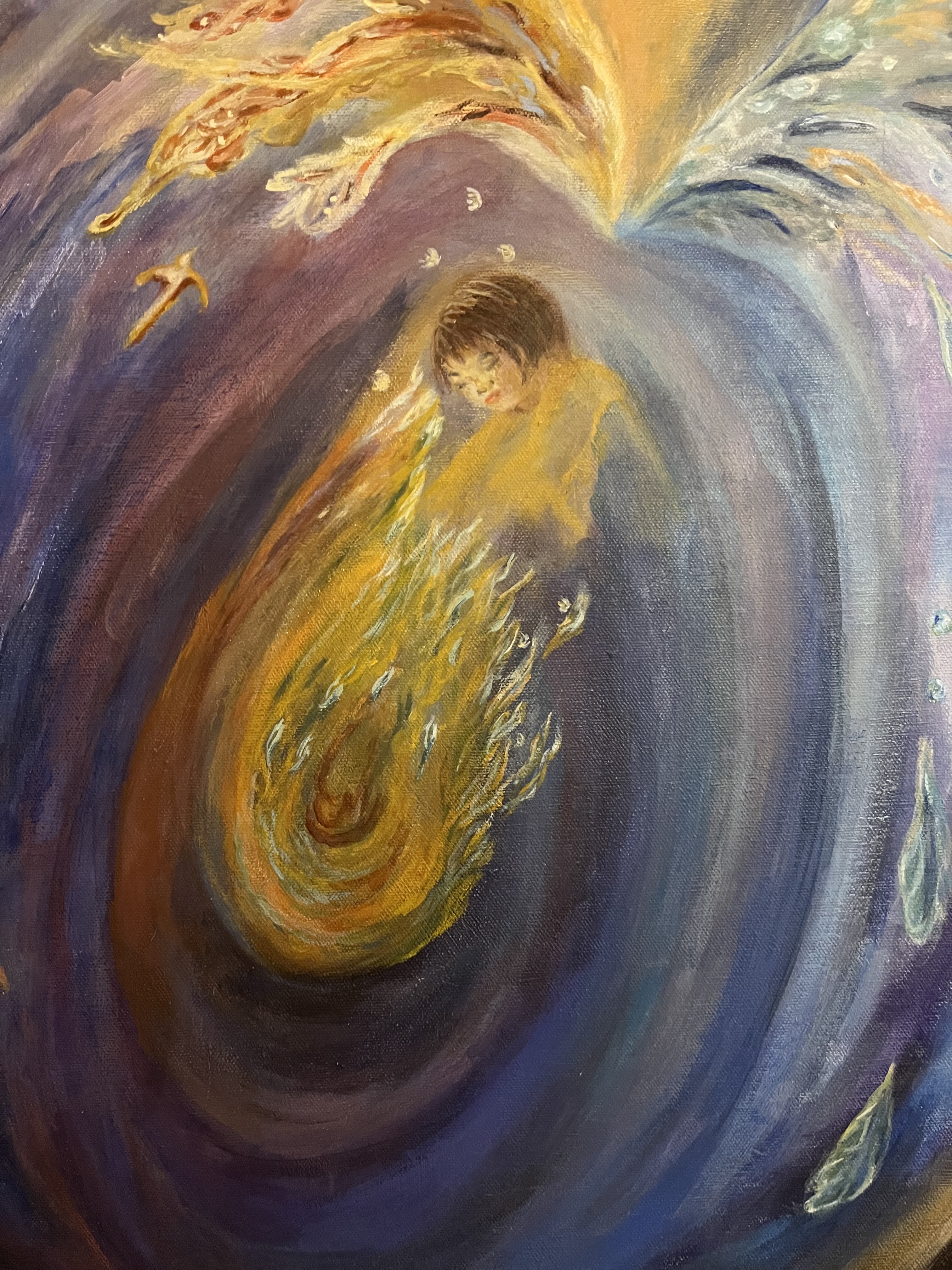
So, today I decided to share on here a close-up detail from one of my paintings. I liked this unexpected detail because it made me think of how while we only see the now moment, we don’t know how today affects everything that unfolds around us. So, let’s just keep on living and doing all that we can today.

Blessings and peace and Agyamanac Unay for reading.

Reflecting on what was and what is now

Today, I think of my father standing in the only hospital in Banaue, right after an armed conflict between the government forces and the NPA. (This incident took place during the martial law period when my dad was the only doctor in the mountains.) I think of him being made to choose: Doctor, if you treat one of theirs, we will shoot you. And my father, who was the only doctor in the mountains at that time said to these men: I don’t see government military or NPA, all I see are wounded in need of care. You can shoot me, if you want, but who will take care of your wounded?

And he took care of all the wounded, and in that space of time when he was taking care of their wounded, while they were waiting for him to do his work, the hospital compound became neutral ground.

We are grieving. We grieve for the ones who suffer the consequences of war. We grieve for those who are lost, for those who suffer, for those who have lost. We grieve for what is broken. We grieve for the innocent and for the loss of innocence. We grieve for the brokenness that is in the world.

I think of these things as I prepare for LIMBO, and I think of how we keep spaces safe and how we hold space for those who are vulnerable and need this space. I don’t have much power but I have now and I can ask: What do you need now? What do you need today? How can I help or facilitate or support in such a way that this need is met in this moment that I am with you?

From this point of beginning, I can think in possibilities. I think of mapping the world we dream about, of making visible what is strong and resilient and hopeful and beautiful inside each one of us. I think of how, in a world where conflict has become the norm, liminal spaces are necessary spaces.

Of course, we knew that when they left the hospital, some of my father’s patients continued on with their conflict. We heard their guns in the distance and we knew there were places where it was not safe. But for a moment, when they were in the hospital compound, there was peace.

I want to walk in my father’s footsteps. To say: I am here to serve. If you leave this space feeling stronger, feeling more hopeful, feeling a little more able to face what life throws at you, feeling more connected than disconnected, then that’s good enough for me. I wish I had the power to right all the wrongs in the world, to heal the pains and the illnesses, to bind up what is broken. I don’t have that power, but I can say: I am here in this now. I am also here for you.

This post is more of a personal reflection than one that offers solutions. Because all things in life are connected, because art and life flow seamlessly into and through one another, it becomes inevitable that this too makes its way into my own work.

May lovingkindness surround you and may peace be with you who read these words.

*Having written this, I am thinking of how my father’s stance was an act of resistance. In choosing not to take a side but to address the problem, he opened a path to neutral ground.

Perhaps a magic carpet

For tomorrow’s workshop with LIMBO, I thought of making use of textile as a medium for storytelling. I thought of how using canvas can sometimes be confronting and how facing a blank page can freeze us instead of invite us into the act of creation. So, I went back to my one of the first dummies I made and thought of how the use of simple unbleached cotton can be so freeing. Some of my favorite pieces are in that first dummy and are made from mixing different textiles and textures and coming to a point of joyful release. The thing I love about artmaking is the conversation that takes place between the medium and materials used and the person who is engaged in the act of making. (At least, this is how it works for me.)

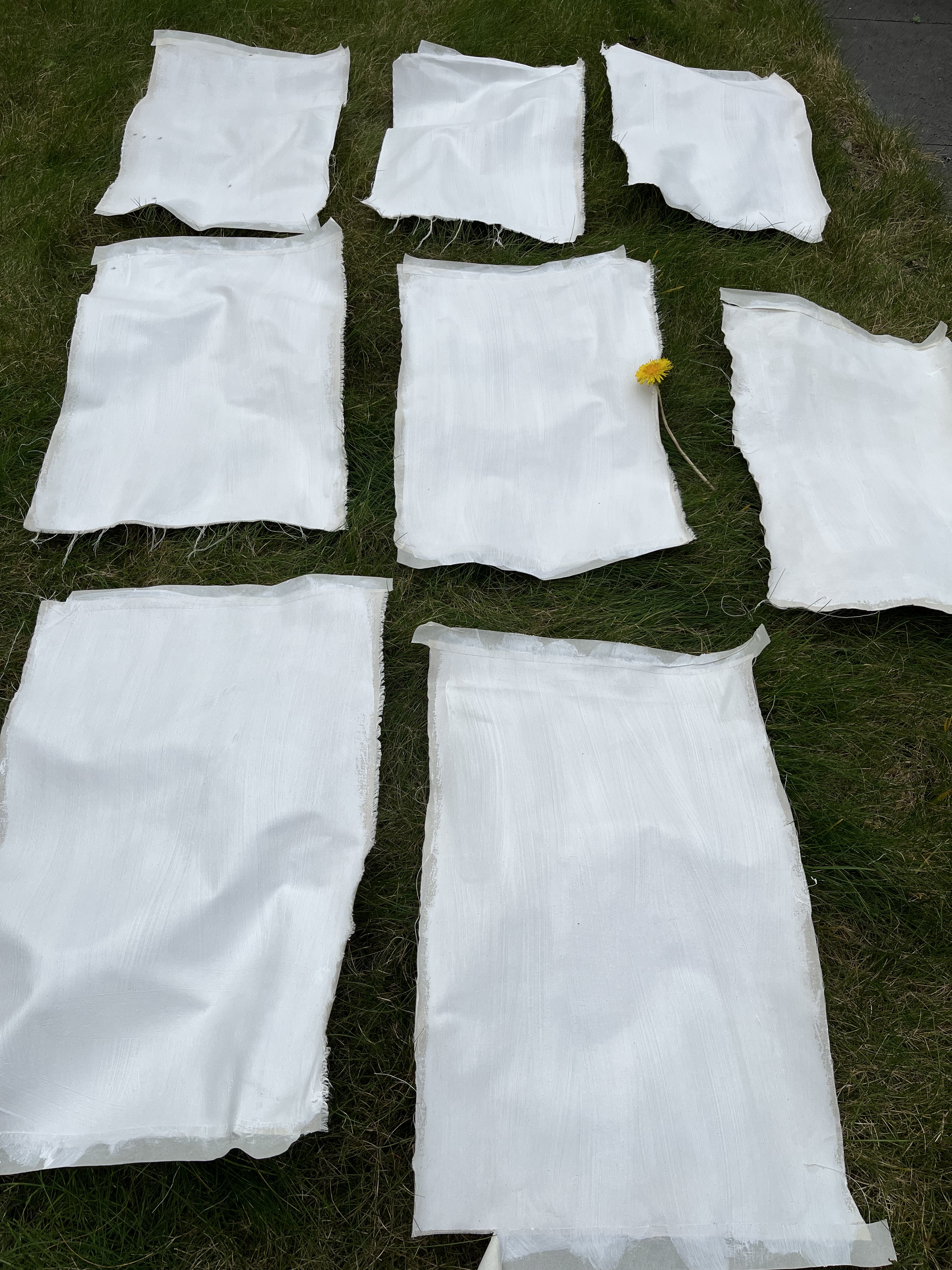
I love the intentional act of preparation which includes me engaging with the material first. It’s like this conversation I have for instance with this piece of cloth. Measuring them out, cutting them up, applying a layer of gesson, and laying them out to dry, had me thinking of how the participants are now part of my preparation. I may not know who shows up, I may not have spoken to them yet, but in this process of preparing they are already in my mind.

So why choose textile? Laying these pieces out on the grass to dry, I thought of Aladdin inviting Jasmin to climb onto the magic carpet and it made me think of how Jasmin might later have told this story to her descendants. Disney gives us a romantic version of the tale, but I wonder if the carpet was as intricate or as ornate as in the fairytale. It also makes me think of a princess confined in a seeming state of limbo and what it must mean to someone in that state to be invited to climb aboard a magic carpet. How did the teller of Aladdin come to this story? And what’s the real story? Is it about the genie? Is it about Aladdin? Or is it about the possibilities that unfold when we choose to climb onto the magic carpet?

This thinking lead me somehow to thinking about AI and creativity and the complex and necessary conversations that need to be had around theft of intellectual property and the indiscriminate use of it. It also had me thinking about what it means to make art and what makes art valuable to us and how the true value of art lies beyond monetary value.

All these thoughts pass through my mind as I prepare these pieces of cloth. What is useful to me as an artist? What is useful to me as a writer? What is useful to me as a person occupying a world that seems to grow more complex as time passes (or maybe I’m just getting older–haha.)

My thoughts on art and what makes something art are complicated because I tend to rebel against formal definitions. I like the idea of life as art which means an artist is someone who makes deliberate choices in the way they step out into life. The form–whether it is painting or sewing or sculpting or writing or cooking–the form is not important. What’s important is the artist’s choice to be deliberate. Perhaps I am making something for tomorrow, but I am present in this moment deliberately thinking on what I am making. It doesn’t matter what medium one uses, it is the deliberate action that goes into choosing that medium that differentiates the artist from the machine.

Thinking on this brings me to thinking about care which was presented to us by my LIMBO partner, Lana Jelenjev. An artist approaches and deliberates with care. Can a machine duplicate that approach and that care? Can another artist reproduce the same deliberation and care to the letter?

It’s a lot of thinking through. It’s all mulch and fertiliser for future work and clearly I still have lots of thinking to do. So, I decide to focus on the now and what I am preparing for.

I go back to the magic carpet and I think of how vehicles like the magic carpet are useful for people who may be going through periods of uncertainty. The magic carpet is an invitation to leave behind what binds you and keeps you from moving forward. It is an invitation to discover and remember and from that discovery and that remembering, create and hopefully in doing so, find your strength.

To you who reads this, go find your magic carpet. Climb aboard and discover for yourself where it takes you.

Blessings and peace. Agyamanac Unay.

Opening a door to story

In my personal preparation for LIMBO, I found myself thinking of how to open the door to story and how to create space for participants to immerse in the act of creation without feeling pressured to perform.

How do we support that limbo state? How do we cherish and protect it? And how do we, at the same time help participants to step into a future they create for themselves?

A realisation came to me that the sessions we are planning are not merely sessions of teaching participants how to work with various materials or tell stories. These aren’t the most important parts of those sessions. Producing something finished or something that can be exhibited or placed on display isn’t the goal. Rather the goal is to empower the participants so they can thrive in the liminal space that so many occupy.

Initially, I had thought to teach working with different mediums with the thought of developing or moving towards a goal.

But I thought of how as a writer among writers, I have sometimes observed how the act of telling story moves from being an act of pleasure to an act where the writer becomes pressured to deliver. These pressures placed upon the creative person can transform what was pleasure into obligation and the result of such obligation isn’t always beneficial to the person who creates or even to the creation itself.

So, how do we invite or open the door for participants to come in and share without pressure? How can I employ what knowledge I have gleaned from life in a way that removes or eases the pressure of creating to an expectation?

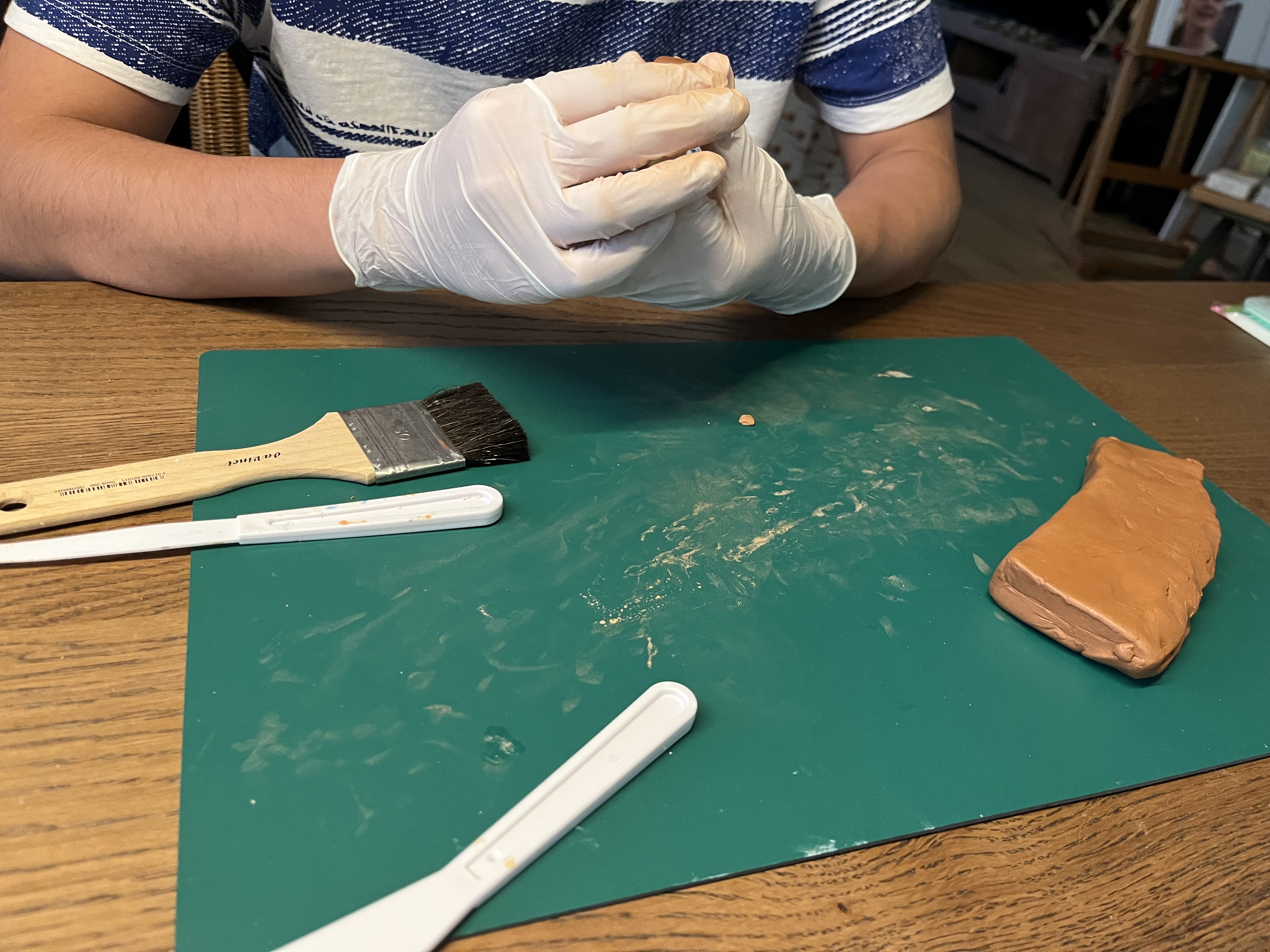
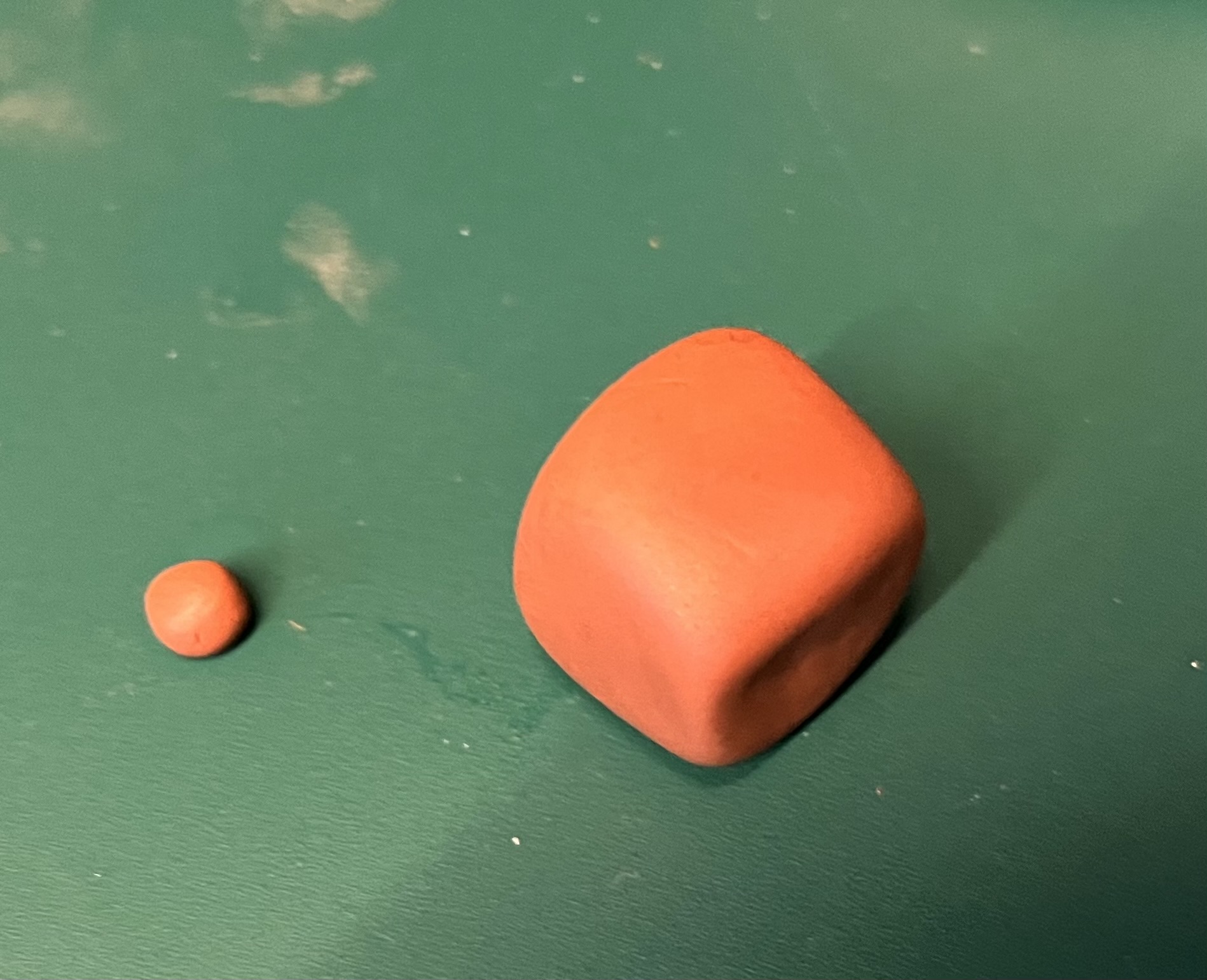
This afternoon, I asked my youngest son to sit down and work with me for a little while as I tried out one of the activities I had in mind. I asked him to treat the raw medium as if he were an archeologist who had time-traveled from the future. I asked him to bring out of this medium an artifact, and with that artifact to tell me something about the future world that he had envisioned.

I simply listened because I didn’t want to impose my interpretation on what he shared.

As his artifacts, he brought back with him a model of a cell and a pill designed to attack bad cells. He found this pill in the office of a family doctor and what it told him was that it was a medicine that was readily available and accessible for anyone who needed it. In his future world, incurable illness and disease no longer existed. 

By thinking of it in science fiction terms, my son is able to time travel back from his ideal future to share with me a story of what is alive inside him today, without the pressure of performing a perfect story or crafting a perfect artifact.

It doesn’t have to go anywhere. It doesn’t need to be published (although I did end up asking him if I could share it here and he said yes.

I realised that what drew me towards creating and giving workshops was in the connection that came from these kinds of sharing. It’s not important whether people end up publishing or not. What’s important is the stories that are shared and the space that is made for these stories. It’s also the wonder that happens when participants discover that there is space for what they have to share.

What can we do to open doors to story? It’s a question that I carry with me. In doing so, I hope to create space and make space for all those stories waiting to be told.

Blessings and peace.