Things I’m thinking about today

The past week has been quite intense and quite busy as I traveled back and forth from home to Amsterdam. The travel is a little more than an hour and when I get to the station I’m supposed to be at, it takes another 10-12 minutes before I’m at my destination.

Last week, I was at the Vrije Universiteit Amsterdam for most of the week where I participated in the Spring School Co-Creation Lab. This was the first Spring School held at the Faculty of Social Sciences and I believe the intention is to have a repeat of this every year for a period of time. The effect of what’s taking place in the US was quite visible at Spring School as events over there made it impossible for one of the invited guests to travel to us in Amsterdam.

It did give me a chance to talk about science fiction, visionary worldbuilding and science fiction as an instrument that can be used for thinking through issues that concern us and then we did a collaborative world-building exercise.

In asking the questions around collaborative exercises, it reminded me once again that in the work we do where we want to bend the needle towards justice and equality, it’s necessary to remember what our community’s vision is. To consult and collaborate and work together even when the outcome is not what we expected. It reminded me too that in the kind of work that we do where we seek to advocate for and are working for communities on the margins, listening and paying attention are some of the most important things that we can bring to the table. (There are a number of other things too like love and acting on the principle of seeing each other as Kapwa, as connected, as human.)

For myself, attending Spring School made me realise that I have to face up to my own responsibility to my written work. One of the comments I read somewhere said that a lot of the links on my website led to dead-ends and it looked like I hadn’t updated in a while. This is, in fact, true. For a long time, I didn’t have the energy or the focus to update this space. I knew the links were dead-ends, but I kept thinking: who cares anyway?

From listening to the conversations around me, I realised that it was important to keep an accounting and a documentation of things I’d written and published. Not only for me, but also because it might help someone else down the line. So, I found myself searching through my disorganised drive, trying to locate as many of the columns that I wrote for Movements as well as other non-fiction work that I had written around change, decolonisation practice and women’s work. (I’m compiling them to create a pdf that can be downloaded for anyone interested in reading. Suggestions are welcome as to how I can make it available as I’m new to this.)

As I was reviewing the work I’d written, I found myself quite emotional. I remembered how a lot of the non-fiction work that I did is what supported our family through the most difficult periods when Jan didn’t have any work and often pay from whatever writing I managed to get published was what helped keep the children fed. Interestingly, my kids don’t seem to remember that time as a time of hardship. It was more like: we ate noodles for a week and it was great!

Writing this my heart aches because I know there are parents at this time who despair because there is nothing to feed their children with. There are parents who don’t even know if their children will survive to see another day, and there are children without parents to worry over them. Having noodles for an entire week sounds like heaven when food supply has been cut off or withheld by the powers that be. What’s happening in Gaza, what’s happening in Sudan, what’s happening in Ukraine, what’s happening in all the places where war and oppression are taking place happens to all of us and we cannot allow ourselves to become numb or to look the other way.

For those of us who live in places of privilege where there is no war or famine or fear of rockets detonating over our heads, while we may not be able to jump on activist boat like Greta Thunberg, we can still do something. We can listen. We can advocate. We can bear witness.

Blessings and peace to you who read this. May we ever be striving to move the needle towards what is just and true and may we recognise how we are connected in our humanity.

There is so much I want to write

There is so much I want to write and there is no way to make the writing short or light or easy or quiet. My thoughts are like waves rising and falling–in constant motion.

I have an ocean drum. A small one that I want to use and share and bring along.

I hold the drum in my hand and listen as the pellets roll around. A loud noise. A crescendo and decrescendo.

Like my feelings and my thoughts.

I know I am much better because I feel the restless yearning tide rising and reaching towards change.

Why can’t borders be porous? Who do we need borders for?

Why does it take us so long to take action? Why do we remain in inertia?

There is so much happening. There is so much injustice going on.

How can we justify genocide? How can we justify war?

What difference does it make? Someone asks. What difference can I make?

My thoughts rise and fall, like waves.

In my head, I stand on the edge of the shore. I dig my feet in the sand and feel the grains between my toes.

From where we are, what we are doing seems so small.

The ocean is big and wide. Our doing is a drop tinier even than a drop of sand. But if we join all our doings together, all these doings could become the shore.

Letting go of perfection

After a while, the portrait I’d been wrestling with made me feel so dissatisfied, I decided to turn its face away from me. Maybe it was the colours I’d been using, maybe it was because I needed a break, but the more I worked on it, the more I felt as if I wasn’t getting anywhere near where I wanted to be. It’s funny to write this when during my last entry, I felt as if I’d had a breakthrough.

So, I decided to step away from the portrait. I didn’t work on it for a couple of days. I didn’t even look at it. I played with my watercolours and didn’t require myself to do anything that was like a project.

There wasn’t really much time to dwell because I had the regular check-up which consists of a bloodwork and a CT scan. I didn’t have time to dwell on the CT-scan because my youngest son was leaving for the traditional end-of-school holiday (it’s a Dutch thing where young people go on holiday with their mates at the end of senior high). It’s kind of difficult to stress about a scan when you’re making sure that your son won’t miss his flight and it’s kind of difficult to stress about a portrait when you remember you have to go to the hospital.

After a busy couple of days, I decided I needed a break. I made a date to meet up with my eldest son in the city and we went shopping for some things (in my case it was art supplies).

The great thing about taking such a break is how there’s time to think while on the train ride to and from the big city. I thought about that little voice that makes tiny sounds of disapproval in the back of our heads. We don’t register it as disapproval because we’re so used to hearing it. It’s a voice that says: Oh, that’s not good enough. Oh, that nose doesn’t look right. Oh, are you sure you want to use that shade of red? Oh. Now you’ve done it. You’re overworking it. You’re doing it all wrong. You’ll never be good at this.

It doesn’t matter whether it’s a painting or a story or a book report, our first and harshest critic is that tiny voice that causes us to tense up and become so focused on being perfect we end up helplessly throwing our hands up in the air and saying: I cannot.

There’s a great little clip I stumbled upon on youtube where a pianist is playing one of Chopin’s etudes (I forget the name but it’s one my mom played a lot). Over a section of the clip with the beautiful cascading tones of the piano, there’s a caption: What the audience hears when the pianist plays this piece. Right after this, there’s a section where the notes are clanging together in disharmony. The caption says: what the pianist hears when playing this piece.

It’s a funny clip, but it’s so apt. It doesn’t matter what art form we practice. Whether it’s making music or making art or writing, somehow we tend to hyperfocus on that one thing that just isn’t working. And it’s all that tiny little self-critical voice will let us focus on.

I laugh as I write this because it seems like this is a lesson that keeps returning to me. In the chase after an elusive perfection, we lose sight of what makes us love the things that we do.

Blessings and peace to you who read this. Thank you for dropping by.

You cannot rush a painting

Soon after I completed my short course in painting portraits with acrylics, I got my first commission to make one. As it was commissioned by close family, I’m not sure if it qualifies as proper commission, but I agreed to make one for the equivalent of another course on painting portraits with watercolours. I don’t know why I had the idea that I could complete a portrait in a week when it took me almost five weeks to work on my class assignment, but hey–time is like an accordion to the neurodivergent mind. So, I delayed starting on the portrait. I did a couple of studies and for some reason my brain registered this as: I have completed the assignment (which of course is far from true).

Anyway, the start of watercolour class was announced and in the lead up to it, I found myself completely immersed in this completely new to me medium. Of course, I had played with watercolours as a child. But I never quite liked it. I found out that it wasn’t my fault, but it was because I didn’t have the proper tools for making good watercolours. Ha! I find myself wondering how many children give up on artmaking because they just don’t have the right tools. Of course–as people say–artists will find ways and means to make art and when I look back, I realise that I was always making art. It wasn’t art in the conventional/traditional sense of how people in my surroundings defined art (art=painting). I wasn’t painting, but I was constantly busy with cutting and pasting and layering things. I was curious about things that were discarded and what could be done with them. When I was a teen, I started using threads and cast away materials. I dried weeds and made cards. I collected pieces of thrown away marble flooring and tried writing on them. Eventually, I combined these with other things and the small projects I started in my parents’ garage bloomed into quite a hectic business. (I confess, I didn’t like it as much once it became hectic business and that probably says a lot about me.)

So anyway, back to the title of this blogpost.

The reason why I was asked to make this portrait was because the portrait I made in class came out so well. Getting it there took me sitting at the easel almost everyday. Carefully observing my reference photos and decided which colours were best. It was me also remembering the way my cousin’s smile looked and what it was about her character that I wanted to capture on the canvas. And the portrait succeeded because I knew my subject really really well. I could close my eyes and see the way she walks, the way she tilts her face to the side, the way shadows play across her face and most of all, I could see the gentleness and the joy shining through her eyes. And that’s what I put on the canvas. As one of my classmates said: she makes me want to smile back at her.

Back to this portrait. On the first day, I did the drawing and filled in light and dark hues. I had my colour palette, and yet somehow it wasn’t working. At the end of day one, I had a stern looking figure on my canvas and another figure who looked like an alien. Skin tone was nowhere near anything human. I stared at the portrait and thought: I think I’ll just go back to using pastels and watercolours. Those are more fun.

Second day: I’m one day away from my self-set deadline. Anything I layer on makes my figures look even more alien. They no longer look anything like the reference picture. Even worst, the main figure looks so unlikeable and scary, I want to throw my brushes on the floor and burn the canvas. I don’t do these things, but I admit I was pretty close.

Self-set deadline day: The portrait is not finished. I don’t know how I’ve managed to turn two humans into beings who look like they’ve come from Mars. I no longer think of them as people. I think of them as subjects–characters who refuse to bend to my will. My paints and brushes keep going, but good grief, my instruments are not making magic happen.

Thankfully, I’m given a reprieve. I don’t have to deliver the portrait just yet. But the person would like to see an in-progress work.

I’m crying. I can’t show this horrible canvas to anyone.

I go to bed and pray. Dear God, I say. Please (please please) I know this is such a tiny ping in all the important things happening around the world, but if you could send me a dream–something that will help me resolve this, I would be ever so grateful.

Here is a detail I remember from my dream. I’m a child crying over this portrait and I’m sitting at the feet of this big person. You need time to make a painting, the big person says. Each layer makes a painting richer, this is why you can’t rush a painting. Look, you should try using yellow ochre and don’t be afraid to mix your colours with white.

I don’t know if there was more, but when I wake up, that remains with me.

I head up to the attic and start squeezing colours onto my palette. Yellow ochre and white and my basic colours. I decide to not use the flesh coloured paint that I’d used previously. I don’t know if it will work, but I start painting. And somehow, things just click into place. The main character now looks kinder and more approachable–just like the person I see when I leaf through the album in my head. The second character looks kind and inquiring–and his skin looks human. I mix in some cadmium yellow, a bit of red…it’s coming together. Burnt sienna and ultramarine blue and some of that white for my shadows. It’s intense, but looks natural. I’m not quite there, but now the painting has more flow.

I think of how the things worth bringing into the world cost time and effort and energy. The act of creating something asks something from us and gives something to us as well. Maybe AI could make a painting much faster than I could, but I wouldn’t be getting the same insights I get from making this painting myself. Everything worth bringing into the world is worth the journey that it takes to bring it into being. And this is why we can’t rush art. We can’t rush stories. And I can’t rush a painting.

To you who have taken the time to stop by and read this, I hope you find something to inspire you on your own journey. Thank you for reading and may you be blessed.

The study I made in preparation for the painting. 🙂

Create and co-create

On my wall, there’s a postcard with the words: Create the things you wish existed. It’s a card that came with an order of art supplies and I loved the words so much I pasted it up where I can see it as a reminder.

From one of the mailing lists that I subscribe to, there’s a link to the work of an amazing artist named Leilah Babirye. If you have time, click on the link leading to the video as it’s so inspiring and a great reminder that when we are engaged in art, we can’t be afraid.

I’m thinking about this as I think about LIMBO and the participants who come to share and create together. More than the things that we produce or make during the time together, it’s about how we hold space for one another and create together the kind feeling that exists in that time. When it’s my turn to give the workshop, I step into the space and think about who’s here and what do they need. Where Leilah talks about reading and listening to the piece, facilitating means listening to the space and reading with the heart. I bring to the workshop all the things that I have learned from other practitioners and I bring also what I have learned from my own journey.

Yesterday, we engaged in making rhythmic combinations, dance steps and improvisations as well as song. I had in mind this idea that we needed to give an answer to the wishlist that had been presented by participants sometime at the start of the season–the wish to create a LIMBO dance as well as a song that comes from us and expresses us.

There was laughter, there was singing, there was lots of body movement and dancing and there was a beautiful musical rendition gifted to us that afternoon by one of LIMBO’s participants.

I love how moments like these give rise to spontaneous sharing. It’s a testimony to how participants feel safe to talk about what they’re going through and what they’re feeling in the moment. To me, it’s this precious quality that we need to take care of when we talk about community.

Today, I am thankful for the privilege of being invited and included in this community. One of the things I’ve learned and continue to be reminded about in LIMBO is how it doesn’t matter that there are moments of discomfort and unease–that sometimes topics can become fraught–that people will have differences. But this is okay. I think of Aminata Cairo talking about family gatherings and how there may be that uncomfortable relation who can get argumentative and you think: Oh, I will just keep a distance. But even so, if we believe we are all connected, then there is still space for discomfort. We don’t always need to resolve it, but we can acknowledge it.

(I want to note here that I do think it’s important to draw a line at abusive and harmful behaviour.)

At present, I’m already looking toward our next gathering which will be on the 1st of June. I’m thinking of how to approach this workshop as we prepare for the launch of LIMBO’s second booklet. For the launch, which will be on the 20th of July, we’ll be going back to FramerFramed as a podium has been offered to us for use against the backdrop of an exhibition about transformation. It’s so very apt. I’m thinking of festive feelings. Of glitter make-up and shiny clothes, of dancing and singing and color and joy. We’ll be creating this programme together, creating this launch, creating this space and holding it for one another.

To you who read this, take time to listen to a beat and move your feet. Thank you for stopping by. Blessings and peace be with you.

Sniff: a funny short dream

I woke up from a dream this morning and it had me laughing. Perhaps it’s because I’ve been thinking a lot about how to continue my stranded work, but I dreamt of homes built into a rock face. In this weird dream, I realised that those dwelling places formed a word. I was so amused by it that I woke up laughing so I thought I would try to recreate how those letter dwellings looked like.

It’s a bit of a sniffy time as hayfever season has come again. Alas.

All the things and how do I choose?

In my previous life, goal setting was a little bit like this thing I would do in intervals. Like at the start of the year, I might set a couple of things for myself and at a certain point a sense of panic would creep in when I realised there were still things I hadn’t done.

Yesterday, as I was reading through the life after treatment module, the goal setting part of it had me thinking. For instance, if I say I want to travel more. What exactly do I mean when I say that? If I say I want to spend more time with my family, what do I really mean by that? And what about getting back to writing and finally finishing that work in progress? What about leaving a legacy and creating space for others? How and where do I even start? That familiar sense of panic came over me–that sense of I’m not sure I have enough time to do all the things.

To be honest, I didn’t actually think about these things when I first listed things down. I basically just filled in whatever and went on my merry way. But yesterday, I realised that I had a rather long list of things I want to do and it’s probably one of the reasons why I’m feeling a bit out of breath because how does one choose and where do I even start?

Thankfully, the module provides the following questions in support, some of which are:

How far along are you in regard to this goal?

What do you need to accomplish this goal?

Do you have all you need to get there?

One of the things on my list is to plan at least one weekend every year when all of us spend time as a family in one house. Last year, we went to Spa in Belgium. We are rather fond of Formula One and I’ve always wanted to visit a race track. Not only is the Spa circuit legendary, it’s also a beautiful track surrounded by lots of nature.

As I was in treatment at the time, my youngest spent most of our visit to the famous Spa circuit pushing me in the wheelchair. I didn’t get to climb up to the viewpoint tower but I loved that the kids got to do that and see it for themselves. It was only for a weekend, but we had a lot of fun with time together as well as time separately.

This year, I’m thinking of a place closer to home with more possibilities for going out into nature and taking walks because I’m more mobile than I was last year and I have more energy than I had.

But while I can plan things and organise things, while music and artmaking and teaching are proving to be quite friendly and within my grasp, I’ve discovered that getting back to writing is a lot more challenging than I had imagined.

Do I struggle with the writing because my brain isn’t quite up to it yet? Or do I struggle with the writing because writing (even when it’s fiction) feels very close somehow and I’m not yet ready to go there? It’s telling that I’m writing about not being ready because that’s actually probably what it is. Will I be ready to go there?

Writing even when it’s fiction has often been a way for me to work through whatever is weighing on my mind at the moment. I doubt that my work is commercially appealing because writing to an audience has probably been the last thing I’ve thought about. I’m not sure if that makes me a bad writer–but basically I write things that tug at me and call to me and make me take that deep dive and a lot of times the dive is personal and involved with the body and how the body moves through society and navigates all these questions that arise. What impact does space have on the body? How does society impact the body? And can one body have an impact or influence in the space they occupy? If so, in what way? (Yep, that’s one example of the process my brain goes through and maybe it’s helpful that I’m writing about it because this is probably a step towards getting there.)

I wish that answers were easy, but often answers are complex and require time and patience and a lot of times solutions to problems are never easy. The concept of good or bad and black and white is simplistic when we live in a nuanced world where many different shades go into what we imagine is one color.

So, this leads me back to goal setting and the objective of it.

Perhaps it’s so we don’t get this feeling of empty hours or days that we must feel. Maybe that’s it. Maybe it’s to give us a sense of purpose. Perhaps it’s to make us feel useful or accomplished. Oh hey, I did this task and that. I cleaned the bathroom without breaking down and I still had the energy to iron some clothes. That’s a win.

Now that I think about it, this sense of time running out is an illusion. We get caught up in the rush of “I must do this” and “I have to accomplish this” or “I must be useful” or whatever narrative we say to ourselves.

I think that we all have the time we need/ to do what we need to do/ and /time never runs out/. We may think that time runs out when we close our eyes in final sleep, but actually time keeps on running and what we accomplish as warm bodies reverberates even after our bodies are gone from the timeline.

Writing about this has helped me shed the rush. What needs to be done will be done and if it’s not done perfectly or as exactly as I imagine it could be, it will be enough. When I look at the timeline, I realise that actually what matters is now. From a minute ago to this minute to the minute that follows after this one. These are the moments that I can make count. Maybe I can give my son a hug or by practice my brush strokes (I’m learning how to use watercolour), or I can go out and find rocks to use for an exercise with the group. Maybe it’s something else. There’s no rush, there’s no panic. Time isn’t running out. I am moving exactly as I am meant to move within the time I occupy.

As usual, this is me thinking out loud on the page. I hope that it’s helpful to someone. Take time to do what matters to you now and if you’re feeling rushed, breathe.

Thank you for taking time to read this. I wish you blessings and peace. Maraming Salamat.

Oh hey! It’s another Tuesday post

Sometimes the words just flow and sometimes they don’t. Today, I was working on the module that comes with the a new program from the physiotherapy class that I signed up for. This class is an intensive three month program which usually is offered after active treatment and it includes not only the physical rehabilitation part of things, but it also offers a module which walks you through a process of reflecting on what’s happened and what you would like to happen moving forward. It’s a module divided into six sessions and signing up for the module includes a page where you list down everything from the moment of diagnosis up to your last active treatment.

It was rather something to look back and realise that from 2022 up to the end of 2024, I was in constant treatment and my days were marked by hospital visits. It’s also good to recognise that I’ve been out of active treatment for five months.

I find myself no longer planning in terms of “if treatment will allow” to thinking in terms of “Oh hey, I can do that thing and take that course and I can play together with the band and go to workshop”. It seems like a small change, but it is actually a huge change from not knowing to some sort of knowing and where planning can now occur in two month stages instead of the one week when I feel good stage. I actually had this idea that I’d dealt with the stages of grief during those three years, but having looked at the dates reminds me that it wasn’t nothing. So here I am thinking on it and feeling thankful that I made it through all those treatments. I am thankful that I’m still here.

I’ve learned that even when we think we can’t, we still can and there is nothing more precious than today and if there’s something worth doing, there’s no sense in delaying the doing of that something.

There was a short period after treatment when I had a sense of “Oh, my days are stretching out now” and “so what do I do?”

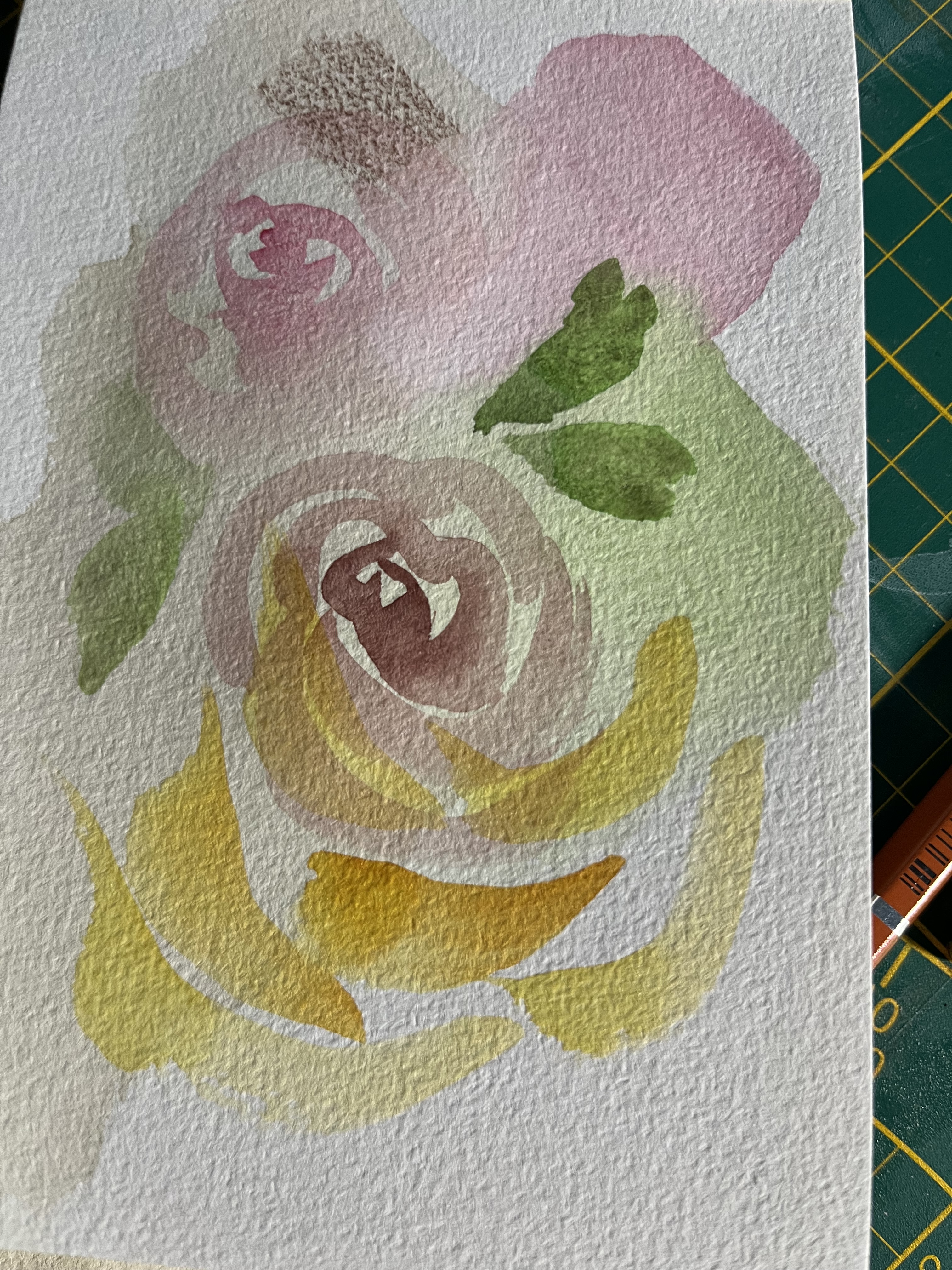
Lately, I’ve been filling my days with watercolour practice. As I said to my therapy mates, I didn’t have the opportunity to learn how to use all these different materials when I was young, but I’m learning them now and it’s like a world has opened up in front of me. I didn’t know, for instance, that getting a good result in watercolours has a lot to do with the materials that you use. Of course, it’s the same for all other things, but watercolours are pickier than pastels and acrylics and if you use bad paper, it’s a given that your watercolours will look more grisly than if you used something that’s a better grade. I’m practicing on Aquapad paper which is thick enough and satisfying enough. (Arches are the best, but I feel like I need to get to that point where I can justify spending lots of cash on Arches.)

I’m happy that I have art making to keep me company, because it seems my fiction brain isn’t quite ready yet. I did the thing last week where I decided to just grit my teeth and open the work in progress and after reading the first page, I just had no idea. The sense of overwhelm was such that I decided to close the document and re-think my strategy. Maybe I’m not ready yet to face a work I left at 70k words. Maybe I need to section it up into smaller units that my brain can focus on in small bursts. I’m not sure yet. The work is niggling on the edges of my awareness, it’s just getting down to it that costs more than I can spend at the moment.

In the meantime, the watercolours are spread open on my desk. Brushes and pens and paper with some grisly attempts at portraiture. For the first time, I did manage a reasonable study in values. Not bad, I thought. I put a date at the top. Maybe I’ll look back at it in a hundred days and say: Oh wow. I started there, huh.

For you who have taken the time to drop by and read this, I want to say thank you. Blessings and peace and may your days be filled with good things.

I’ve fallen quite in love with Daniel Smith’s Green Apatite Genuine.

It’s only Tuesday and yet . . .

Not that I post with any kind of regularity or schedule, but here I am on a Tuesday. I’ve enrolled in a five session course on portraits with acrylics and the first session went pretty well. The advantage of acrylics is the drying time and how it’s much easier to take it home to continue work on it. Compared to pastels where the work has to be carefully transported, acrylics are easy. I’m enjoying these courses which are in series of five sessions each time focusing on a particular medium as I feel like I want to understand how different mediums work.

I do enjoy portraits a lot and I want to try and see what different things I can do with it once I get the basics down.

When I was a young girl, my mother once showed my notebook of writings to the daughter of a friend of hers. I think my Mom was proud that I was writing, but I was quite embarassed because her friend’s daughter was (at that time) already playing the violin for a big orchestra. I was like: Eh…Mom. Why?

But instead of dismissing my work, this young woman looked at it carefully, then she said something to me which I’ve carried around much like a puzzle that I keep trying to unfold.

“An artist,” she said. “Can see beyond the leaf.”

I never got around to asking her what she meant because soon after that this violinist went abroad to play with other orchestras and our paths never crossed again.

I think of her words every now and then, though.

Today, those words came bubbling up again and I thought of the following reply:

Beyond the leaf is a world (maybe more than one)

Lives are lived. Not all are told or written down in story.

Not one is insignificant.

To you who read these words, may you be surprised by small moments of daily joy. Thank you for stopping by.

Here’s one of my favorite exercises from this week. On a background of sennelier soft pastel, an impression of branch and leaf.