art and narrative

Last Thursday, I moderated a panel discussion on the Fractal Art of Julius Horsthuis at NXT Museum. It was quite an interesting event as not only was the artist on panel, but we also had Dr. Margriet van der Heijden on panel–a physicist who specialised in particle physics at CERN. I’d never thought all that much about fractals before–I mean, if someone said the word fractal, I would understand that they’re talking about self-similar patterns which we often see in nature, but I probably wouldn’t be able to tell you what it is in-depth. For math people, talk about fractals will often lead to thinking about the Mandelbrot equation, but did you know that before Mandelbrot, there was the Julia? (Yep. I learned all these things while doing my prep.)

I also found myself thinking on the question of what makes art. What do we mean when we say a thing is a work of art? And what function do we ascribe to art? Julius Horsthuis says that his focus on Fractals lies in the fact that he hasn’t gotten bored by it yet.

For Julius, documenting or discovering the 3D worlds opened up by the input of various equations is what makes it fascinating for him. He talks about the films Baraka and Samsara which don’t follow a conventional narrative and how these films were an inspiration for the 3D films that he makes.

I certainly think that experiencing this kind of art by being in a space where you are surrounded by it is a different one from that of seeing it onscreen (on your laptop, your pc or your television). There is a mesmeric quality to it, but at the same time there is (as one of the audience said) a feeling of loneliness. Perhaps because there is an absence of characters interacting with the landscape. (Perhaps the person in the space becomes a character interacting with the landscape or could it be the maker himself?)

I watched Baraka and thought about that difference (the absence of humans in Julius’s work) and found myself thinking of how a landscape changes with the presence of humans. As Margriet said to me later on: Humans are not fractals.

I do like the concept of non-conventional narration and how it ties in with how story doesn’t have to conform in order for it to matter.

Later, Julius speaks of how the absence of narration is deliberate, although as he explores the possibilities of bringing his creations to VR, he realises that the absence of narration may not be conducive to people engaging with the art, particularly if they come to the experience for the first time.

Is story an experience? Is art an experience?

I think about these as I deliberate on my own work and process. I think of how as writers of story, there is a certain expectation arising from centuries of stories being told. What happens when story doesn’t conform to expectation? What happens when a story simply wants to show a world in the same way a documentary maker would show the world?

But is showing the world enough? We could argue that the majority of science fiction and fantasy books are about showing the world.

Piranesi, one of the books I read when I finally got my reading brain back, feels very much like that. It’s basically Susanna Clarke showing us the world Piranesi occupies. Piranesi’s voice compels us to come along and see and learn more about the world they live in. The cast of characters is barely there, but we’re seeing the world through Piranesi’s eyes and it’s beautiful and fascinating and a lot of times it is lonely. Piranesi eventually conforms to a story expectation but then not really and the feeling of fascination remains long after the book is finished.

Does Horsthuis’ art work in the same way? I can’t help but wish I had thought to ask how exploring the world of Fractals has changed or enriched the artist as a person. I’m not even sure if this is what the artist is after. Does it even matter? Should our work change us or reflect us or enrich us even? Does a work have to mean something in order for it to have value? Is fascination and sense of wonder enough?

In the light of discussions around the lives of creators, to what extent does the character and life of a creator influence our engagement with the work that they create? And can we separate things made from the people who make them? (Probably something for another post…my brain tends to wander off in tangents and this is my blog. πŸ™‚ )

I think there is room in the world for different kinds of artmaking because every form of creation will find its own audience and will speak to audiences in different ways. Thursday’s event reminded me of that. It reminded me of the beauty of physics, the endless mystery of the world we live in and that joyful feeling that arises when people come together with a desire to create bridges of understanding and knowledge.

If you’re in Amsterdam, I would recommend checking out NXT Museum (check out what’s on exhibit first as it varies). Not only is Julius Horsthuis’s Fractal Art on display, but they also have a fascinating exhibition by the postdigital art group Random International.

Blessings and peace to you who read this. Daghang salamat for passing by.

On my mind today

One of the marks of a good leader, my father said, was the capacity to encourage others to make full use of their talents and to make others grow into their gifts. It’s not about having the loudest voice or being the most visible, it’s about thinking on how we can help others discover and become their best selves.

My Mom also used to tell me that the sign of being a good teacher was when your student outgrows you and no longer needs you.

I think about these things because one of the writers who came to attend the six week workshop I gave for Other Futures (and who I’ve been mentoring a bit since then), was accepted to the Clarion Workshop. It is quite a milestone moment and I feel like a proud mama bird watching a fledgling spread their wings.

Last Saturday, I got to do one of the things that brings me joy. I got to work with young people again. This is a thank you to Lana Jelenjev and the Neurodiversity Foundation for inviting me to give a workshop to young people between the ages of 11-17 as part of celebrating Neurodiversity pride day.

There’s something about the way young people approach the act of creating together that makes me so hopeful. I saw the will to encourage one another, the willingness to compromise and make space for each other, and the readiness to help when the other person gets stuck. As Lana’s husband said afterwards, we could all learn a lot just by watching the kids work together.

It makes me think of how we all have that capacity to create and work together within us. Maybe it’s just that some of us didn’t know that we could just go about it, or we’ve been so programmed with this idea of individualism (mine is mine and yours is yours), we’ve been trained to think so much in boxes that we forget the joy of collaborating. And then, there is this soul-killing thing which I’ve sometimes observed in the grown up world where people think the important thing is to be better than someone else, win the most awards, have the most fans, make the most money, sell the most books…that sort of thing.

Life and art and the creation of story are not a competition. It’s not about having the best words or the coolest ideas, it’s about feeling safe enough to share what you love that make life and art and creation beautiful. What I loved about Saturday’s workshop was how I got to see young people bounce ideas off of one another in a space where they feel safe from being judged or found wanting, they just went ahead and talked about things they loved or were passionate about and they made space for each other to include those things in the worlds they were creating.

This method of creating together is a practice not only in worldbuilding but also a practice in bridge-building, in compromise and collaboration.

We could certainly do with more bridge-building and collaborating in these turbulent times, because it often feels like we have forgotten concepts like meeting each other halfway and compromise. We think we have waited a long time for change to happen and we would really like for change to have happened yesterday. The problem is, we live in a world that’s run by systems and systems are slow and resistant to change. As a good friend said to me: “you think maybe by being in the system, you can change the system, but it’s such a complex thing because by being in the system, you somehow become part of it.” I really don’t know what the answer is. We can only do what we can to the best of our abilities and hope that the little that we do will create some change no matter how small.

This week, I was in conversation with a dear friend, we also talked about this same thing. She told me about how she learned to think in terms of “good enough”. Perhaps it’s not the ideal change, perhaps it’s not the big change that we wanted, but maybe it’s good enough for now. How change happens in increments of time, by checking in and finding out whether a recalibration is needed. Maybe we can move forward a little bit more or it could be that we have to just be satisfied with good enough until the next check in moment.

I think about the words “good enough” when I have the conversation with my oncologist later in the day. I ask my questions and she patiently explains her interpretation of the data. It’s not yet where we want to be, but it’s good enough for now. And while the ideal would be to be completely rid of all the tumors, nodules, lesions and bad cells floating around, a stable or chronic state for a long period of time would be good enough.

It may sound like a strange comparison but I make these jumps in my head because that’s how the brain works. I think: it’s okay to not achieve the ideal all in one go. It’s okay to take it step by step. The important thing is to remain open and curious, interested and ready to look into options and points of compromise. Yep. I’m making the body and world parallel again.

Today, I’m speaking to my body. I’m thankful because I have a strong and sturdy body that has withstood a massive operation and all the treatments so well. I am thankful that I am able to work at regaining the strength and fitness that I had before it all started. I am thankful for the spirit that lives in me, that reminds me to take it one day at a time. I am thankful for today. Thankful that I can hug my son and tell him how proud I am of him (he’s having a bit of a tough time atm). I am thankful for friends who have reached out to me, for loved ones and for people from surprising places who tell me they are sending healing thoughts or praying for me. There’s always something to be thankful and joyful about.

As long as we have life in us, we are not without purpose. We are here to make as much of a difference as we can make. Sharing our stories, passing on our experience, strengthening and encouraging others to spread their wings and fly–discovering things, making memories (all those other things) remind us we are alive. As long as we are in the world, we can make every moment count.

Agyamanac Unay for stopping by. Blessings and peace to you who read these words.

End of our week at Gladstones Library

It’s hard to believe that it’s Friday. I can hear the tolling of the church bell from the church that’s right beside the library and it’s just finished bonging out the 10th hour of the evening. Ah. It really is the last evening of our final day at Gladstones Library.

Being here has been a wonderful and enervating time for me. Being among the books reminded me too of my family and how books played such a huge part of our growing up years. My sister and I spent so much time in books, and much later, when we were older, we found ourselves discussing books and arguing or agreeing on the virtues or the failures of particular novels or stories. When my sister went for her Masters in Theology, we had long discussions about theology and politics and I do miss my sister’s outspokenness over matters patriarchal as well as the wrong interpretation of scripture.

‘Where does it say that in the Bible?’ She would say, when someone was inclined to lay down some ancient patriarchal thing as word of God when it really wasn’t. When I discovered myself sitting between stacks on theology and philosophy, I couldn’t help thinking of how much my sister would have loved it here. What kinds of conversations would we have had about Reinhold Niebuhr or Kierkegaard? (I confess to feeling quite learned right now. I mean, my sister probably would know who Niebuhr was, but I read him here for the first time. Kierkegaard is a familiar name, but I hadn’t read him until I was sitting next to a stack with a number of shelves with books by or about him. I admit something Kierkegaard says did give me an idea for a horror story. So….I don’t know that my sister would count me as learned, considering how I have this tendency to turn serious things silly.)

Here at Gladstones, I have been well fed. Not just with the books and with the writing, but also with rich conversations around the dining table. Milford writers are just the best and it seemed to me as if the words spoken and the knowledge shared–all the conversations and all the warmth and kindness worked to open up a portal to that realm where the good words dwell.

I think of this time with so much thankfulness. Who would have imagined that I would be able to fly and travel on my own again? Or that I would write so many words in the space of week. Or that I would finally get around to properly organising the novel.

At tea with friends, I shared how it felt to me like I was waking up from a long amnesia and it was like I was remembering to write what I love to write the most. Worlds and worlds and the undying hope for change and a better future.

Follow where your heart takes you. If you’ve tended it well, your heart won’t lead you astray. You’ll always end up exactly where you are meant to be.

Blessings and Peace and Agyamanac Unay for stopping by.

Fluidity and freedom

After the first LIMBO of 2024, I find myself eager to see how future LIMBO’s will unfold. We started the first LIMBO with some discussion and reading and from that discussion and reading we went on to write our own letters inspired by some readings from The Letter Q: Queer Writers Notes to their Younger Selves. For those interested, some of these letters are available on poets.org.

The letter writing was a divergence from the workshop theme/plan which I had in mind, but in coming to LIMBO, I felt what was important was to find out first where the discussion would lead us. Every announced aspect of the session was a placeholder for what might come up as being more important or beneficial to the participants at the moment. I think the fluidity of conducting meetings in this way might be more helpful/fruitful than creating a set program with activities we nudge participants towards. I think of how participants might come up and say: can we do this instead? Or can we work together on something? I’m curious as to that last part as I do want to try something at a future meeting.

For me, LIMBO is an ongoing process and it’s one that I find quite joyful. I do wonder how workshop culture would change if we shifted our approach and started asking ourselves: what is it that those coming to the workshop need in this moment? Is it be possible to make room for a different approach and would a consumer-minded society be willing to embrace a workshop that doesn’t clearly label itself from the get-go?

For all the complexity that comes with it, I find LIMBO to be freeing. No doubt there will be difficult moments but LIMBO is about working together to hold and keep this space wherein we can all just be (as one of the participants so beautifully put it) just be human.

Here’s a challenge that mirrors what we did: Read one or two letters from the Letter Q out loud. Give yourself 30 minutes and write a letter to yourself: could be your younger self, your present self or your future self. No editing. No passing judgment on yourself. Just write. Afterwards, read out loud. Ask yourself: what surprised you?

Blessings and peace to you who read and may you find yourself joyfully surprised.

Alive and working

In the lead up to our first LIMBO of the year, I wanted to try a different approach. One that’s more loose and which means also posting to the group more in the lead up to the Sundays. I think of how providing material to think on could become a basis for discussion before we go on towards the work of collaborative or individual creation. This time, I want to focus on the questions around writing and creation of story, character and world. I think of ways in which we tell story and where our stories come from and how sharing our works and our words with one another is an act of affirmation and also an act of recognising and taking and making space in the world. If we can encourage confidence and voice so people can stand up and say: this is what I sound like and will you listen to me? I feel that we will have already done some of what we are meant to do.

These past weeks, I have also been thinking on and off about a piece I’m supposed to be writing in Dutch. It’s an interesting process to be writing in Dutch. Understanding that some of what I say and how I say will give me away to the reader and tell them that I am not a natural-born Dutch person. I think of how the tongue stumbles and wrestles with language and how language can be a stumbling block at times, how it can at times be a wall, but how it also can be a bridge if we can let go of wanting perfection. For the recipient it means being willing to listen even when the syntax or the grammar doesn’t sound as a “real Dutch person” would say it. But on my part it also means a willingness to be vulnerable and admit that I really don’t know how to write everything as it’s meant to be written, but this is the meaning that I want to get across. It’s kind of funny to be going through this process as for a long time I fought against writing in Dutch. It was this weird feeling of: I’ve already had to do my best to write English really well and now I have to work at writing in yet another language. But unlike when I was younger, I find myself less resistant to the process. I suppose it’s a certain knowledge that comes with age.

I wonder when do we become more than a person living in a country? When do we make that transition into being part of a country? And what does this mean for my identity as Filipino? I am still Filipino. Philippines is still home to me. But I am also Dutch and The Netherlands is also home to me. So, it is possible to be two things at the same time and to occupy two identities at the same time. To be Dutch and Filipino. To be at home here and there.

These are some of the things going through my head as I write and work on things that I want to work on. My thoughts are still quite messy, but I like messiness. Life is always more interesting when there is some messiness in it. I remember my sister and I joking with one another about how our chaos was order to us because we knew just exactly where things were and because in the search for misplaced objects, we sometimes stumbled upon the most interesting things. I wonder what my sister would think of life and its messiness at the moment and I wonder how she would feel in LIMBO space. I think she would have fit right in and in a sense I take her with me when I enter that space. Ah. She would have loved it. She would love the space, the participants and everything that LIMBO represents. A space for people to just be and where just being is enough.

One day at a time. I take life, one day at a time. I dream and I plan and I do what I can. One day at a time. Everything else will unfold as it’s meant to unfold and in this knowledge there is peace.

Blessings and peace to you who read this and may 2024 bring you good things.

Perhaps a magic carpet

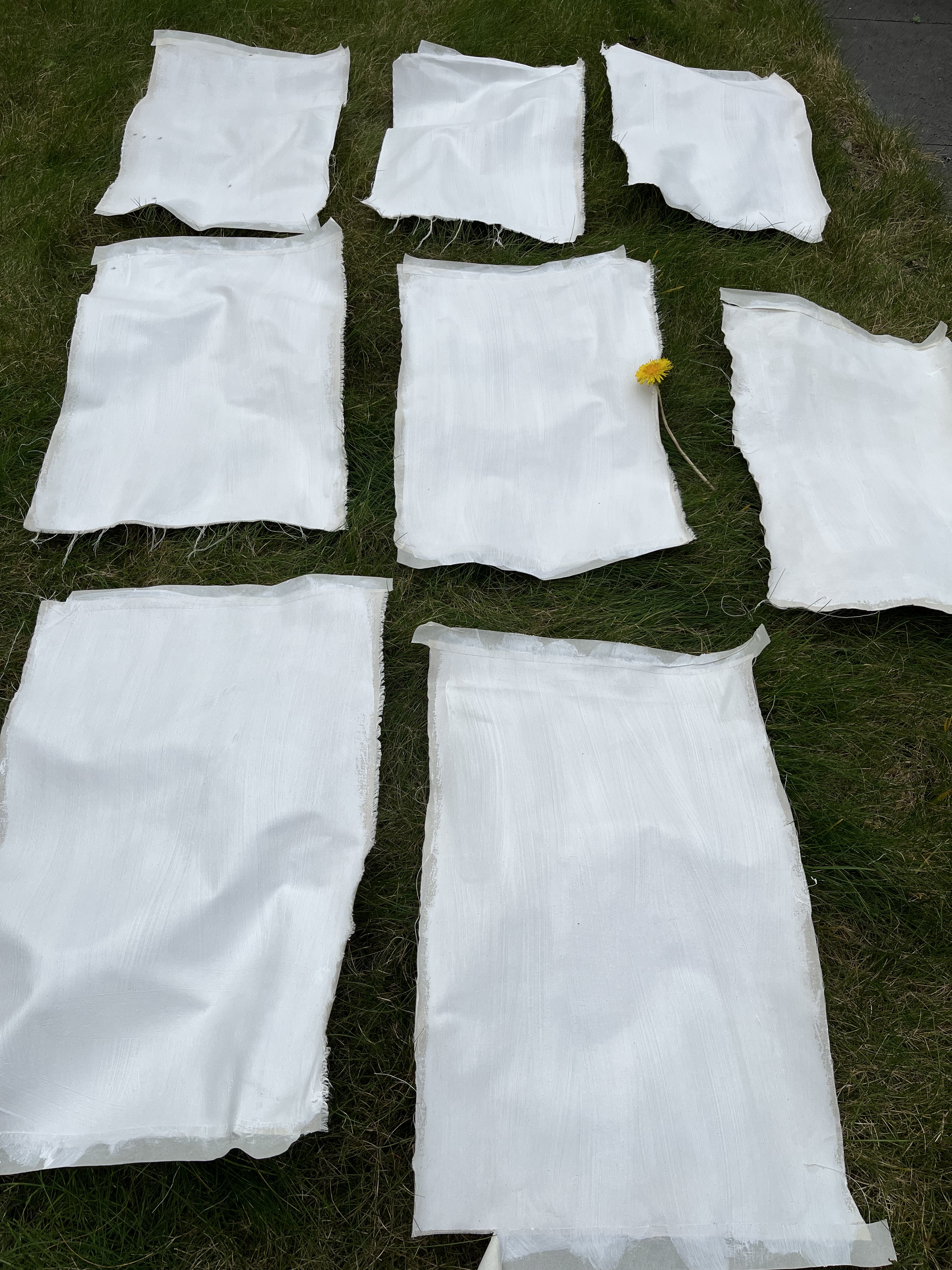
For tomorrow’s workshop with LIMBO, I thought of making use of textile as a medium for storytelling. I thought of how using canvas can sometimes be confronting and how facing a blank page can freeze us instead of invite us into the act of creation. So, I went back to my one of the first dummies I made and thought of how the use of simple unbleached cotton can be so freeing. Some of my favorite pieces are in that first dummy and are made from mixing different textiles and textures and coming to a point of joyful release. The thing I love about artmaking is the conversation that takes place between the medium and materials used and the person who is engaged in the act of making. (At least, this is how it works for me.)

I love the intentional act of preparation which includes me engaging with the material first. It’s like this conversation I have for instance with this piece of cloth. Measuring them out, cutting them up, applying a layer of gesson, and laying them out to dry, had me thinking of how the participants are now part of my preparation. I may not know who shows up, I may not have spoken to them yet, but in this process of preparing they are already in my mind.

So why choose textile? Laying these pieces out on the grass to dry, I thought of Aladdin inviting Jasmin to climb onto the magic carpet and it made me think of how Jasmin might later have told this story to her descendants. Disney gives us a romantic version of the tale, but I wonder if the carpet was as intricate or as ornate as in the fairytale. It also makes me think of a princess confined in a seeming state of limbo and what it must mean to someone in that state to be invited to climb aboard a magic carpet. How did the teller of Aladdin come to this story? And what’s the real story? Is it about the genie? Is it about Aladdin? Or is it about the possibilities that unfold when we choose to climb onto the magic carpet?

This thinking lead me somehow to thinking about AI and creativity and the complex and necessary conversations that need to be had around theft of intellectual property and the indiscriminate use of it. It also had me thinking about what it means to make art and what makes art valuable to us and how the true value of art lies beyond monetary value.

All these thoughts pass through my mind as I prepare these pieces of cloth. What is useful to me as an artist? What is useful to me as a writer? What is useful to me as a person occupying a world that seems to grow more complex as time passes (or maybe I’m just getting older–haha.)

My thoughts on art and what makes something art are complicated because I tend to rebel against formal definitions. I like the idea of life as art which means an artist is someone who makes deliberate choices in the way they step out into life. The form–whether it is painting or sewing or sculpting or writing or cooking–the form is not important. What’s important is the artist’s choice to be deliberate. Perhaps I am making something for tomorrow, but I am present in this moment deliberately thinking on what I am making. It doesn’t matter what medium one uses, it is the deliberate action that goes into choosing that medium that differentiates the artist from the machine.

Thinking on this brings me to thinking about care which was presented to us by my LIMBO partner, Lana Jelenjev. An artist approaches and deliberates with care. Can a machine duplicate that approach and that care? Can another artist reproduce the same deliberation and care to the letter?

It’s a lot of thinking through. It’s all mulch and fertiliser for future work and clearly I still have lots of thinking to do. So, I decide to focus on the now and what I am preparing for.

I go back to the magic carpet and I think of how vehicles like the magic carpet are useful for people who may be going through periods of uncertainty. The magic carpet is an invitation to leave behind what binds you and keeps you from moving forward. It is an invitation to discover and remember and from that discovery and that remembering, create and hopefully in doing so, find your strength.

To you who reads this, go find your magic carpet. Climb aboard and discover for yourself where it takes you.

Blessings and peace. Agyamanac Unay.

Last Night in Rotterdam

Last night I was on a panel celebrating the launch of De Komeet. It was a lovely evening hosted by The Base Bookspace and Bosch and De Jong in the Fenix Food Factory in Rotterdam. I’m mentioning the location specifically, because when I got to the place, I was just blown away by how cool it is to find a bookshop in a Food place. I wish I’d remembered to take pictures, but Trip Advisor has cool pics of the location in case you want to get an impression of what it’s like. I love that there is this independent bookshop in a space where people meet to have a bite and I totally made an agreement with writing friends to meet up at that place and do some writing together. ( I also had some amazing oesterzwam bitterballen so I am definitely going back for that too.)

She may not read it, but I want to send a shout-out to Lianne from The Base Bookspace for an amazing job as moderator. I think the space itself contributed a lot to that feeling of warmth and energy and safety. On panel were Vamba Sharif and Martijn Lindeboom who were both editors and contributors to the anthology, Shiantie Singh, Weegbree, and myself. We discussed SFF, what editors Vamba Sharif and Martijn Lindeboom hoped to achieve with this anthology, and also what our experience and hopes were as contributors to this anthology. My dream, as I shared it with those who’d come to the panel, was that we would in the future see a blurring of borders between genres so we move away from thinking in terms of labels.

I now find myself reflecting on how labels are more harmful than we think they are and how wanting to put labels on creative work is an outward expression of humanity’s need to be in control. We can’t always label or control creative expression, and this is why work that moves out of the expected or work that refuses to conform or submit to a particular label can be viewed by some as threatening. There’s a lot to unpack around how the fear of losing control and our discomfort with not being able to predict or control an outcome contributes to the increased polarisation we see in today’s society, but there are a lot of folks way smarter than I am who can do that. My job as a creative person engaging in different forms of art making and creation is simply to tell the story of how refusing to be bound to labels frees us to discover what’s truly joyful, what is truly kind, what it is that heals us where it matters the most and what can give us hope when the world brings hard things our way.

In the meantime, I have resumed writing again (thanks to my precious friend, Marielle). I admit that at one point I told her, I probably won’t write ever again because my sff brain seems to have gone with the chemo. But Marielle just kept on speaking out her hope that I would pick up the writing again and so I am writing again and Marielle is keeping me honest and writing. She may or may not read this blog as she’s pretty analogue, but I just wanted to put this out there.

I want to say thank you to the lovely people who showed up for the book panel. I may show up at a future panel for De Komeet, it all depends on proximity and energy. But in the meantime, I will try to update this blog as much as I can with thoughts on writing, art, reading and life.

Blessings and peace to all who read. Agyamanac Unay for reading.

workshop prep

Saturday will be the third and final session for the first iteration of the Invitation to Dreaming series. I am in the midst of preparing what’s called a draaiboek for Saturday. This is a useful tool that I highly recommend for people planning workshops. Basically, what I’ve done is create two different scripts for the day. One that’s detailed and one that’s bare bones. The barebones script is an approximate time schedule with lunch and breaks figured out while the detailed script includes notes and reminders to myself with highlighted notes on what it is that I want participants to take away with them. I’ve also written out my lesson plan so that I hear the words I want to say in my head. They may undergo transformation in the telling as I don’t do the workshop with a script in my hand, but the gist of it remains the same.

For this final day, I want participants to reflect on how the exercises we’ve used during the first two sessions are useful when we think of planning out a longer work and working over a longer period of time on a particular project.

Because not all of my participants may end up embracing a writing project, I want to emphasize that while they might not think of story making in terms of publishing professionally, they can also think of writing or creating and sharing stories as a form of legacy related to their journey as BIPOC and as members of a migrant community. We can never underestimate how valuable such sharings are for the younger generation or for the generations that follow. I am still very grateful that my Dad wrote lengthy letters to his children and that he decided to try and write a little about his personal history before he died. Knowing that I have that record that I can look back on now that he’s no longer here gives me this feeling of still being connected.

I have participants who are very interested in embracing writing or storytelling in some form. Some might want to embrace doing roleplay or theater type performances together, while others may go on to write their memoirs or continue to explore other kinds of fiction writing and that’s definitely something I want to encourage. These different types of making are beautiful and magical and transformative in power.

I feel very privileged indeed to be witnessing such flowerings and also to hear people say that they’d never imagined that writing a story was a possibility for them (even if they’d always wanted to)–well, that’s the reason why I felt and do feel it’s important to bring this workshop to communities.

During the communal worldbuilding exercise, one of the women said that it was hard to imagine in a science fiction way and that it was hard for them to envision a future world without thinking of politics. (Imagine me doing mental squee.) And then, this woman went on to share a story that was so damned good, I was like: what do you mean you can’t write science fiction?

In its naked self, story is about writing, sharing, telling what you see, what you envision and what it means to you. And the best stories are the ones that come from that place of feeling safe enough to be vulnerable. I have heard so much joy and laughter among the participants during the first two sessions and I want to continue to remind them that this is the joy you hang onto when you’re in that space facing your story.

I know there are many other things that go into stories, but on the journey, joy is one thing we need to take along with us. Hope, joy, and love, and also community.

Day Two

It’s the end of the second day of the workshop series. I’m thankful that we’ll have a few days before the third and final session as these two days have been quite intense. We had a number of new participants join the workshop today and so I had to think a bit on how to introduce them into the workshop without making the session feel repetitive for participants who’d attended yesterday.

Here’s what I learned: given a space where people feel safe and accepted, they will share amazing stories. By creating a safe space for others to tell their stories, I’ve created a space that feels safe and warm and loving for myself and created a space to which participants tell me they want to return to.

Removing the mystery around story creation and throwing out the myth of talent or giftedness opens the door for those who’ve felt uncertain about writing or telling their stories. The realisation that story can be as simple as taking a walk around the block and noticing things and talking about them is enough to free participants from uncertainty and the fear of even attempting story.

At the heart of today’s session was a moment of history making. I’d prepared a science fictional scenario. In it, I asked participants to create a history of that future world from the perspective of five groups of people who are often overlooked. It was a risky exercise since I was asking participants who had never engaged with science fiction before, to imagine or envision in a science fictional way. But just as yesterday, the workshop participants blew me away.

Next week, we’ll be holding the final session of this workshop series. I know I am being ambitious yet again. Who in their right mind gives fledgling writers and storytellers only 30 minutes to build a world and create a story?

The thing is…when you tell people to just have fun, they will take you at your word. There will be laughter, there will be lots of chatter, but in the end, they will blow your socks off and to me, that’s just magic.

It’s finally happening

I sit here on the eve before the first day of a workshop series I’ve been working on for quite some time. Thanks to the WereldMuseum Rotterdam and to Dona Daria, the workshop I’ve been dreaming of will finally become a reality. Tomorrow, will be the first day of a three-day workshop for BIPOC participants in Rotterdam and I am looking forward to it with anticipation.

In preparing the final schedule for the workshop days, I’ve had to refine and narrow down exercises. Creating exercises that will be doable for participants who are a mix of people who might have done some writing before and people who have always thought of creating stories as being something not for them for innumerable reasons, has been a challenge. And I am really thankful for my partner, Hodan, who’s given me such great feedback and encouragement throughout the process of putting the workshop and the schedule together.

I still don’t know what the class will look like exactly, but the programme includes a mix of individual and communal work, and a mix of spoken, written and visually expressed work. I’ve used different elements of this workshop in different environments with different groups and now I’m eager to see what will happen when these elements are used and applied together over the span of three days. Perhaps the most challenging aspect of this workshop is the multi-lingual aspect, but I will cross that bridge when I get to it.

Most important to me is to let the participants experience how much fun it can be to engage with story on their own terms. That is what I’m keeping in mind as I wind down for the night.

I just had to quickly write about it because it’s finally happening.

Oh yes. We will have fun.