how it’s going

I’ve been going to physical therapy with a group of oncology patients for a couple of weeks now and have noticed that while mornings are often much better in terms of energy, afternoons are now improving. I’m not as tired as I was during the first afternoon training. I take this to be a good sign.

Upon my return home from Gladstones, the eldest son told me that I could transform his former bedroom into a writing space. Something I hadn’t even thought of doing because it was always his room, a lot of his things are still in it, and perhaps it’s that mother thought in my head that held the space for him just in case. But, as I was reminded, it’s been a year since he moved out. Birds spread their wings, they leave the nest, and go discover the sky.

So finally, after more than twenty years of writing at the dining table and having to move my mess when it’s time to eat, I have this space where the books I am reading can be left as they are. Where my pens and pencils don’t have to be tidied up and where when I am done for the day, I can close the door and let the projects I’m working on percolate.

I can’t help but think again about Virginia Woolf talking about a room of our own and how women who write need this kind of space.

Before I went to Wales, I downloaded a book by Joanna Penn. In the past, I’ve read books on writing that made me go: Oh, that’s nice. But it doesn’t work for me. Joanna Penn’s “How to Write A Novel” is perhaps the first book on novel writing that’s made me stop and say: I recognize that. For one, Joanna Penn calls herself a discovery writer. She talks about how overwhelming the process of writing a novel can be when you’re like her(like me). It was like a letter from a friend saying: look, I get it. Now tell me why you’re not finishing that novel. For me the greatest thing was a sense of overwhelm. I’d get bogged down in the details and before I knew it, I was lost. (I have a bunch of novels with great beginnings where the middles and ends are all squashed together because I got caught in a tide of overwhelm and couldn’t see where things were going anymore.)

But here I am. It is the beginning of the week. I have returned from my therapy class feeling energized and thinking: you know, you’ve come this far. Look at the horizon. Can you see where this story is going? Can you see how it’s going to end? Can you see what the story is about? Coming on close to 50,000 words, it’s really getting there. (Alarming thought.)

I think of how my sister would tell me to write whatever I wanted to write and to never give up. If my sister were still here, this is the novel I would give her. I would tell her, this is the novel I wrote because of all the conversations we’ve had and which we continue to have in my head. There are moments I just wish I could turn to her and say: what do you think about this?

What’s kept me from finishing novels in the past? At the heart of it has always been fear. Fear I wouldn’t have the right words. Fear I wasn’t up to the task. Fear I would screw up.

It’s funny how my sister’s legacy continues in the words she used to speak to me. My youngest son has had some difficult moments at school (understandable in the light of everything) but I’ve said these words my sister used to say to me: “It’s your dream, do something about it.”

Since I got this room, I’ve been coming up everyday to write words because when we see each other again, my sister will probably ask me what I did about my dreams and I don’t want to say that I was too scared or too overwhelmed to do something about it.

Blessings and peace to you who read this. Agyamanac Unay for stopping by.
At work in Gladstones

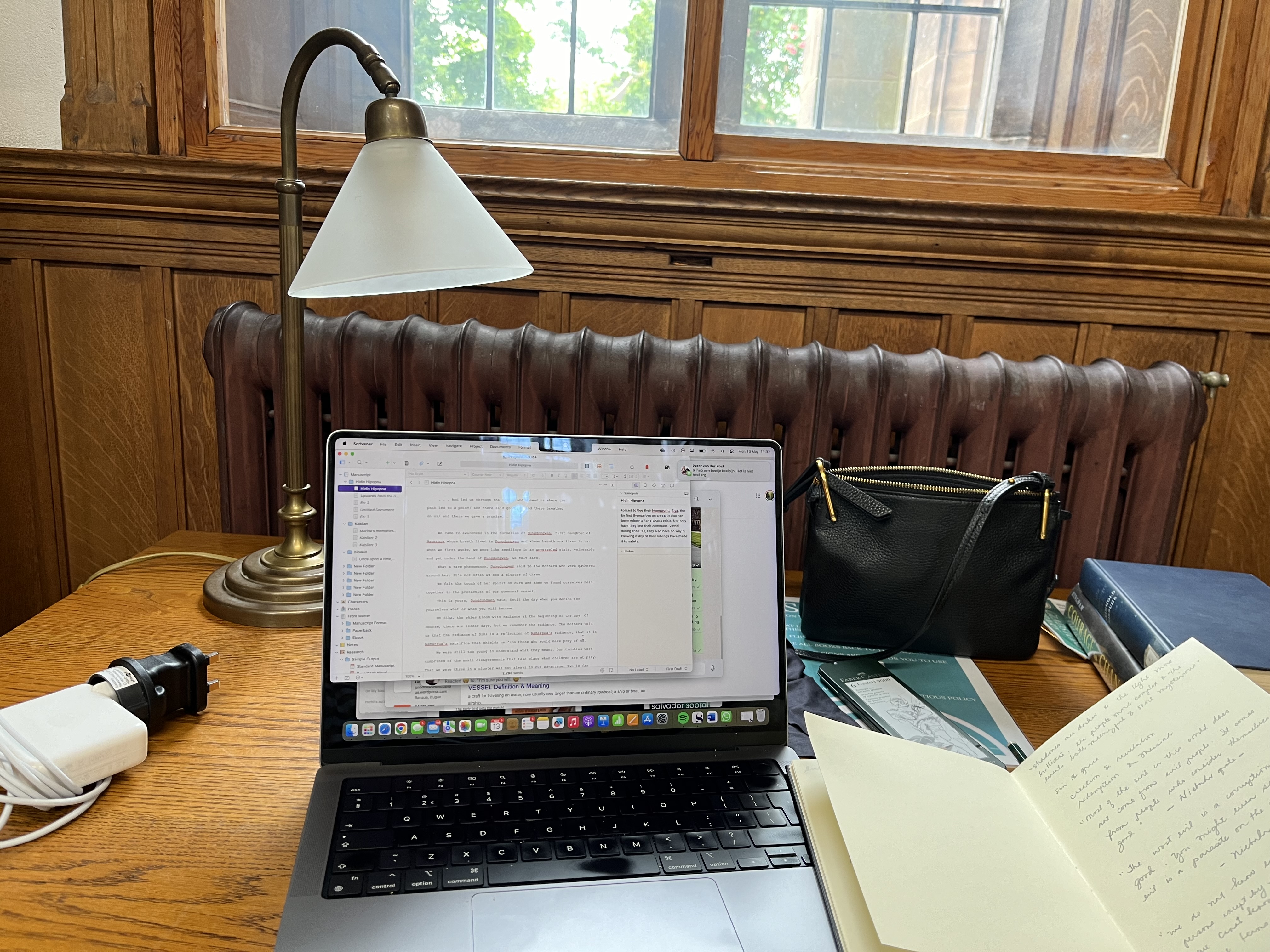
Here I am in Gladstones Library in Wales for a week of writing at the Milford Writer’s Writing Retreat. It has been a while since I’ve done something like this and I had quite forgotten just how enervating taking time out to write can be. It’s more than carving out time during the regular day, but just being here among so many books with other writers and just focusing on the work of writing has proven to be quite helpful in my process.

Before the diagnosis in 2022, I had been working on a couple of projects which I quite forgot all throughout treatment, so finding them again early in 2024 made me realise that I actually still liked these projects and they were stories that deserved to be finished. But coming to the Milford week, I was still torn on which project to work on.

In the end, I found myself drawn quite strongly to what I call the En story. I had been avoiding finishing it because the scale felt just so large. I realised that I have to acknowledge that it really is a novel. Not a novella, not a long short story, but a novel. It also means that writing in Gladstones works perfectly. I am in the process of putting together all the bits and pieces which I feel belong in this work and there it was staring me in the face…climate change. And what joy to be able to look through the library catalogue, head to the stacks, take all the books you think will be helpful and find exactly what you need for the huge thing you have been terrified about. It also helps a lot that one of my writer friends is a geophysicist and so I could send her a message saying: “uh…I have a question, help”.

It’s interesting to me too that the desk I’m seated at right now is located between two stacks of philosophers.

There is something about the moment and place of creation and how tapping into the source will bring you to the places/people/sources that you need in order to keep moving.

Working on the En story, I understand what it is about this work that terrified me. Now that I have the proper focus, I see how the world has always been comprised of opposing forces. Forces at a constant push and pull and forces that threaten to overwhelm each other. There is the nature that uses up worlds without thought or without care. It’s the kind of nature that discards without thought because when something is used up, there will always be another to take its place. It is the assumption born of privilege. There is another nature at place here too. It’s the nature of lifegiving and restoration and nurturing. Because the second nature is not brutal in nature, it’s often trampled on or made little of. But without the second nature, what would happen to our earth? What would happen to humankind? There is another nature somewhere in there and this is one wherein I hope balance takes place. I am working on it and my head is constantly busy with it.

A little while ago, I had a conversation with one of my Dutch friends. We talked about the balance between the realm of the spirit and the real world and how it’s easy to get caught up and lost in the spiritual, but we need to remember that we are also here in the real. It is the same with writing. My first drafts tend to be vague and starry eyed and not too grounded…more floaty and slippery than solid.

I started writing again in 2024 and it feels to me like I am learning all these things all over again. But what a joy to be able to do so. To be able to write and tell the stories I want to tell. Isn’t that a blessing?

Blessings and peace to you who read this. Agyamanac Unay for stopping by.
Reflecting on what was and what is now

Today, I think of my father standing in the only hospital in Banaue, right after an armed conflict between the government forces and the NPA. (This incident took place during the martial law period when my dad was the only doctor in the mountains.) I think of him being made to choose: Doctor, if you treat one of theirs, we will shoot you. And my father, who was the only doctor in the mountains at that time said to these men: I don’t see government military or NPA, all I see are wounded in need of care. You can shoot me, if you want, but who will take care of your wounded?

And he took care of all the wounded, and in that space of time when he was taking care of their wounded, while they were waiting for him to do his work, the hospital compound became neutral ground.

We are grieving. We grieve for the ones who suffer the consequences of war. We grieve for those who are lost, for those who suffer, for those who have lost. We grieve for what is broken. We grieve for the innocent and for the loss of innocence. We grieve for the brokenness that is in the world.

I think of these things as I prepare for LIMBO, and I think of how we keep spaces safe and how we hold space for those who are vulnerable and need this space. I don’t have much power but I have now and I can ask: What do you need now? What do you need today? How can I help or facilitate or support in such a way that this need is met in this moment that I am with you?

From this point of beginning, I can think in possibilities. I think of mapping the world we dream about, of making visible what is strong and resilient and hopeful and beautiful inside each one of us. I think of how, in a world where conflict has become the norm, liminal spaces are necessary spaces.

Of course, we knew that when they left the hospital, some of my father’s patients continued on with their conflict. We heard their guns in the distance and we knew there were places where it was not safe. But for a moment, when they were in the hospital compound, there was peace.

I want to walk in my father’s footsteps. To say: I am here to serve. If you leave this space feeling stronger, feeling more hopeful, feeling a little more able to face what life throws at you, feeling more connected than disconnected, then that’s good enough for me. I wish I had the power to right all the wrongs in the world, to heal the pains and the illnesses, to bind up what is broken. I don’t have that power, but I can say: I am here in this now. I am also here for you.

This post is more of a personal reflection than one that offers solutions. Because all things in life are connected, because art and life flow seamlessly into and through one another, it becomes inevitable that this too makes its way into my own work.

May lovingkindness surround you and may peace be with you who read these words.

*Having written this, I am thinking of how my father’s stance was an act of resistance. In choosing not to take a side but to address the problem, he opened a path to neutral ground.

Titles are a challenge

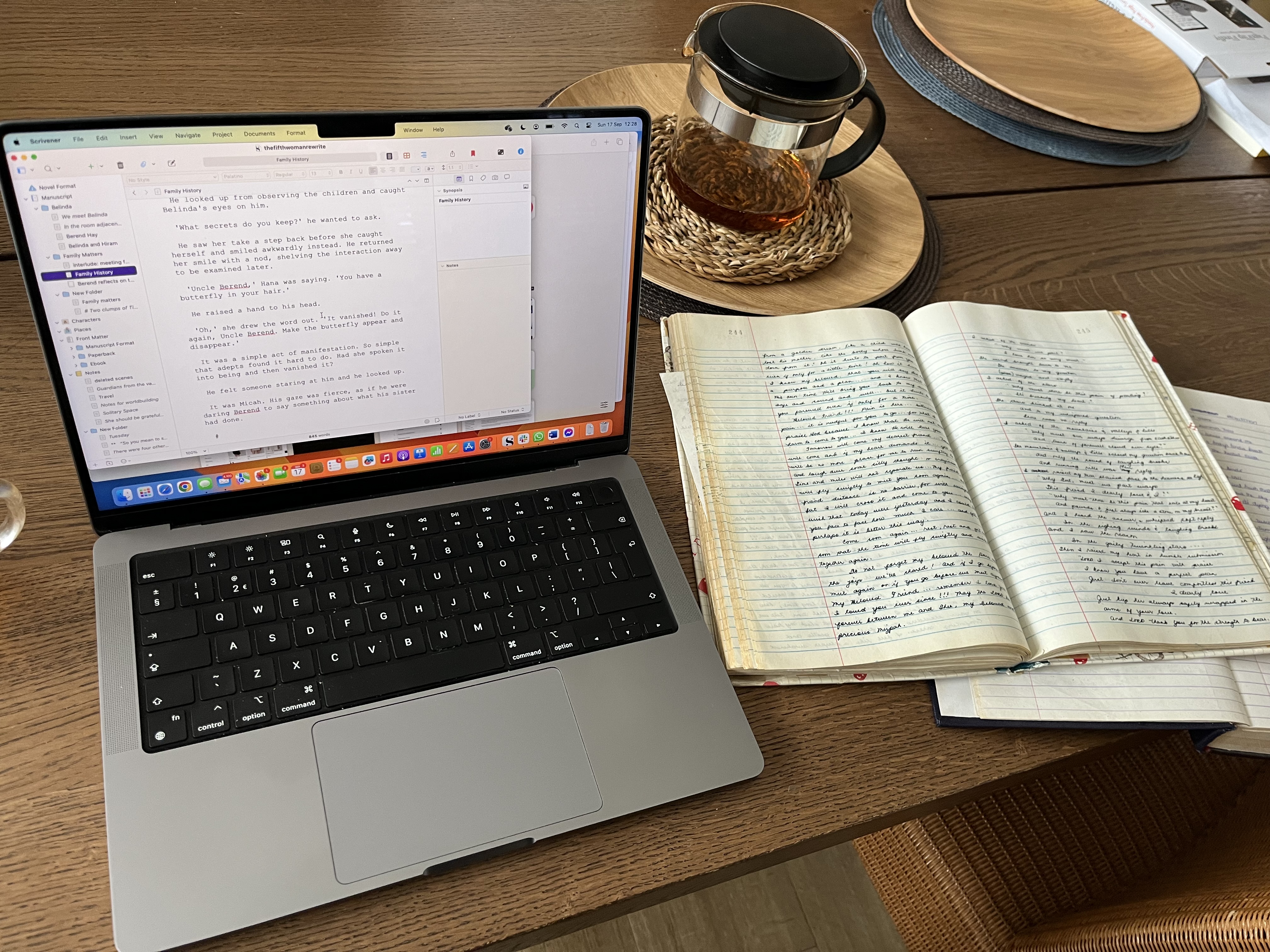
Titles are not my strong point. I am currently working on the second draft of a novel titled The Fifth Woman. Don’t ask me why…it probably just felt cool at that time or maybe I was just like: whatever. Let’s just call it this as a sort of jumpstart. So far, I haven’t found anything in the draft that talks about a fifth woman. It’s a pretty amazing feeling though to have been writing consistently everyday for the past two months as prior to that time, my brain often felt like a jumble of words and there was not enough quiet to properly focus on fiction. To my surprise, I have passed 15k on second draft and it looks like it’s still going.

Before I found The Fifth Woman, I had been writing away at The Cartographer novel which I’ve left stranded at 85k because the world was getting so big and unwieldy I had to step back from its noise for a bit.

Finding The Fifth Woman (first draft from end of 2021 before cancer struck) was like finding a gift because there was enough distance for me to appreciate and see where I’d gone off the rails with it ( characters with names like ‘this person’s dad’ and lazy shorthand place names ‘let’s just call this place wherever’ and I’ll call this form of transport something unpronounceable). Clearly, I was just in a rush to finish first draft. When I read it for the first time after regaining my focus, I thought it was someone else’s work, until I got to some place names and memory hit me…oh right. I wrote this while doing the Munabol online workshop for BIPOC kids. And then…Oh. This thing is long. It’s super-long. What is it? Is it a novel? Is it finished? (Yes. It was indeed a first draft clocked in at a little above 65k.) That was two weeks ago.

My current writing speed is an average of 1000 words a day (sometimes 1500), but at the end of a writing session my brain refuses to focus and I just want to go watch Formula one or something mindless for a while. (I have become quite the Formula One and bike racing addict. Tour de France, the Giro, Vuelta, and then there are the classics. Cobblestones! I can hardly watch but I still do anyway.)

I’ve noticed that there is a lot of messiness in my head the closer I get to the appointments for my bloodtest and immunotherapy. As I said to people closest to me, it’s quite weird because it doesn’t hurt, but I have an increasing aversion to being stuck with needles. It melts away once the bloodtest and immunotherapy week have passed and for most of the time I forget that I am under treatment. My oncologist tells me we are on this road for two more years and then we’ll see. It’s an interesting space to be in because no one really knows and I think that’s okay.

Just a little while ago, I bumped into an acquaintance who I hadn’t seen in a long while. Upon hearing about my diagnosis and about all the treatment things, she went: But you’re too young… (I won’t insert what was implied here because it took me aback). It’s one of those really odd responses that makes me want to laugh out loud. I know it’s well-intentioned and well-meant, but I remind people that I am not dead and I have no intention of dying anytime soon. I am completely in the land of the living and I believe I’ll still be here for as long as I am meant to be here. It’s the thought that comes to me when anxiety strikes: Peace. I remind myself. As my mother said to me at the start: you go ask God what he wants to do with you because until He’s done with you, you’re not done doing.

My mother, a cancer survivor, was diagnosed with metastasised cancer when she was 46. It had spread to her bones and she was given one year to live. Today, she’s 85. She laughs talking about it: ‘Actually,’ she says. ‘I decided I wouldn’t die because I didn’t want your Dad marrying someone else.’

There’s this thing about coming face to face with mortality. You come to understand what it means to be alive. I think about one of the participants to the workshop saying: this is my now.

It’s a pretty radical thing to say and to do. To be present in the now. To rest in this moment. To give as well as to take pleasure, to share in what is funny, what makes you laugh, what makes you cry, what warms your heart, what melts you–to choose to be here in now is such a powerful and radical act because it is the essence of being alive.

It’s easy to get pulled into the rat race. To think: I’ll make time for what matters and what makes me happy when I have more time. Time is an ephemera. It’s an illusion we create for ourselves. Time that matters is now. What am I doing now? How am I being present now? What am I sharing of myself now? What kind of memories and legacies am I putting in place now? It’s in this now moment that we are doing and creating and making and establishing connections and as I said to someone precious to me: humans and relationships are more important than things. Wealth, status and possessions you can replace. Connections, relationships and humans you cannot.

Perhaps it’s why I’ve become so invested in The Fifth Woman. Because it’s a messy novel about messy relationships. It’s about the now space versus the could be space. It’s about family and relationships and all the pressures that are exerted upon that precious space of simply being. It could be fantasy, but it could also be science fiction. I really do not know. I’m just writing it. In the now.

Blessings and Peace and Agyamanac Unay for reading.

Starfish, trees and time

A lot of recent conversations have had me thinking a lot about time and about how the way we experience time is not the same for everyone. For instance, time for trees move quite slowly whereas time for humans moves very quickly.

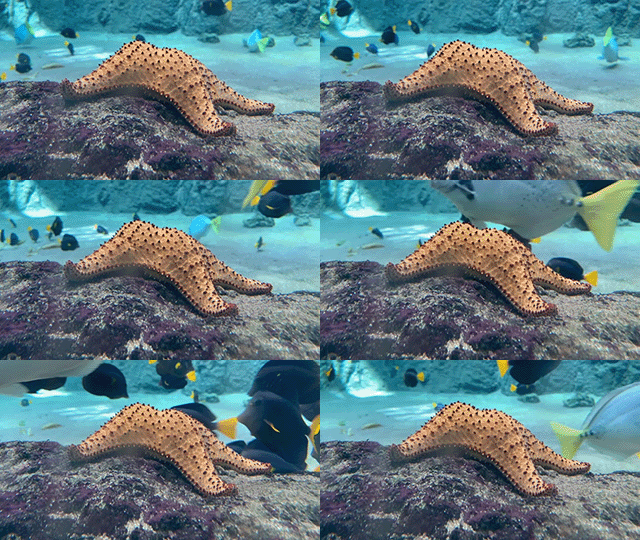
I thought of sharing a gif of this time lapse clip of a starfish with fish as it expresses my thoughts on the difference in the how we experience time.

The starfish doesn’t seem to move when viewed in real time, but on the time lapse clip, the slow and small movements come into view while all around, fish dart about in quick motion.

I was talking about this today with my eldest son. About how time moves differently for everyone and how while we might like to think of time as moving at the same speed for everyone, it’s not like that for all beings. Perhaps, just as with the starfish gif, some of us may already be in the future while some of us are still sitting in the past or deliberating in the present. (This is of course very science fiction but I still want to hold that thought as I figure out stuff for the piece I’m working on.)

Basically, what I wanted to say was how while we are in the moment of living our lives, comparing ourselves to others is useless. Comparing our trajectory to another person’s trajectory isn’t productive or fruitful because time moves differently for everyone. As I said to my son, what’s important is to think about what you’re doing in this moment. Are you taking care of yourself? Are you nurturing your connections? Are you creating space for others? Are you thinking of what you are doing now in this moment?

Ultimately, our lives are our most important work of art. Whatever speed we move at is not as important as how we move in it.

Here’s an excerpt from the current work in progress:

“You’ll see,” Una said when Mahari had drawn closer. “Time unfolds differently for everyone, Mahari. You should understand this by now. After all, Iranira’s work called to you. You’re not here by accident but by design.”

“I don’t know about that,” Mahari said. “I’m not as gifted as you are.”

Una made a clacking sound and Mahari realised that the other cepha was laughing.

“What?” Mahari said. “You’ve got this amazing ability that no one else has. How am I supposed to compete?”

Una emitted more bubbles, the pattern on their skin shifting and changing as they gave themself over to amusement.

Mahari stopped and stared at the unusual sight. Like this Una was attractive. They were no longer plain skinned. Whorls of light seemed to ebb and flow all over their body.

“You children,” Una said when their composure was restored. “Oh, you children. It’s always the same with you youngsters. When will you understand that it’s not a competition?”

To you who are on the journey, never be afraid to dream.

( edited to add credits for the gif which was created by and belongs to Peter van der Post. Used with permission. )

writing progress

Funny how the brain works. Maybe it’s because I put away the first draft of Waypoints during a dark period–maybe it’s because I decided that writing wasn’t working at all, but I had this idea that I had never gotten around to finishing first draft on it. So, I was quite surprised when I opened scrivener to find that I had indeed managed to finish first draft on that novel. True, it wasn’t a clean first draft; true, it was filled with open and close parenthesis that looked like this: (fill this information in later on) and (what does this person want anyway and why is this character here? Justify that.); but, it was a first draft.

I know it needs quite a bit of work before I can even show it to anyone else, so I’ve decided to discipline myself and focus on working on this story for at least a couple of hours each day for the duration of the stay at home rule.

When I started working on Waypoints, I had no clear plan of where I wanted this story to go. What I had was an image and an idea and a very strong feeling. I followed those things and just put words on the page without stopping to consider whether each event was helping the story or moving the story forward or doing anything useful in the story.

At one of the first workshop meetings, I told my students that when we write, what we put on the page must serve the purpose of the story we want to tell.  I find it amusing to discover that these were the exact words I needed to hear as well because I quite forgot about that point while writing the first draft for Waypoints. I was just indulging myself and having fun.

I do remember going back to visit this first draft sometime ago and feeling a sense of overwhelm. It felt like this incredible mess and I had no idea how to make sense of the mess. So I shut the file up again and shelved it.

The interesting thing about some stories is how they will nag at you and refuse to let you go. You put them away determined to forget about them, but they keep coming back to haunt you. They nag and nag and remind you that you haven’t really given them their due. I have two stories on file that keep doing that to me and Waypoints is one of them.

Today, I’ve identified my main problem with this novel and why I’ve found it more challenging to organise as compared to when I make sense out of the chaos of a first draft short story. 

First of all, I have lots of characters on the page who want all kinds of different things. Second, my viewpoint keeps shifting and right now it feels like I have more than three threads vying for dominance. 

It also suffers from a thing one of my instructors pointed out to me when I was at Clarion West–I’ve tried to stuff so many things into this draft that it’s hard for the reader to identify what’s most important. (Considering how I am reading this draft after a year and having trouble identifying what’s what already says a lot.)

So today, I’m asking myself questions as I look at my draft. What do my characters want? Where do their wants coincide? Where do their wants diverge? Who has got the most lose? Who gets hurt the most? How much are they prepared to sacrifice in order to achieve their wants?

It’s small progress but I am working at this one step at a time.

Process: Fire and Life and Story

Wrote 1647 words to the wip yesterday.

Worked on that story that I let lie for a long long time.

I am sitting at my writing desk–butt in chair, eyes to the screen. I plan to write and I plan to keep on writing.

I think of conversations had with friends about the writer’s life and the act of writing. I think of stories and I think of fire and I think of how what is twisted and cold and hateful will always try to kill what is warm and passionate and alive.

Fire and life.

I think of how we come to story from many different backgrounds. Half-scared out of our skins because to write story is to bare yourself to the world. It is to make yourself vulnerable and open to possible derision, to possible shaming, to possible rejection, to possible pain. And yet, we keep doing it. Again and again and again.

While sorting through the business of paperwork and thinking through how I should go on, I told the accountant who was helping me to deal with the finance side of stuff that I was working on my first novel. She smiled and told me that it’s a rare writer who is able to make a living off of their writing. I know this. I know this very well.

Still, I write.

I write because stories are life. They remind me of hope and joy and of the passion that is so vital to life. I know what it’s like to walk in this world carrying worlds inside my body–to have that feeling of knowing a place that is beyond the space my physical self occupies.


Story is a fire. It is my job to open the door, to make the fire so inviting that the reader can’t help but come in. It is my job to make the world I carry inside me become just as real to the reader as it is to me.

There is enough killing hatred in the world. There are enough people who populate the world with killing words and killing deeds.

Words have power. (Fantasy reminds us of this.)

I write to remember that the world is filled with infinite possibilities, that there is still hope, that we have the power to change, that we can change ourselves and the world around us.

Blow fire into your story.  Keep hold of your hope. Be contagious.

Writing progress

I’ve been working slowly on the Cartographer’s World novel. I have the world so fully formed inside my head that I sometimes feel like I’m walking in that place and introducing people who populate it as well showing out the sights while I’m at it. While Siren from Song of the Body Cartographer plays a major role in this novel, there are other characters who intrigue and catch my attention with their own stories. I should probably start a character chart soon as the world and their stories come out on the bigger canvas. Writing a novel is an immersive and fun experience.

In the meantime, I’ve also been working on two different stories. One which springs from an image of a person looking out towards earth from the viewing deck of a generation ship. It’s a pretty cliched image, I know, but the possibilities that exist there…I found myself thinking of where this person came from and where this person was headed to. I also thought of possible dialogues that were running through this person’s head as the ship draws farther away from earth. This is the first time I’m attempting something like this and I’ll admit it’s a bit daunting, particularly since using the first person pov is something I’m not very good at.

I was prompted too by the thought of what happens when someone is sent into exile where the exile benefits those who are in power. It’s not an easy story to write and I rather hope it ends on a good note.

The second story that I’ve written a draft of is a bit of a fun caper. This one was inspired by a conversation I had with Tade Thompson on family coaches. I meant, the person who helps families restore structure in the family setting but somehow this morphed into something else .It’s a lot of fun and also involves some really cute animals. <g>

I haven’t talked about it on here, but I am participating in the Clarion West Write-a-thon. I’m hoping to raise at least 200 dollars for Clarion West and have promised to post a previously unpublished short story for every 50 dollars I raise. I’ve just raised my first 50 dollars, so watch this space for a free story soon. I will be sure to post about it on twitter and facebook and will also let my sponsors know that it’s up. Please do check my profile at the Clarion West website. There are lots of other fabulous authors participating, so you can take your pick of who you wish to sponsor.

Finally, I have been sitting on a bit of good news. I received an acceptance for Magnifica Angelica Superable and just sent out the signed contract this week. I had a lot of fun writing Magnifica Angelica. I think I chuckled to myself while writing most of it.

I’m working on updating and revamping the book blog, but will post more about that once things are better in place.