On Reading Kate Elliott’s The Witch Roads while travelling

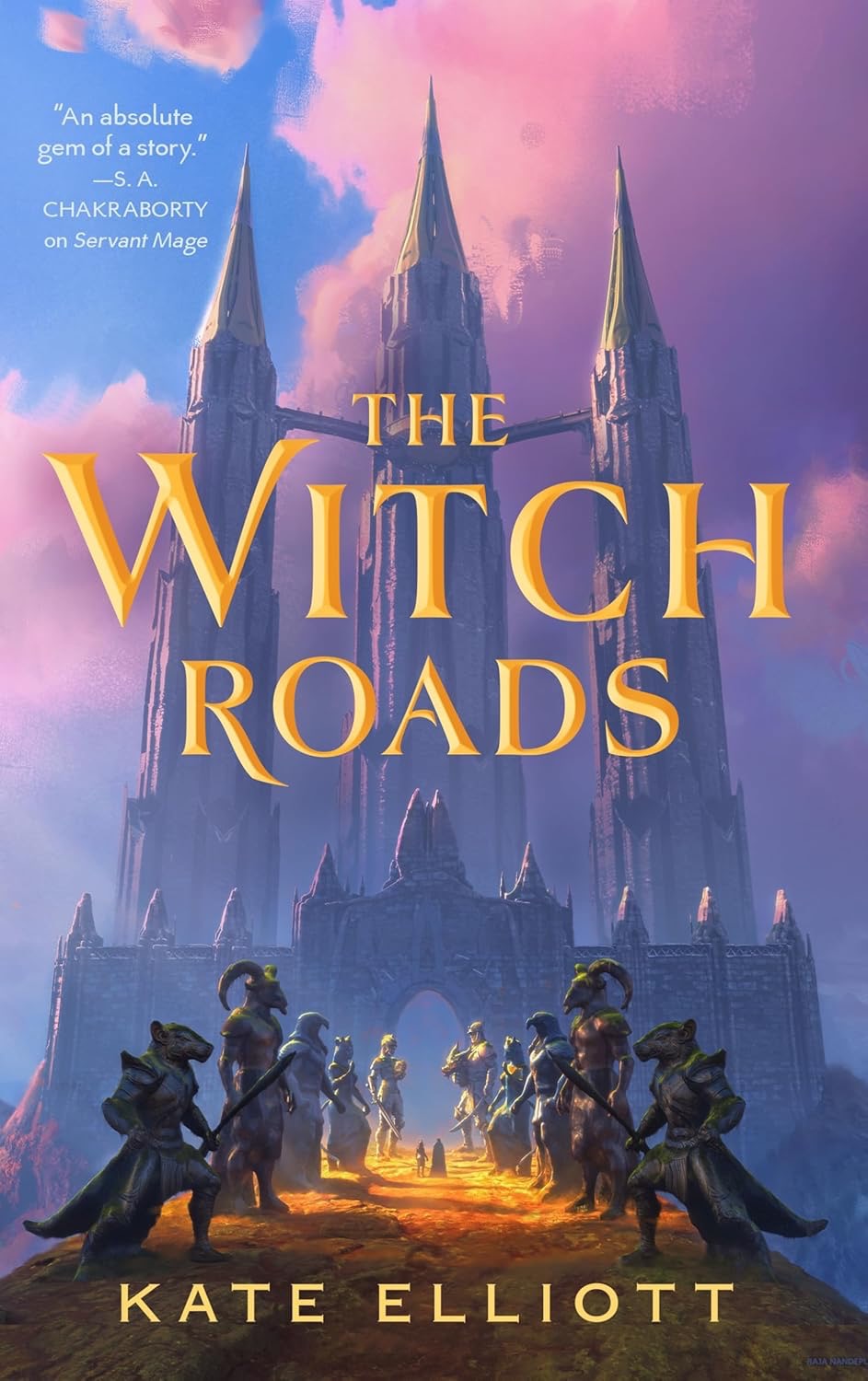
I read Kate Elliott’s The Witch Roads while travelling in Norway and I feel like this was the perfect companion book for my travels as each time I looked up at the mountains or hiked a path, I would think about Elen and her crew travelling through the lands of the Tranquil Empire. Of course, the roads we walked and the paths we hiked were not at all as rough or as challenging as say the crossing Elen and company make at Grinder’s Cut (also there is no pall in Norway). But still, it gave me a sense of satisfaction to observe how time passes when your main form of transportation are your legs. Of course, there are also carriages and horses in this book, but the pace of travel is perfectly done and also a perfect way for the reader to get to see and know this world and its perils (mind you, it’s not just all peril. There is also sense of wonder in walking through this world). I found myself quite enchanted by the pacing of this novel which wasn’t a quick read because I had so much going on that I also had to keep putting it down. I’ve had some books where I eventually give up because I have to start all over again, but this wasn’t a problem with The Witch Roads. Picking up where I’d left off wasn’t a problem with this novel. Rather, it felt like picking up the thread of a journey once again and going: Oh, yes. We did this yesterday and so we’re going onwards.

If I’m giving the impression that The Witch Roads is a tame read, let me disillusion you. The Witch Roads is far from tame. There is an imperial prince and there is a haunt. There is danger because the company must stay wary not only of possible ambush, but also they need to stay wary of spores and the pall. There is magic and there is all kinds of love, from filial love to love born of allegiance to the kind of love that transcends. There are also lots of secrets and I feel like there is even more intrigue and danger waiting in book two.

There are so many deep and speaking lines in this novel. I thought I should post some of them, but I’m just gonna say: go read the book and highlight your favourites.

The Witch Roads is not just Elen’s journey or the haunt’s journey or the Prince’s journey, it’s also Kem’s journey and there’s something so beautiful about how Kate Elliott weaves all these things together and by the time I reach the end of this novel, I find myself thinking again about the question of who is the centre and where is the centre and from whose perspective narratives take place and it’s beautiful how Kate Elliott reveals the ways in which this journey has changed the different characters in different ways. Bringing them to places where they understand theirselves and those around them better.

Yesterday, I was at the Bryggen’s Museum, observing tapestries made by the tapestry artist Ragna Breivik (currently on exhibit at the museum). While observing the loom on which she worked and thinking about all the different threads and shadings and the amount of detail and work that went into making tapestries that continue to speak to this day, I thought of the way Kate Elliott’s work does this kind of tapestry making with her words where all the little threads come seamlessly together forming a story with different shades of meaning and texture.

The Witch Roads gives us a world that’s rich and full. Complex characters, each with their own path and their own priorities. We get the narratives around inequalities and the different relations that exist between different strata in society within the world but these are done not in an intrusive or shouty way. Thread by thread, shade by shade, with intention, Kate Elliott gives us this world that is rich and full peopled by complex characters who we can identify with and love.

For all that this first book ends with a foreshadowing of what might come in book two, book one leaves me feeling satisfied. I’m a bit impatient to know what happens next (of course), but there’s a lot to reflect on and think on about the first book and I’m very happy about making the choice to pick up this novel and read it (even though I tend to try and not read unfinished series).

On the dedication page, Kate Elliott writes about how The Witch Roads duology reignited her love for writing during a rough period when she wondered if she should just quit. I am so thankful she decided to keep on writing and I hope she will continue to do so because the world is a better place for having her books in it.

The Witch Roads is published by Tor Publishing Group.

Important note: I purchased my own copy of this novel, as I have done with most books that I write about. Reviews or thoughts on these books appear as time and energy permit.

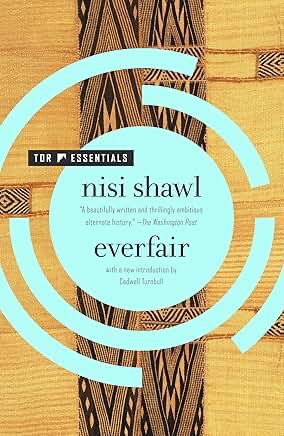
Some thoughts on Nisi Shawl’s Everfair

If you’ve taken the time to come visit my blog, it must mean that you enjoy discovering new works and reading almost as much as I do. Nisi Shawl’s Everfair was published in 2016, but at that time I was going through some challenging stuff. I made a note of it and somewhere along the timeline, I bought the e-book. But as happens in life, it took me until this year to get around to reading it. I’ve since found out that there is a book 0.5. and other books as well. It probably means there are things that have happened before this book that I might not be aware of, but it doesn’t take away from the joy of reading volume one.

What to say beyond simply saying: buy this book or read this book?

I want to say that Everfair is not an easy read. It’s not the kind of book that you just breeze through. It’s also not a lighthearted summer read. It’s the kind of novel that takes you on a journey–a journey that happens in a timeline that’s historically different from ours. Along the way, you decide to make notes. You might put the book down for a while, to take a breath of air, but then it calls you back and you keep on reading. It’s the kind of book where you look up from its pages and scan the clouds because there might be air canoes floating up there. The attention to detail is amazing.

In the beginning, it took me a while to sort out the personages. I tend to be a bit forgetful, but Nisi does a great job of reminding us who this character is and where we first met them. I found it pretty intriguing to witness the transformation Thomas undergoes (for instance). And I like how things are not always explained.

One of the joys of this novel is how Nisi Shawl gives us characters we can root and feel for. Characters we care about and it is those characters who we travel with and through whose eyes we see the world as it changes and evolves. It’s interesting to think about how Nisi Shawl makes use of riding cats (for instance) because in a manner of speaking we are riding the novel as we discover and learn more about Everfair. The politics of the Mote was interesting to me as well as the politics and the power struggles that take place inside and outside of Everfair. There is spionage and adventure enough to thrill the heart of anyone who loves spy novels. Relationships are never simple even personal relationships. I love how Nisi brings nuance to all these things. I found myself thinking on where and how I would draw a line where relationships are concerned. (I’m not gonna spoiler but you will find out when you read the book.)

Afterwards, I found myself still thinking on the questions around loyalties, allegiances, friendships and relationships. What makes us loyal to places and people? How do we determine loyalties? What about the dynamics that exist in friendships? And is it possible to have real friendship when there is a power imbalance? Those sorts of questions rise to mind when I think about Everfair.

Everfair would not be Everfair if it didn’t acknowledge the historical conflicts that took place in and around the Congo of our timeline. The conflict first with the Belgians, then with countries interested in what can be mined or taken from the Congo, and then the war that breaks out when King Mwende makes this decree where all who are foreigners must leave and return to their own countries. (How different would the world have been if the Belgians had been defeated in their mission to colonise the Congo?)

Everfair also speaks to ongoing discussions in the real world where the line “go back to your own country” has become a go to phrase when someone says something we don’t agree with. And while my kneejerk reaction was the same as King Mwende and I was like: ‘yes, go back to your own country.’ Nisi Shawl asks us: what do we really mean by that? What does it mean to be of a country? And how do we determine that?

I love how King Mwende with the help of Queen Josina (one of my favorite characters) realises that saying “leave and go back to your own country” is not the solution and that war is waste–primarily a waste of human life.

Nisi Shawl creates this world that isn’t utopian even though it starts with a utopian dream from those who first founded of Everfair. I like how Nisi doesn’t back down from knotty problems that occur when you’re trying to build a nation that’s home to and for everyone regardless of race, regardless of creed. It takes a while (for example) for one of the characters (Daisy) to come face to face with her own prejudices, her privilege and assumptions.

I’ve sometimes read books with relationships that feel forced, as if the author doesn’t understand how queer relationships or mixed race relationships work, but just wants to include them. Nisi does such a beautiful job at showing us not just how these relationships unfold but also how there is a lot of work that goes into making such relationships successful. Nisi doesn’t take a shortcut or take the easy way out. Yes, these relationships are complex, but Nisi also gives us joy.

Reader, I’m pretty sure that if you wanted me to tell you about historical things and what genre this novel might belong to, you would just head over to Amazon.com or google for one of the many reviews far more in-depth than this. I thought I would write this as if I were writing a letter to my sister who also loved reading books like these. I wish she could have read Everfair along with me.

If you enjoyed reading this topsy-turvy response to Nisi Shawl’s Everfair, I hope you’ll consider helping me reach 100% of my Clarion West Writeathon goal. There’s a button on the top right of this page that will lead you to my page.

Thank you for reading. And may joy accompany you on the journey.

On reading Maria Dermout’s Tien Duizend Dingen

There is a house on an island and there is a garden around the house and in that garden are the graves of three little girls.

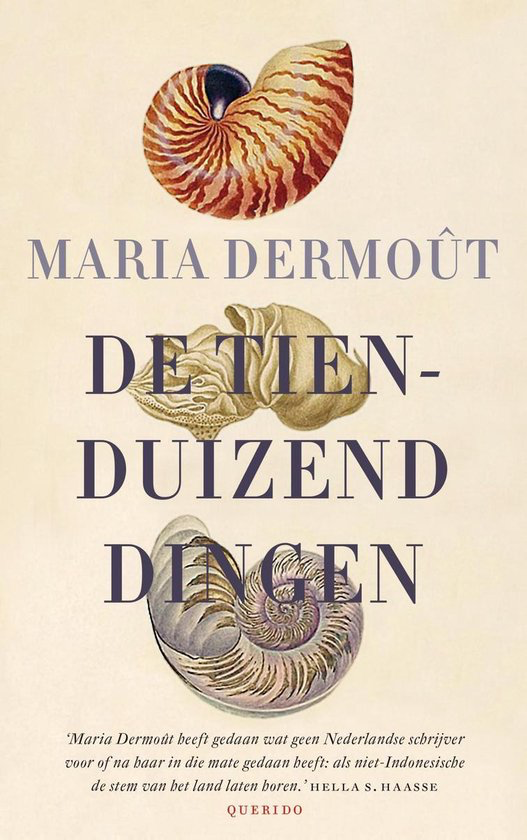
I read Maria Dermout’s De Tien Duizend Dingen in Dutch, so the above sentence is as close as I can get to summing up the opening of this Dermout’s beautifully immersive novel.

What captivated me the most about this novel was the intentional use of language and how through language Maria Dermout pulls the reader into the rhythm of a time and a place. It’s beautifully evocative and not only does the writer make us see the house, but we also see the garden, the leviathan who lives near the edge of the water that is in the garden, and then we are made aware of the graves and the possible ghosts of the three dead girls.

There is also the history of a place and of the first Mevrouw Kleyntjes who lived in this house and the second Mevrouw Kleyntjes who still lives in this house. There is the history of these women and the stories of the lives of the people who have interacted with and lived in relation to the house and around them is the history of place.

Somewhere halfway through De Tien Duizend Dingen, I sent a message to the friend who told me about this book. I told her that it made me think of Virginia Woolf. It’s been quite a long time since I read Virginia Woolf, but I remember a similar mesmerising almost hypnotic use of language in The Waves.

We are immersed in the world Maria Dermout writes about. We are transported to a period in time when the then Dutch East Indies (now Indonesia) is heading towards–an upheaval that will lead to a complete social-political change. Through the manner of telling, we can feel the simmering undertone of imminent change. Something is about to happen. What is about to happen is faintly present at the opening of the novel, but as the novel progresses, so does the sense of danger and precariousness–it is enough to make us recognise that at this point in time, the people in this place are no longer willing to simply accept the authority of Dutch masters. In this world, the woman, the house, the garden and its ghosts are relics of a past that will soon be nothing more than a dream.

De Tien Duizend Dingen was published in 1955 by Querido publishing house. It’s also available in English as The Ten Thousand Things.

What I have read and what I am reading

Now that I’ve regained enough focus to read whole novels, I find myself missing the conversations I used to have with my sister. A lot of our conversations used to revolve around books we’d read and what we thought about the story or how the writer managed to do something well or not well enough. I think my sister was the original bookworm in our family and I simply followed in her footsteps because whatever my sister read, I had to read too. Anyway, I’ve started reading the books I downloaded onto my reader and I thought I would write a little bit about the one I’ve just started reading as well as the one that I just finished reading. I thought I’d switch between fiction and non-fiction. Non-fiction often takes me longer as I like to reflect on what I’ve just read.

Fiction Read:

I’ve just finished Tade Thompson’s excellent Far From the Light of Heaven. I’m pretty sure Tade has written and published a bunch of novels since this one, but I just got around to reading again and the title of Tade’s excellent murder mystery called to me. It took me a week and a half to finish reading (this is my current reading speed for novels) but I never once lost track of the thread of the story. I’m also glad that I decided to get a tablet because it’s made it easier for me to just open a book and read when I’m on the train or when I remember that I am in the midst of reading a book.

I understand the importance of titles now because for some reason, that title just kept jumping out at me each time I clicked on my reader and I decided that once I had enough focus I would read that novel first. Far From the Light of Heaven makes use of elements of space opera and science fiction but at the heart of it, Far From the Light of Heaven is a murder mystery. The stakes are high and I liked how the characters feel real. I have to admit a fondness for Shell Campion’s Uncle Larry. I could relate to that feeling of wanting to protect someone younger who you consider part of your family. I found myself quite intrigued by the Lambers as a race and I want to know more about them. Reading this book, I also had to think about conversations around AI and the use of AI. I like how Tade doesn’t take sides on that, but tries to show how AI can be useful but also how it has its vulnerabilities and can be subverted in a way that it becomes a danger. I don’t know if this was intentional, but it felt very much so.

One of the things I loved about this novel is how we get to see how what happens on and to Ragtime affects the world the characters live in. It’s a reminder of how actions taken reverberate in the world. The question becomes this: do those actions lead to understanding that brings lasting change or do those actions lead to polarisation and division in the society around us? I may very well be putting my own interpretation on it, but this is something I thought about when I got to that part. Another memorable scene for me is the communal rite of grief/processing trauma.

I won’t say anymore as I might spoil the book for those who haven’t read it yet, but if you enjoy murder mysteries that are more than just murder mysteries, this might be just the book for you. Highly recommended.

I have a rather lengthy TBR list and I think I would like to try and write about as many of them as I can. I’m pretty sure there are things I’ve read in the past three years and a half that I forgot to write about.

Current Non-Fiction reads:

As I tend to dip into multiple non-fiction books at one time, I might write about my impressions from those books every now and then.

I’ve started on Karen Barad’s Meeting the Universe Halfway. I don’t even know who recommended this book or why I decided to buy it, but I’m pretty sure the person who recommended it made an impression on me. Anyway, I’ve just started reading it and there’s a line in the preface that just resonates so much with me. In the preface, the author writes about entanglements and how to be entangled is not simply being intertwined but it’s more than that. It’s a really great preface and if you’re interested in quantum physics, it does look like an engaging read.

A recent book I’ve recommended and gifted to fellow community workers is Aminata Cairo’s Holding Space. Aminata was one of the guest facilitators for LIMBO and the workshop she gave was joyful and beautiful and one that opened up space for stories to be shared and told. In this book, Aminata talks not just about holding space, but shares her own journey towards holding space. It’s a book that calls for reading and re-reading and for dipping back into when you feel the need.

Just yesterday, I had a lovely conversation with a friend who shared this line with me from a conversation she had with an older Dutchwoman. In that conversation, the Dutchwoman spoke of her husband, not as passed away or dead, but as someone who had stepped out of this timeline. I rather liked that phrase and it makes me think that entries like these are like missives sent to where my sister now lives–in a timeline that is outside of this timeline. It’s a lovely, lovely thought.

What are you reading now and what from those readings do you choose to keep with you?

art and narrative

Last Thursday, I moderated a panel discussion on the Fractal Art of Julius Horsthuis at NXT Museum. It was quite an interesting event as not only was the artist on panel, but we also had Dr. Margriet van der Heijden on panel–a physicist who specialised in particle physics at CERN. I’d never thought all that much about fractals before–I mean, if someone said the word fractal, I would understand that they’re talking about self-similar patterns which we often see in nature, but I probably wouldn’t be able to tell you what it is in-depth. For math people, talk about fractals will often lead to thinking about the Mandelbrot equation, but did you know that before Mandelbrot, there was the Julia? (Yep. I learned all these things while doing my prep.)

I also found myself thinking on the question of what makes art. What do we mean when we say a thing is a work of art? And what function do we ascribe to art? Julius Horsthuis says that his focus on Fractals lies in the fact that he hasn’t gotten bored by it yet.

For Julius, documenting or discovering the 3D worlds opened up by the input of various equations is what makes it fascinating for him. He talks about the films Baraka and Samsara which don’t follow a conventional narrative and how these films were an inspiration for the 3D films that he makes.

I certainly think that experiencing this kind of art by being in a space where you are surrounded by it is a different one from that of seeing it onscreen (on your laptop, your pc or your television). There is a mesmeric quality to it, but at the same time there is (as one of the audience said) a feeling of loneliness. Perhaps because there is an absence of characters interacting with the landscape. (Perhaps the person in the space becomes a character interacting with the landscape or could it be the maker himself?)

I watched Baraka and thought about that difference (the absence of humans in Julius’s work) and found myself thinking of how a landscape changes with the presence of humans. As Margriet said to me later on: Humans are not fractals.

I do like the concept of non-conventional narration and how it ties in with how story doesn’t have to conform in order for it to matter.

Later, Julius speaks of how the absence of narration is deliberate, although as he explores the possibilities of bringing his creations to VR, he realises that the absence of narration may not be conducive to people engaging with the art, particularly if they come to the experience for the first time.

Is story an experience? Is art an experience?

I think about these as I deliberate on my own work and process. I think of how as writers of story, there is a certain expectation arising from centuries of stories being told. What happens when story doesn’t conform to expectation? What happens when a story simply wants to show a world in the same way a documentary maker would show the world?

But is showing the world enough? We could argue that the majority of science fiction and fantasy books are about showing the world.

Piranesi, one of the books I read when I finally got my reading brain back, feels very much like that. It’s basically Susanna Clarke showing us the world Piranesi occupies. Piranesi’s voice compels us to come along and see and learn more about the world they live in. The cast of characters is barely there, but we’re seeing the world through Piranesi’s eyes and it’s beautiful and fascinating and a lot of times it is lonely. Piranesi eventually conforms to a story expectation but then not really and the feeling of fascination remains long after the book is finished.

Does Horsthuis’ art work in the same way? I can’t help but wish I had thought to ask how exploring the world of Fractals has changed or enriched the artist as a person. I’m not even sure if this is what the artist is after. Does it even matter? Should our work change us or reflect us or enrich us even? Does a work have to mean something in order for it to have value? Is fascination and sense of wonder enough?

In the light of discussions around the lives of creators, to what extent does the character and life of a creator influence our engagement with the work that they create? And can we separate things made from the people who make them? (Probably something for another post…my brain tends to wander off in tangents and this is my blog. πŸ™‚ )

I think there is room in the world for different kinds of artmaking because every form of creation will find its own audience and will speak to audiences in different ways. Thursday’s event reminded me of that. It reminded me of the beauty of physics, the endless mystery of the world we live in and that joyful feeling that arises when people come together with a desire to create bridges of understanding and knowledge.

If you’re in Amsterdam, I would recommend checking out NXT Museum (check out what’s on exhibit first as it varies). Not only is Julius Horsthuis’s Fractal Art on display, but they also have a fascinating exhibition by the postdigital art group Random International.

Blessings and peace to you who read this. Daghang salamat for passing by.