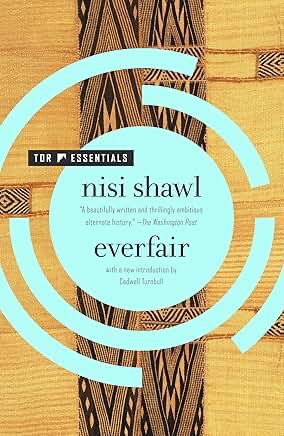
If you’ve taken the time to come visit my blog, it must mean that you enjoy discovering new works and reading almost as much as I do. Nisi Shawl’s Everfair was published in 2016, but at that time I was going through some challenging stuff. I made a note of it and somewhere along the timeline, I bought the e-book. But as happens in life, it took me until this year to get around to reading it. I’ve since found out that there is a book 0.5. and other books as well. It probably means there are things that have happened before this book that I might not be aware of, but it doesn’t take away from the joy of reading volume one.
What to say beyond simply saying: buy this book or read this book?
I want to say that Everfair is not an easy read. It’s not the kind of book that you just breeze through. It’s also not a lighthearted summer read. It’s the kind of novel that takes you on a journey–a journey that happens in a timeline that’s historically different from ours. Along the way, you decide to make notes. You might put the book down for a while, to take a breath of air, but then it calls you back and you keep on reading. It’s the kind of book where you look up from its pages and scan the clouds because there might be air canoes floating up there. The attention to detail is amazing.
In the beginning, it took me a while to sort out the personages. I tend to be a bit forgetful, but Nisi does a great job of reminding us who this character is and where we first met them. I found it pretty intriguing to witness the transformation Thomas undergoes (for instance). And I like how things are not always explained.
One of the joys of this novel is how Nisi Shawl gives us characters we can root and feel for. Characters we care about and it is those characters who we travel with and through whose eyes we see the world as it changes and evolves. It’s interesting to think about how Nisi Shawl makes use of riding cats (for instance) because in a manner of speaking we are riding the novel as we discover and learn more about Everfair. The politics of the Mote was interesting to me as well as the politics and the power struggles that take place inside and outside of Everfair. There is spionage and adventure enough to thrill the heart of anyone who loves spy novels. Relationships are never simple even personal relationships. I love how Nisi brings nuance to all these things. I found myself thinking on where and how I would draw a line where relationships are concerned. (I’m not gonna spoiler but you will find out when you read the book.)
Afterwards, I found myself still thinking on the questions around loyalties, allegiances, friendships and relationships. What makes us loyal to places and people? How do we determine loyalties? What about the dynamics that exist in friendships? And is it possible to have real friendship when there is a power imbalance? Those sorts of questions rise to mind when I think about Everfair.
Everfair would not be Everfair if it didn’t acknowledge the historical conflicts that took place in and around the Congo of our timeline. The conflict first with the Belgians, then with countries interested in what can be mined or taken from the Congo, and then the war that breaks out when King Mwende makes this decree where all who are foreigners must leave and return to their own countries. (How different would the world have been if the Belgians had been defeated in their mission to colonise the Congo?)
Everfair also speaks to ongoing discussions in the real world where the line “go back to your own country” has become a go to phrase when someone says something we don’t agree with. And while my kneejerk reaction was the same as King Mwende and I was like: ‘yes, go back to your own country.’ Nisi Shawl asks us: what do we really mean by that? What does it mean to be of a country? And how do we determine that?
I love how King Mwende with the help of Queen Josina (one of my favorite characters) realises that saying “leave and go back to your own country” is not the solution and that war is waste–primarily a waste of human life.
Nisi Shawl creates this world that isn’t utopian even though it starts with a utopian dream from those who first founded of Everfair. I like how Nisi doesn’t back down from knotty problems that occur when you’re trying to build a nation that’s home to and for everyone regardless of race, regardless of creed. It takes a while (for example) for one of the characters (Daisy) to come face to face with her own prejudices, her privilege and assumptions.
I’ve sometimes read books with relationships that feel forced, as if the author doesn’t understand how queer relationships or mixed race relationships work, but just wants to include them. Nisi does such a beautiful job at showing us not just how these relationships unfold but also how there is a lot of work that goes into making such relationships successful. Nisi doesn’t take a shortcut or take the easy way out. Yes, these relationships are complex, but Nisi also gives us joy.
Reader, I’m pretty sure that if you wanted me to tell you about historical things and what genre this novel might belong to, you would just head over to Amazon.com or google for one of the many reviews far more in-depth than this. I thought I would write this as if I were writing a letter to my sister who also loved reading books like these. I wish she could have read Everfair along with me.
If you enjoyed reading this topsy-turvy response to Nisi Shawl’s Everfair, I hope you’ll consider helping me reach 100% of my Clarion West Writeathon goal. There’s a button on the top right of this page that will lead you to my page.
Thank you for reading. And may joy accompany you on the journey.
 From the Beloved Country
You must be logged in to post a comment.