Current doings

I’m waiting for CT scan results and I thought it would be good to post this before I get distracted.

I’ve been writing and rewriting the work in progress which expands in size, decreases in size and expands again as I write on it. At the same time, I’ve found myself asking questions of myself as I write. For instance: I think I might have fallen into the trap of trying to write something that’s commercially in line with what’s already out there. You know: a nice hooky opening. Action and bam we are in the middle of the story. It’s not bad, but a part of me was raising an eyebrow and going: what did you want to achieve with that?

I am a bit of an over thinker and I found myself asking what I really enjoy about writing science fiction and fantasy. The answer really isn’t very deep. One of the reasons I enjoy science fiction and fantasy is how there’s this wild space where you get to imagine all kinds of strange or weird worlds that may or may not be related to this world.

Of course, I write about the things I’m passionate about and I write about matters that are on my mind and things I want to work through. But most of all, I love the freedom to create outside of the expectation that I will be writing about my culture or about my experience of displacement or as someone once said at a symposium I attended: I don’t want to tell you another story about my pain.

Perhaps the most freeing thing we can do is to unshackle ourselves from the having to be something and instead embrace what gives us joy and freedom. For example, I’m invested in the furniture of strange worlds and I enjoy the experience of wandering through it in a documentary film kind of way. Oh look, shiny curtains. What are they made of? Oh wow. They’re alive. These plants can tell stories: I’ll sit here and let the trees talk to me now. (I confess, I also do this in real life.)

But as I progressed, I realised that my first draft wasn’t really all that great. It was fun, but it was kind of meh. So, I asked myself a few more questions: Oh hey, Rochita, I know your subconscious does this for you most of the time, but let me ask you if you are aware of who the stakeholders are in your world? I had a short laugh at how I progressed from “yay, sentient furniture” to “here’s my project proposal”. But also, I find myself thinking of how it’s not just about the motions of living, it’s the why are you living there and how are you living there. There’s a part of me that thinks back to the conversations had around the table as we discussed TTRPG creation and where I asked out loud if villains or enemies or oppressors were a necessity in story. (I know I’m gonna eat my question because I’m not sure if a big world story is possible without one of those things coming up and even if the conflict comes organically from the direction of ‘player A does not recognise your innate ability to become an amazing superhero’, there is still going to be an acting opposition, right?)

In the midst of all this wrestling, I read an article penned by someone (I forgot who) where they write about this experiment they did with an AI writing machine while working on a column. They were using a particular program and they fed it with a prompt and with an instruction to check out their blog and write something in the same style and voice. The machine spit out something which the writer then proceeded to rewrite and adjust and by the end of it the only things left over from what the machine had given her were articles like a and the. It was rather fascinating to observe the writer defending the use of an LLM because they ended up writing their column in under an hour instead of more than an hour. A part of me was like: Uh…I’m not so sure why you did this exercise, but it seems to me sitting down and writing the entire thing on your own would have been better. (Also, damn girl, you are a good writer. Why would you do that to yourself?)

I think about the journey I’m taking with this work in progress and how I’m discovering the world as it unfolds on the page and how there are bits of the world that I’m writing now that will likely not make it to the final cut, because I’ve already put them in my notepad under the header: cuts. But I really really like those bits and I had so much fun writing them. (I’m having some thoughts around waste and intentionality and how using an LLM in this way makes me think of landfills and fast fashion. I know. It’s how my brain works.)

After my last posting (How thinking of language leads to thinking about other things) a friend asked me how we could possibly escape the machine if the machine also copies our imperfections. I thought about this for quite a while and then I was reminded of the various movements in the art world and how all of these movements were a fighting against and a coming up against and a wrestling with what is established. History tells a story of invention and reinvention, of how there are always ways of escaping something that becomes establishment and the norm and also I find myself thinking about impositions and how artists don’t really like impositions. So I find myself rather invested in what our answer to this question will be. (If you have any thoughts on it, I’d be interested in them.)

In the meantime, I thought I’d share the link to a weirdly wonderful story which involves playing with language from my lovely friend Weegbree. If you have time, do click to read Brood/Pain/Pan: A Breadtale in Three Movements.

Blessings and peace to you who read this and Agayamanac Unay for passing by.
Thinking about co-creation

Traveling to and from destinations is helping me catch up with my reading list. I find it sometimes surprising when I recognise how much traveling I’m doing. I live very close to a train station and from here it’s easy to catch a train to Amsterdam or Utrecht or Rotterdam or The Hague. I haven’t been to The Hague in a while and my library card has lapsed, but I want to return to writing and reading in the Royal Library sometime late in July after the projects I’m involved with have moved into the summer holiday phase. I also want to think more around what I want to do when the season starts up again. What is necessary to me? What do I want to keep on doing? What do I need to let go of and what do I need to prioritise?

I’m currently working together with a team that was put together with the goal of creating a table top rpg. It’s a process that’s new to most of us, but one of our team is an experienced Game Master and that helps the process along as we think around gameplay and building something that is interesting, fun and hopefully thought-provoking. We’ve been thinking around themes that we want to see as well as the kind of world and stories we hope to explore.

It’s a process that I needed time to wrap my head around as perhaps the biggest difference between writing alone and writing in the team is the work of coming to agreement. There’s also the process of making space for how we will not always agree and how we are fine with that.

We might fall into thinking that co-creation is some harmonious zen process. It can be, but by large it depends on the size of the team, it depends on the kinds of participants and the dynamics in a group, it depends on a lot of factors so co-creation can be as zen or as gnarly and messy as all get out, but it needs to be what it needs to be and there is no way to go around that and effectively co-create. I realise that going through the gnarly mess is a good thing. It’s good when we are able to show our faces to each other, to say: I don’t agree with you on this and I don’t want things to go in this direction and I actually would like to go elsewhere. When that kind of freedom exists, that holds a promise of something extraordinary coming into being.

Co-creation is a process that takes time because when we are creating together, it means we have to give a little and be willing to compromise in order to reach our common goal. I don’t think it can be hurried along and I think the best thing we take away from such engagements is how creating together allows us to quickly move away from surface and shallow niceties into spaces where we feel safe and seen and where we know that just because our thoughts and ideas are not shared by everyone, it doesn’t mean they are of lesser importance.

[Some questions I’m thinking around in relation to the work and the projects I’m working on: Do we want to build community? Do we want to share stories? Do we want to heal ourselves? What do we need and what do we want and how do we get there?) ]

At the heart of it, co-creation has to do with relationships. It’s related to how we’re entangled and connected to one another. If we are open and ready to make space for ideas and ways of thinking that are not the same to how we think and if we are willing to let go of control or if we are willing to step into the gap when we recognise a gap. Does this then mean that there is no space for individuality or for the individual choice?

I like to think that there can be room for both. That we can share and compromise and adapt while leaving space and room for ourselves to do and to create and to work around what speaks to us individually. I think that leaving space for individuals to come to terms with what works and what doesn’t is necessary if we want to come to satisfying conclusions.

I’m ruminating on this because creating world in a team feels very actual to the discussion around co-creation and I also am interested in how that translates into community building and creating together outside of fiction spaces.

Where ttrpg is concerned, we can try to think of directions in which we want players to go towards, but we can’t control or predict and while we can prepare for some scenarios, it’s quite possible that players will go towards outcomes we don’t expect or even want and that’s perfectly fine. I like to think that’s a good thing because there should definitely be room for insights and outcomes other than what we want.

Perhaps the most important takeaway for me from this process is to let go of the self that goes: ‘oh but actually’. Instead, I should just let the part of me that carries on snarky and whacky conversations with my other parts come out and play.

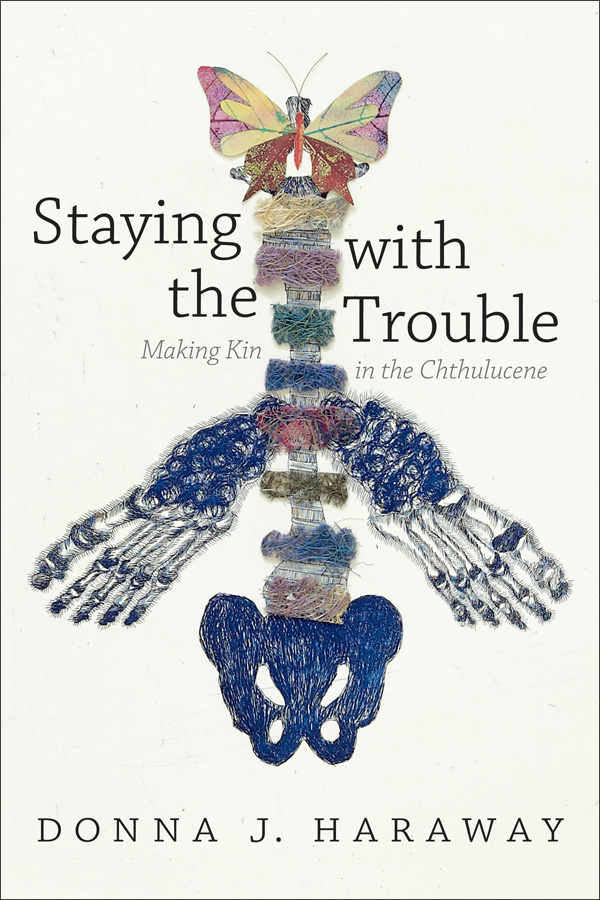
Throughout this writing, I keep thinking of that phrase from Donna Haraway from Staying With the Trouble: “It matters what matters we use to think other matters with; it matters what stories we tell to tell other stories with; it matters what knots knot knots, what thoughts think thoughts, what descriptions describe descriptions, what ties tie ties. It matters what stories make worlds, what worlds make stories.”

Blessings and peace to you who read this and maraming salamat for passing by.

Staying with the Trouble is available from Duke University Press and from other booksellers.

(editing to add my thanks to Aliette de Bodard and Vida Cruz-Borja for listening to me while I worked through this process.)

Things I’m thinking about today

The past week has been quite intense and quite busy as I traveled back and forth from home to Amsterdam. The travel is a little more than an hour and when I get to the station I’m supposed to be at, it takes another 10-12 minutes before I’m at my destination.

Last week, I was at the Vrije Universiteit Amsterdam for most of the week where I participated in the Spring School Co-Creation Lab. This was the first Spring School held at the Faculty of Social Sciences and I believe the intention is to have a repeat of this every year for a period of time. The effect of what’s taking place in the US was quite visible at Spring School as events over there made it impossible for one of the invited guests to travel to us in Amsterdam.

It did give me a chance to talk about science fiction, visionary worldbuilding and science fiction as an instrument that can be used for thinking through issues that concern us and then we did a collaborative world-building exercise.

In asking the questions around collaborative exercises, it reminded me once again that in the work we do where we want to bend the needle towards justice and equality, it’s necessary to remember what our community’s vision is. To consult and collaborate and work together even when the outcome is not what we expected. It reminded me too that in the kind of work that we do where we seek to advocate for and are working for communities on the margins, listening and paying attention are some of the most important things that we can bring to the table. (There are a number of other things too like love and acting on the principle of seeing each other as Kapwa, as connected, as human.)

For myself, attending Spring School made me realise that I have to face up to my own responsibility to my written work. One of the comments I read somewhere said that a lot of the links on my website led to dead-ends and it looked like I hadn’t updated in a while. This is, in fact, true. For a long time, I didn’t have the energy or the focus to update this space. I knew the links were dead-ends, but I kept thinking: who cares anyway?

From listening to the conversations around me, I realised that it was important to keep an accounting and a documentation of things I’d written and published. Not only for me, but also because it might help someone else down the line. So, I found myself searching through my disorganised drive, trying to locate as many of the columns that I wrote for Movements as well as other non-fiction work that I had written around change, decolonisation practice and women’s work. (I’m compiling them to create a pdf that can be downloaded for anyone interested in reading. Suggestions are welcome as to how I can make it available as I’m new to this.)

As I was reviewing the work I’d written, I found myself quite emotional. I remembered how a lot of the non-fiction work that I did is what supported our family through the most difficult periods when Jan didn’t have any work and often pay from whatever writing I managed to get published was what helped keep the children fed. Interestingly, my kids don’t seem to remember that time as a time of hardship. It was more like: we ate noodles for a week and it was great!

Writing this my heart aches because I know there are parents at this time who despair because there is nothing to feed their children with. There are parents who don’t even know if their children will survive to see another day, and there are children without parents to worry over them. Having noodles for an entire week sounds like heaven when food supply has been cut off or withheld by the powers that be. What’s happening in Gaza, what’s happening in Sudan, what’s happening in Ukraine, what’s happening in all the places where war and oppression are taking place happens to all of us and we cannot allow ourselves to become numb or to look the other way.

For those of us who live in places of privilege where there is no war or famine or fear of rockets detonating over our heads, while we may not be able to jump on activist boat like Greta Thunberg, we can still do something. We can listen. We can advocate. We can bear witness.

Blessings and peace to you who read this. May we ever be striving to move the needle towards what is just and true and may we recognise how we are connected in our humanity.

At work in Gladstones

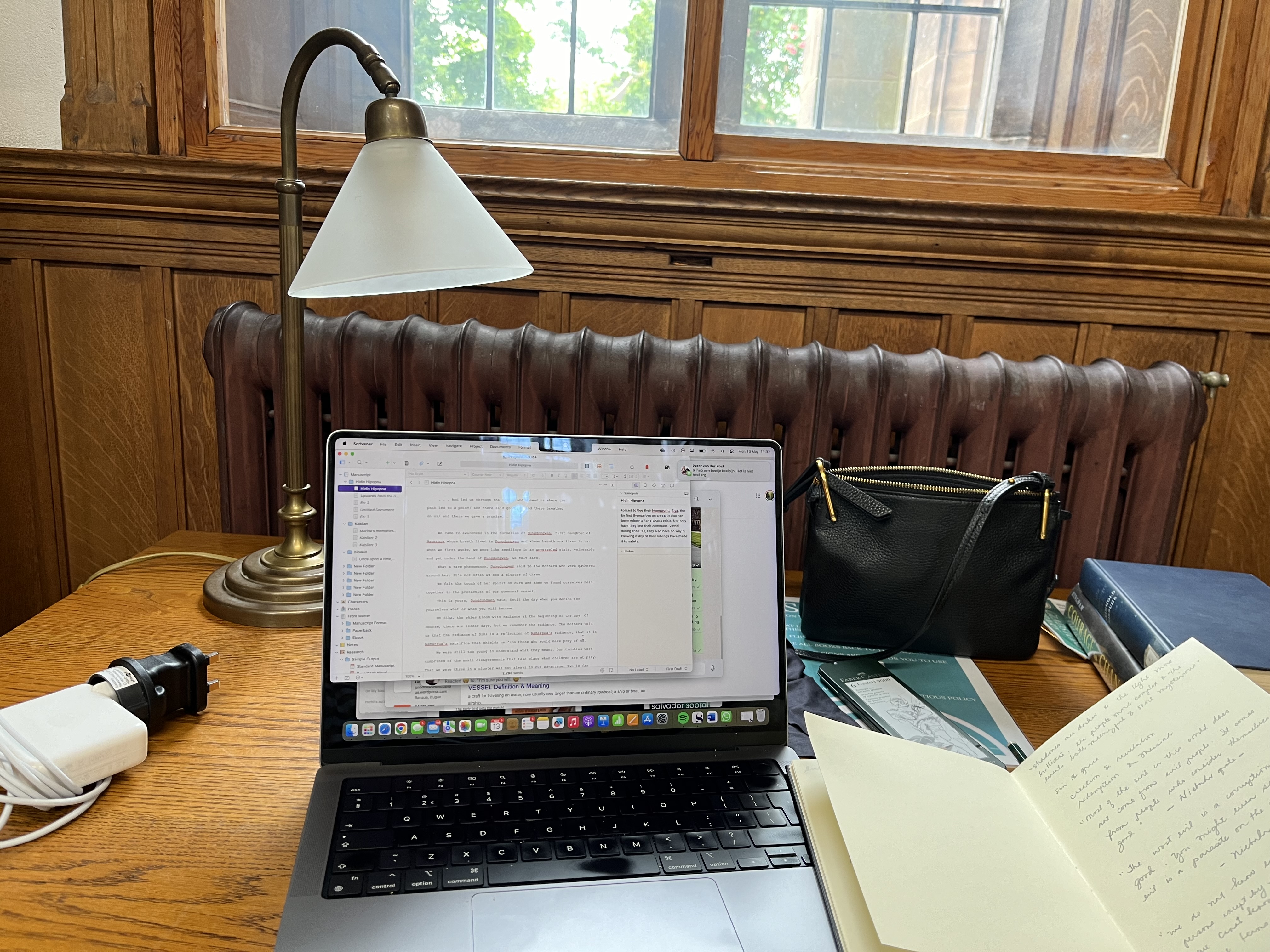
Here I am in Gladstones Library in Wales for a week of writing at the Milford Writer’s Writing Retreat. It has been a while since I’ve done something like this and I had quite forgotten just how enervating taking time out to write can be. It’s more than carving out time during the regular day, but just being here among so many books with other writers and just focusing on the work of writing has proven to be quite helpful in my process.

Before the diagnosis in 2022, I had been working on a couple of projects which I quite forgot all throughout treatment, so finding them again early in 2024 made me realise that I actually still liked these projects and they were stories that deserved to be finished. But coming to the Milford week, I was still torn on which project to work on.

In the end, I found myself drawn quite strongly to what I call the En story. I had been avoiding finishing it because the scale felt just so large. I realised that I have to acknowledge that it really is a novel. Not a novella, not a long short story, but a novel. It also means that writing in Gladstones works perfectly. I am in the process of putting together all the bits and pieces which I feel belong in this work and there it was staring me in the face…climate change. And what joy to be able to look through the library catalogue, head to the stacks, take all the books you think will be helpful and find exactly what you need for the huge thing you have been terrified about. It also helps a lot that one of my writer friends is a geophysicist and so I could send her a message saying: “uh…I have a question, help”.

It’s interesting to me too that the desk I’m seated at right now is located between two stacks of philosophers.

There is something about the moment and place of creation and how tapping into the source will bring you to the places/people/sources that you need in order to keep moving.

Working on the En story, I understand what it is about this work that terrified me. Now that I have the proper focus, I see how the world has always been comprised of opposing forces. Forces at a constant push and pull and forces that threaten to overwhelm each other. There is the nature that uses up worlds without thought or without care. It’s the kind of nature that discards without thought because when something is used up, there will always be another to take its place. It is the assumption born of privilege. There is another nature at place here too. It’s the nature of lifegiving and restoration and nurturing. Because the second nature is not brutal in nature, it’s often trampled on or made little of. But without the second nature, what would happen to our earth? What would happen to humankind? There is another nature somewhere in there and this is one wherein I hope balance takes place. I am working on it and my head is constantly busy with it.

A little while ago, I had a conversation with one of my Dutch friends. We talked about the balance between the realm of the spirit and the real world and how it’s easy to get caught up and lost in the spiritual, but we need to remember that we are also here in the real. It is the same with writing. My first drafts tend to be vague and starry eyed and not too grounded…more floaty and slippery than solid.

I started writing again in 2024 and it feels to me like I am learning all these things all over again. But what a joy to be able to do so. To be able to write and tell the stories I want to tell. Isn’t that a blessing?

Blessings and peace to you who read this. Agyamanac Unay for stopping by.