Traveling to and from destinations is helping me catch up with my reading list. I find it sometimes surprising when I recognise how much traveling I’m doing. I live very close to a train station and from here it’s easy to catch a train to Amsterdam or Utrecht or Rotterdam or The Hague. I haven’t been to The Hague in a while and my library card has lapsed, but I want to return to writing and reading in the Royal Library sometime late in July after the projects I’m involved with have moved into the summer holiday phase. I also want to think more around what I want to do when the season starts up again. What is necessary to me? What do I want to keep on doing? What do I need to let go of and what do I need to prioritise?
I’m currently working together with a team that was put together with the goal of creating a table top rpg. It’s a process that’s new to most of us, but one of our team is an experienced Game Master and that helps the process along as we think around gameplay and building something that is interesting, fun and hopefully thought-provoking. We’ve been thinking around themes that we want to see as well as the kind of world and stories we hope to explore.
It’s a process that I needed time to wrap my head around as perhaps the biggest difference between writing alone and writing in the team is the work of coming to agreement. There’s also the process of making space for how we will not always agree and how we are fine with that.
We might fall into thinking that co-creation is some harmonious zen process. It can be, but by large it depends on the size of the team, it depends on the kinds of participants and the dynamics in a group, it depends on a lot of factors so co-creation can be as zen or as gnarly and messy as all get out, but it needs to be what it needs to be and there is no way to go around that and effectively co-create. I realise that going through the gnarly mess is a good thing. It’s good when we are able to show our faces to each other, to say: I don’t agree with you on this and I don’t want things to go in this direction and I actually would like to go elsewhere. When that kind of freedom exists, that holds a promise of something extraordinary coming into being.
Co-creation is a process that takes time because when we are creating together, it means we have to give a little and be willing to compromise in order to reach our common goal. I don’t think it can be hurried along and I think the best thing we take away from such engagements is how creating together allows us to quickly move away from surface and shallow niceties into spaces where we feel safe and seen and where we know that just because our thoughts and ideas are not shared by everyone, it doesn’t mean they are of lesser importance.
[Some questions I’m thinking around in relation to the work and the projects I’m working on: Do we want to build community? Do we want to share stories? Do we want to heal ourselves? What do we need and what do we want and how do we get there?) ]
At the heart of it, co-creation has to do with relationships. It’s related to how we’re entangled and connected to one another. If we are open and ready to make space for ideas and ways of thinking that are not the same to how we think and if we are willing to let go of control or if we are willing to step into the gap when we recognise a gap. Does this then mean that there is no space for individuality or for the individual choice?
I like to think that there can be room for both. That we can share and compromise and adapt while leaving space and room for ourselves to do and to create and to work around what speaks to us individually. I think that leaving space for individuals to come to terms with what works and what doesn’t is necessary if we want to come to satisfying conclusions.
I’m ruminating on this because creating world in a team feels very actual to the discussion around co-creation and I also am interested in how that translates into community building and creating together outside of fiction spaces.
Where ttrpg is concerned, we can try to think of directions in which we want players to go towards, but we can’t control or predict and while we can prepare for some scenarios, it’s quite possible that players will go towards outcomes we don’t expect or even want and that’s perfectly fine. I like to think that’s a good thing because there should definitely be room for insights and outcomes other than what we want.
Perhaps the most important takeaway for me from this process is to let go of the self that goes: ‘oh but actually’. Instead, I should just let the part of me that carries on snarky and whacky conversations with my other parts come out and play.
Throughout this writing, I keep thinking of that phrase from Donna Haraway from Staying With the Trouble: “It matters what matters we use to think other matters with; it matters what stories we tell to tell other stories with; it matters what knots knot knots, what thoughts think thoughts, what descriptions describe descriptions, what ties tie ties. It matters what stories make worlds, what worlds make stories.”
Blessings and peace to you who read this and maraming salamat for passing by.
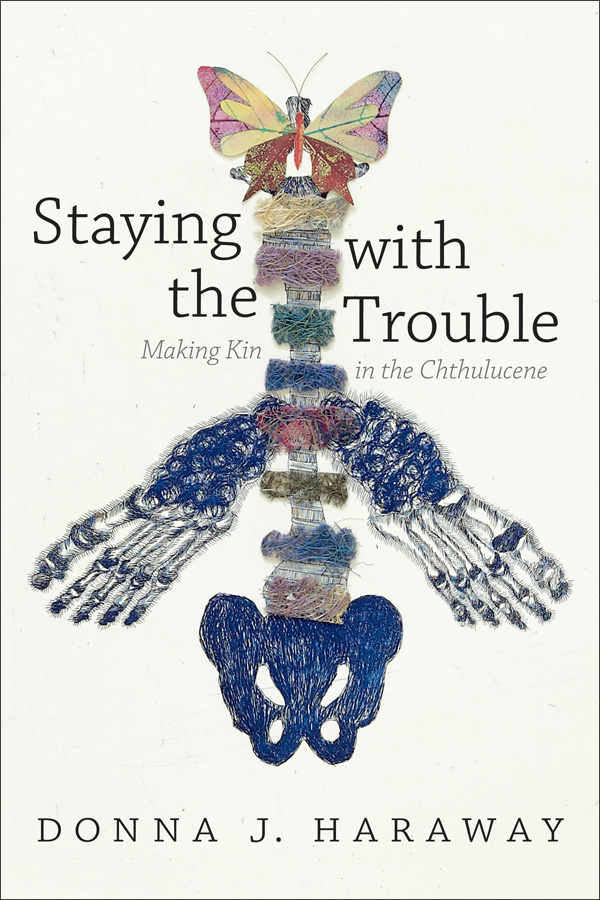
Staying with the Trouble is available from Duke University Press and from other booksellers.
(editing to add my thanks to Aliette de Bodard and Vida Cruz-Borja for listening to me while I worked through this process.)
 From the Beloved Country
You must be logged in to post a comment.