My father’s unfinished memoir

My youngest brother sent me a message, asking if I’d read my father’s unfinished memoir. I told him I hadn’t been able to because in the chaos following my father’s unexpected death, we lost track of his documents. After this reply, my brother told me he’d found it, but it wasn’t finished and it needed editing. I am thinking and processing some of what I’ve read so far and am in touch with other members of the family as I seek to fill in the blanks.

I remember asking my father lots of questions about his parents. He’d say that we would sit down and talk about it some time. Except, that never really happened. My grandma told me that they’d been part of the resistance during the Japanese occupation. I’d often wondered if it was just a story or if it really happened.

In his memoir, my Dad writes vividly about that period. His account relays the complexity of growing up in that time with an awareness of the work his parents were doing while at the same time living alongside the presence of the Japanese soldiers. There are moments of quiet, like the period before his parents were discovered and they were forced to flee from hideout to hideout while the Japanese hunted for them. My Dad doesn’t dramatise and yet there is drama. It’s also an absorbing read because of the level of detail that he remembers. Names of resistance fighters, their commanding officer, places where they hid, and the locality where they eventually were able to find refuge. Nico on bluesky makes a comment about this being a historical document and I think that it could be described as such. The curious person in me wants to book a flight to The Philippines and go do research. Instead of doing that, I decide to patiently read some more.

My father writes about life after the war. About moving locations until they settle in Gingoog City. My grandfather builds a practice. My grandmother works as a respected teacher. Their home life seems to be a stable one. And then, in the year that he finishes high school, his parents break up for good. He writes about the break-up quite dryly. It’s a mutual decision. His parents have decided that it’s time for them to live separate from one another. It turns out that my grandfather was a womaniser. All throughout, my grandmother looked the other way, but this last adventure (my father writes) was the straw that broke the camel’s back. My grandfather leaves them. He leaves my grandmother and his three sons and goes away. My father doesn’t know where he’s gone and he loses touch with his father until much much later when he finally tracks him down in Zamboanga city where his father has a thriving surgical practice. It’s there that he meets his father’s other family.

My Dad’s younger half-sister tells me a story of my father showing up at their house one day. Just out of the blue. He’s there. My Dad, demanding that he see his father and telling his father that he is going to med school and as he is unable to pay for his tuition, he feels his father must pay for his tuition. She’s very insistent about how her mother impresses on Lolo that he must pay for the tuition of his son. After all, they have the money to pay for it.

It’s quite something to think about this after reading about my father working at different odd jobs. He is fifteen or sixteen at the time and when his mother’s younger brother comes across him working instead of studying. He is then brought to meet his maternal grandfather who tells him he should study and it is his grandfather who makes him apply for Ateneo de Agusan.

I want to know what happened in between the break-up and my granduncle finding him. I think about my grandmother’s proud nature. I think about her younger sister telling me that my grandmother was very stubborn and had married my grandfather against her father’s wishes. It feels plausible that my grandmother might have hidden the break-up from her family until it’s found out.

I recall someone telling me that my grandfather couldn’t remain where he was. That he had to move away because of how people viewed their break-up and because of all the things that were said. In that time period, it was, of course, a scandal. In present day Philippines, separation is still viewed as a scandal. I remember someone saying to my sister once that divorce was a sin. My sister, who holds a masters in Theology, answered quite sharply: “Where in the Bible does it say so, because I can point you to multiple passages that contradict what you’re saying.”

My father mentions my grandfather two more times in his account. One when his father comes to visit him after my Dad loses one of his patients and the second time when my grandfather comes to Banaue to die.

My grandfather’s death feels like a punctuation.

I think about memory and pain and wonder. Perhaps when a memory is too painful, we decide to overlay those hard memories with something easier for us to live with.

I also think about myth making and how myth can tell us a truth that a factual and chronological narration of facts cannot.

Beyond all expectation, I find myself writing about family; about my father and his parents and about the life that he lived. In conversation with someone, I speak about my father’s life of faith and how in the end the overarching theme in my father’s life is that of grace. He became who he was not because he was exceptional or special. He became who he was because he found grace for living.

I’m not sure how to go on from here. I do think that we are all in a constant process of transformation. We don’t stand still. We change as our lives are touched by other lives and we change too in the process of touching other lives. When we make the choice to live with intention, it is just like that.

In a way, reading my father’s memoir is like hearing his voice speaking from the other side. I have so many questions, I say to that voice. But you’re not here to answer them.

A voice in my head says: What if the answers aren’t as important as the process of asking? If you keep asking how and why and what does it mean, and when you acknowledge that you don’t know all the answers, but are also searching, then perhaps you’ll find better answers than the ones that exist today.

I’m going to end this here. I’ve just heard that the English version of Hymne van de Overlevers has gone live on Philippine Genre Stories. In English, it’s titled Hymn to Life. Clicking here will take you there, if you want to give it a read.

May joy accompany you on the journey and maraming salamat for passing by.
How we conceive a familial history

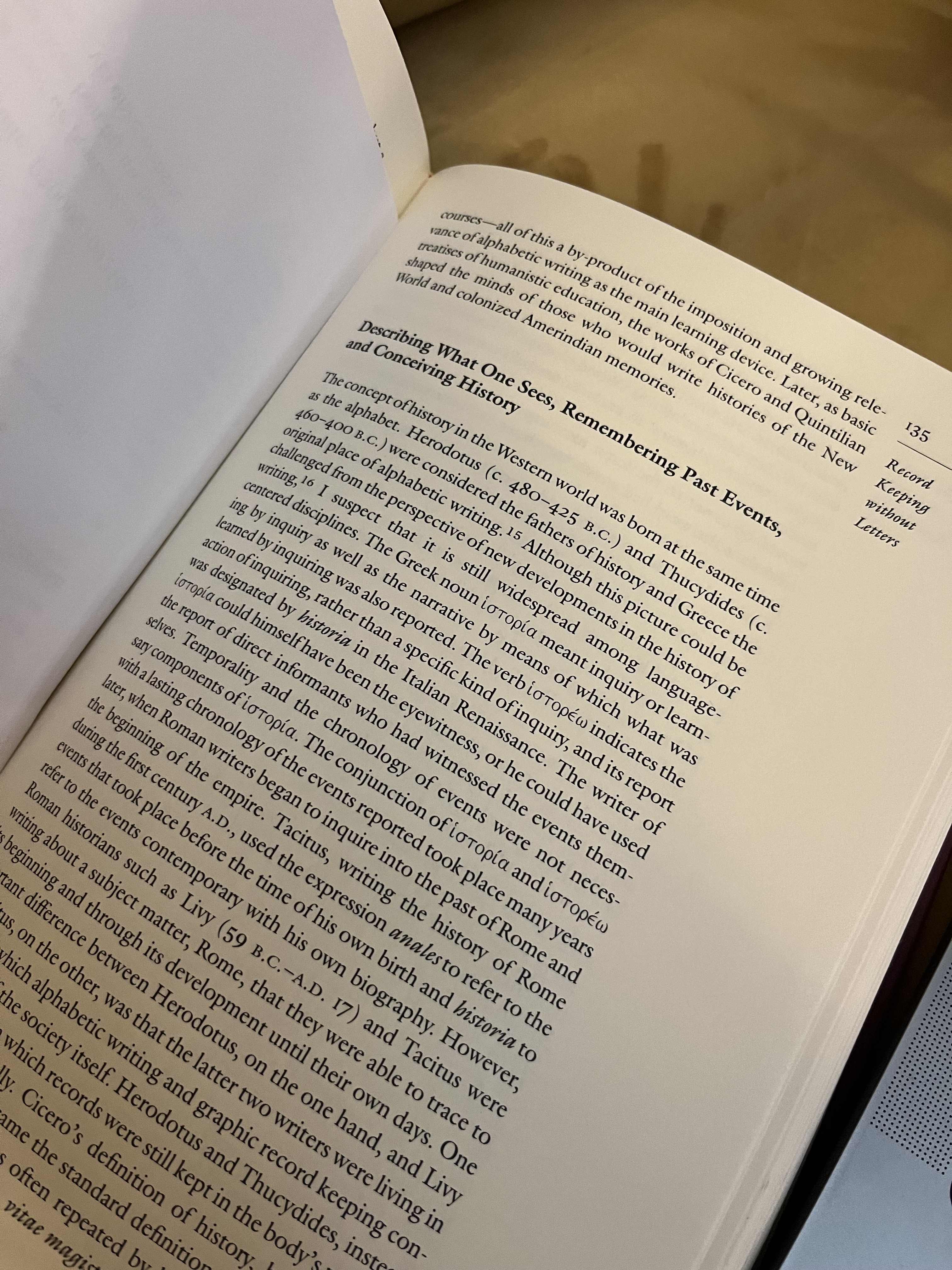
In The Darker Side of the Renaissance, Walter D. Mignolo quotes Isidore in the chapter on Record Keeping without Letters. He quotes this from Isidore: For among the ancients, without exception, only those who were witnesses and who had seen the things they narrated wrote history, for we understand what we have seen better than what we know by hearsay.

I had a conversation with a cousin who is older than I am, who might know more about the history of my grandparents. They might know more, not just because they are older, but they might know more because of how they were situated in physical proximity to my grandfather. My cousins lived in Cagayan de Oro and this cousin tells me that our grandfather visited them often and the story they tell about my grandfather is one of a gentle and kindhearted giant of a man. Someone whose visits they looked forward to and whose presence was very much welcomed.

Our family was located far from where the rest of my father’s family lived. In fact, we were located on the opposite end of the archipelago. My sister and I grew up in the mountains of Ifugao, my brothers were born there too, and we spent our childhood blissfully unaware of any drama that might be taking part in that place that could just as well be another country. We were far from where my grandmother was located. Also far from where my grandfather and his second family lived. Back then, the trip from where they were to where we were would have been almost the same as traveling from The Netherlands to the Philippines. By Filipino standards, it still is a costly trip.

My cousin tells me that my Dad, being the youngest, was his mother’s favourite and so he didn’t receive the same kind of harsh corporal discipline that his elder brothers received when they were growing up. My memories of my grandma are those of a rather strict lady. I thought at that time that it was because she had Spanish blood and Spanish people are strict (right?). She was always affectionate towards our Dad and the affection was reciprocated.

The story of familial relation unfolds differently when told from the perspective of my cousin who tells of the horror that came with growing up in the proximity of my grandmother. According to this account, my grandmother was more than strict. Indeed, she was quite unreasonable, more than demanding, and even cruel. Any sign of enjoyment when she was visiting with them, was punished with a lengthy sermon that would end only after one of my cousins was punished for an imagined wrongdoing.

My cousin relates this to me from her perspective. We didn’t see, she tells me. We didn’t know what our grandmother was really like. And so, she wants to relate what we never witnessed or experienced for ourselves because of distance. The grandmother she knew and the grandmother I knew seem to be two different people.

A memory arises from a time when my grandmother took me with her to visit her younger sister in Manila. She was fussy about my comfort and then when we arrived at her sister’s house, she was devastated to find out that she’d forgotten to pack extra underwear for me. I think I must have thrown some kind of a tantrum (I was a bit of a handful as a child) and she just didn’t know what to do or how to get me out of the bathroom as I kept on blaming her for not knowing that kids are supposed to have clean undies everyday. She was strict, but not more strict than my own mother and she didn’t spank me for throwing a tantrum. She waited and then made me do what she wanted me to do. (Just as my mom would have done.)

By the time my grandmother came to live out her days with us, she had been gentled by years. She had had had a stroke, but she was recovering even though she wasn’t very mobile. She loved telling stories about the past while I massaged her legs and listened eagerly.

I loved hearing her talk because my Dad didn’t tell us very much.

Later, when we were much older and after my grandma was no longer with us, my Mom tells us an entire story of how she would warn my Dad each time my grandma came to visit: Bantay ka! (watch out). Your Mom isn’t going to lay a finger on one of my kids.

None of us ever experienced such harsh punishments or treatments as those described by my cousins. We might have been subjected to some nagging, but our mother would send us out to play and even though we were scolded by my grandmother, I always had this idea that it was because she wanted the best for us. Did this have to do with how my mother stood between us and her? Was it because of the close bond between her and my father? Or are these things that I have imagined because there is a lot I do not know.

I can remember the sound of my grandmother’s voice whenever she called out to my Dad.

“Nonoy,” she would say.

Now that I have children, I recognise that tone of affection that one reserves for one’s own children, and in particular, for the youngest one.

For a long time, until my grandfather came to visit, my sister and I believed my grandmother was a widow. And then, when we found out that there was a grandfather, we thought he must have done some dastardly crime because no one spoke about him.

I suppose this speculation was natural considering how we grew up far from anyone belonging to my father’s family, in our defence, we only ever met him once.

My sister and I met our grandfather for the first time when he was already sick. By the time he came to visit us in Ifugao, he was dying. But he came to see us, or perhaps he came to see my father. No one spoke about why he’d come; not even afterwards, so I can only speculate. Did he come to mend broken bridges? I don’t know.

In my mind, I see my grandfather as a tall man with a gaunt and lonely face trying to connect with us kids. I can still see him towering over us, trying to win us over by showing us his magic slippers.

This memory is overshadowed by whispers and a feeling of tension. It seemed as if we saw him only that one afternoon, but I’m sure it must have been more than that one afternoon. I remember my mother trying to keep my father from going away to the city on an errand and my father’s stubborn insistence on going and how while my father was gone, my grandfather died.

My mother talked about how she had to have a casket made. It must have been a while before my father arrived because I remember visiting the carpenter’s shop and the carpenter explaining to me how he was making a casket for my grandfather. I thought I should feel properly sad, but I didn’t know how to feel about the tall stranger with magic slippers who now lay in a casket in our living room while the voices of visitors filled our living room. I felt uncomfortable and impatient for my father to return.

It’s interesting what kinds of snapshots the mind retains. I see one of myself frozen in the moment when my father arrives. The house is teeming with people, but the living room is in the shadows. I am standing on the stairs looking down onto the porch as my father climbs up toward my mother. He doesn’t look up to where I am, all that is him is focused on my mother and then a sound breaks from him. After my sister died, I understood what that sound was and what kind of deep grief that sound contains.

Is this the memory that colours my recollection of my father’s pain?

Did I imagine my father’s feelings towards my grandfather? I know we hardly spoke about him and when I did try, he tended to be quite abrupt. Was he in pain because he wasn’t there when his father died? Had he left because he didn’t know what to say after so many years of not seeing each other? Had something been left unsaid or undone? I can only speculate.

The person writing about my father’s life writes from the perspective of someone who spent time in conversation with my Dad, long after the pain had been healed. Their conversations took place after a transformation had taken place. It gives me peace to know that my father was no longer angry. He was no longer in pain. He had reconciled his grief and pain and he had become the beautiful self everyone remembers–a man filled with compassion, gentled by time, always present and in service of those who needed him.

If we are to take Isidore at his word, then it means I can only write what I have seen and what I have understood from that seeing. As Mignolo writes, Isidore wasn’t concerned with the distinction between a narrative of witnessed events (which will become past events from a future perspective) and a narrative of the narrative of witnessed events.)

Again, Mignolo quotes Isidore: Things that are seen are reported without any ambiguity. This discipline pertains to grammar, for only the things deemed worthy of memory were written down.

These entries are (for me) a way of processing. Thinking about family history as I think on what I am reading. Blessings and peace to you who read this and Daghang Salamat for passing by.

History in episodes

I’m chatting with a person who’s writing about my father’s life while reading this section called Describing what one sees, Remembering Past Events, and Conceiving History in Walter D. Mignolo’s The Darker Side of the Renaissance: Literacy, Territoriality and Colonization. I am seated in the lounge of the Royal Library of The Hague and it’s nice and cool with the small sounds coming from different occupants of the library. In a corner of this lounge, someone is snoring. The seats are comfortable and conducive to a siesta and I am seated on a comfy sofa with my belongings around me–it’s kind of like being at home but being able to focus in a way that’s more library-like (if you know what I mean, you know what I mean). I think about history–family histories–the things that are said and that aren’t said–what we pick up without words having to be said and how we carry these histories with us and how we don’t speak about the painful or dark parts of familial pasts.

Reading Mignolo, I reflect on how histories are made and passed onward from generation to generation. Mignolo writes about histories being kept in the body memory, of histories being transmitted orally. And somehow, I find myself thinking of history that we keep in our bodies.

Recently, a friend of ours spoke of finding out that the father she’d grown up with wasn’t her biological father and the pathway to connecting with her biological family from the side of her biological father all came down to taking a DNA test that matched her with a niece who for some unknown reason decided to also take a DNA test. This connection eventually led to her finding the sister who had been searching for her for a long time.

A whole puzzle with unmatched edges fell into place. Character traits she’d wondered about finally made sense, once she spoke to her sister. Conversations that were cut-off mid-sentence. Hints of something secret–dates that didn’t match. Unspoken tensions that she somehow registered. She had this feeling that maybe there was something hidden, but it wasn’t until it was time to clear out her mother’s attic that she discovered the secret of her paternity.

In an age where histories are being re-shaped, re-written and erased, it feels urgent to think about the position from where histories are being told. Who is telling this history? Under what terms is that history being told? In what form and in what shape and with what words or means is that history being put in place?

It feels necessary too to keep a record of what is happening in the world around us as we keep a record of our own histories.

I think about my father and I wonder what he would say about the ongoing conflicts in the world today. I want to think he would also feel urgency and the need to speak out against injustice. The truth is, I don’t know what his response would be were we in conversation today. That’s because my last memory of him is one of heated conversation where we disagreed on what was just and what was unjust and how we left it in the middle as something we would come back to later on.

Familial history often feels episodic. When we talk about memories and things that happened in the past, we remember in bits and pieces and then we look to each other for confirmation.

I’m going back to reading Mignolo. I want to think about memory and the fallibility of memory and how we tend to remember people in a different light once they are no longer in the world.

Blessings and peace to you who read this. May you find joy in the journey.

What does it mean to flow without borders?

I have had in my mind this thought which I came back to me and seems to become more concrete as I try to put it into practice: what do we mean when we talk about a world without borders? Or what do we want to see? Or how might that experience be like if there were only superficial restrictions in place and if we could — as Glissant expressed it, move through to taste the atmosphere of a place. I have to go back to reading Glissant because a lot of things are mixed up in my memory (chemobrain) but this definitely stuck and remained with me and I was reminded of it again when in one of our latest LIMBO meetings, some of the participants asked why is it that we have to put borders in place? Why all these restrictions? Doesn’t the world belong to all of us?

I went home thinking about borders. How do we see borders? Are they protection? Who is protected by these borders? And who are we protecting ourselves from? And why do we need to keep others out in order to feel protected or safe? What do we mean by safety? What do we mean by security?

I asked these questions of myself because I live in a country to which people from other countries migrate to or flee towards to ask for asylum. I live in a country in which the discussion around migrants and asylumseekers is so fraught that one actually risks losing friendships in the process.

I don’t have the power to make change happen on a big scale and I don’t have the power to go out into the large arena and make discussions happen but I thought on how to bring that practice of flowing through borders into a very small space.

For this month’s LIMBO, I thought of asking participants to work together to fill up white space with writing or drawings, with lines or curves or symbols, with whatever they can think about to express their presence in the world. The invitation being this: if someone puts down a mark, how will you interact with it? How will you cross the borders? How do you enter space where you didn’t put a mark first?

It’s an exercise that I find myself wanting to repeat with others. Without our realising it, we have our own concept of borders, even on something as small and simple as a piece of paper. Creating on a space reserved and marked yours feels different from creating in a space that says–this is for all of us. Leave your marks, interact with other marks, there is no one artist, no one author, no one creator, it belongs to all of us.

There are questions that arise from this exercise that I also want to think about and which I find myself curious about: how does it feel to cross over into another space? What changes once you make that decision to leave a mark there? To interact with something that’s there? How does it change the way you perceive the work?

I didn’t get to ask this of the group, but I find myself wondering: How do exercises of collaborative creation change the way we see the world and the way we interact with one another?

In talking about this with a dear friend who is a fellow artist, activist and also a writer in the field, I expressed a vision of a room that becomes filled with doodles and maps and words and drawings. And how, it would be interesting to discover how willing we are to layer on top of what is already there and how that space would not be a work attributed to any one person but it would be attributed to all who collaborated whether the person is invited or comes upon it by happenstance, where those making marks can also be living creatures that we take care of.

Writing this, I realise that I am writing about the world we live in. We are all in the process of creating or re-creating, making or re-making, building or re-building–perhaps we layer over what is already there–we bear witness. We see how systems put in place have shaky foundations and how those who benefit from these systems try to prop them up. We bear witness, we offer criticque. But is offering criticque enough?

Marking the empty page to make something together can involve some risk. Stepping out into the world, making a decision to make or leave a mark involves much deeper and more thoughtful movement. What kind of mark do I want to leave? How will the mark that I leave affect those whose spaces or whose lives I live a mark on?

In any case, for me, the question strikes closer to home and makes me think that if I have marked my children with love and care and the ability to be thoughtful and considerate of others, then some of what I am meant to do has been done.

I wish I could share the picture of our collaboration, but it belongs to the group. But perhaps it’s an exercise some of you who read this blog might want to try on your own. Just take the step. Make the invitation and see where it takes you.

Agyamanac Unay for stopping by. Blessings and peace to you who read this.

thinking about language again

I’ve been writing in Dutch and this has me thinking about language again and how it relates to taking up space in the world (or making space) and how gatekeeping in language and use of language relates to the question around permissions. Why do we need borders when the world belongs to all of us? Why do we need permissions to cross from one place to another? And why do we as societies feel this need to create perimeters and conditions keeping people from traveling or moving into spaces we have labeled as “ours”?

I have a complex relationship with language. Perhaps this explains my fascination with it. I am also something of a geek and language and the conversations around language have also fascinated me.

Small as the Dutch publishing landscape may be (compared to the US or the UK), it’s still predominantly comprised of white native Dutch speakers. I made a decision to at least attempt to write and publish in Dutch because I believe it’s important to make space not just for my work, but for the work of those who like me were not born or raised in The Netherlands, but have come here from non-western countries.

In 2021, when Martijn Lindeboom and Vamba Sharif asked me to participate in De Komeet, a specfic anthology from diverse writers in NL released by a De Geus, I said an immediate yes. When the anthology was published, some people I know who read my story said that they were at first a bit hesitant because of the use of nb pronouns, but were quite surprised to find it wasn’t preachy as they feared (yay). It was also favourably reviewed in De Telegraaf which is a major Dutch newspaper (so Yay again). The comment I do get from people I know (who’ve read it) is how the reader can tell that I’m not a native Dutch speaker because of my use of language. Here’s where I admit that I did have an editor and first readers who tried to tell me to rewrite some sentences but the rhythm and the off-center use of language made me happy, so I kept them.

I can’t pass for a native Dutch speaker and to be honest, I don’t even want to. It’s the same as I don’t pass as a UK or US raised English speaker, and I don’t want to. The way I use language reflects how I have acquired the language, it reflects the rhythms by which I have learned to speak it or write it. It may seem like a minor thing, but there is a deliberate reasoning behind this. I understand the importance of the rules of language–grammar and such. But as one reader said to me: the use of language in an alien setting by alien characters, reminded me that my characters are aliens and the emotion came across because of the way “the language was used in a way I am not used to”. (That kind of made me go: yep. That was the intention.) (Of course, I have no doubt there were readers who were just irritated and went “another outsider who wants to write in Dutch”. Lol.)

There are different ways of using language and by opening ourselves to these differences, we expand our borders and our perimeters.

Mind you, I’m not advocating for using wrong grammar. I am advocating for knowing and having a grasp of language and at the same time remaining faithful to the rhythm that echoes in your inner ear. (I did adapt a lot of suggested edits because I am aware that while I may be proficient in Dutch, I tend to be more English in my grammar use. But there were definitely one or two sentences where I just said to the editors–this just feels right to me. It conveys an emotion that I want to convey.) So, I am perfectly okay when faced with the criticism that the language use isn’t perfectly Dutch or Dutch as it’s meant to be. It is not meant to perfect, it’s not meant to conform. (Sorry not sorry for being a rebel.)

When we engage in writing in LIMBO, I like to encourage participants to write in the language they are most comfortable in. Perhaps a majority will opt to write in English, but I have discovered that when someone chooses to write in the language closest to them, while we may not understand the words, we are often able to hear the movement of the writer’s heart in the movement of the language they use.

It’s this kind of rhythm and this kind of movement that we want to capture when we decide to write in an acquired language. Maybe it’s not perfect. Maybe the grammer is not 100%. But all these things are cosmetic. They can be fixed in edits, they can be discussed.

We are a multicultural society and when traveling through the city, I hear a rich tapestry of sounds and voices–different languages, different accents, different ways of using language. Dutch interspersed with Middle Eastern languages, Filipino mingled with Dutch and interestingly too–Dutchies who bend Dutch words to make them sound somewhat like English. Language, like society, like culture, doesn’t remain static. It’s never standing still and every year new words are added to our ever-changing vocabulary–not all these words are rooted in the Dutch language.

Yep. I can keep going about language. But I’ll stop here as I have a bunch of things on my to-do list. I am interested in comparing notes though. How do you write in an acquired language and how does the language you’re most skilled at using influence the way you write in another language? And if you’re writing in an acquired language, what made you decide to write in it?

Blessings and peace to you who read this and Agyamanac Unay for dropping by.