My father’s unfinished memoir

My youngest brother sent me a message, asking if I’d read my father’s unfinished memoir. I told him I hadn’t been able to because in the chaos following my father’s unexpected death, we lost track of his documents. After this reply, my brother told me he’d found it, but it wasn’t finished and it needed editing. I am thinking and processing some of what I’ve read so far and am in touch with other members of the family as I seek to fill in the blanks.

I remember asking my father lots of questions about his parents. He’d say that we would sit down and talk about it some time. Except, that never really happened. My grandma told me that they’d been part of the resistance during the Japanese occupation. I’d often wondered if it was just a story or if it really happened.

In his memoir, my Dad writes vividly about that period. His account relays the complexity of growing up in that time with an awareness of the work his parents were doing while at the same time living alongside the presence of the Japanese soldiers. There are moments of quiet, like the period before his parents were discovered and they were forced to flee from hideout to hideout while the Japanese hunted for them. My Dad doesn’t dramatise and yet there is drama. It’s also an absorbing read because of the level of detail that he remembers. Names of resistance fighters, their commanding officer, places where they hid, and the locality where they eventually were able to find refuge. Nico on bluesky makes a comment about this being a historical document and I think that it could be described as such. The curious person in me wants to book a flight to The Philippines and go do research. Instead of doing that, I decide to patiently read some more.

My father writes about life after the war. About moving locations until they settle in Gingoog City. My grandfather builds a practice. My grandmother works as a respected teacher. Their home life seems to be a stable one. And then, in the year that he finishes high school, his parents break up for good. He writes about the break-up quite dryly. It’s a mutual decision. His parents have decided that it’s time for them to live separate from one another. It turns out that my grandfather was a womaniser. All throughout, my grandmother looked the other way, but this last adventure (my father writes) was the straw that broke the camel’s back. My grandfather leaves them. He leaves my grandmother and his three sons and goes away. My father doesn’t know where he’s gone and he loses touch with his father until much much later when he finally tracks him down in Zamboanga city where his father has a thriving surgical practice. It’s there that he meets his father’s other family.

My Dad’s younger half-sister tells me a story of my father showing up at their house one day. Just out of the blue. He’s there. My Dad, demanding that he see his father and telling his father that he is going to med school and as he is unable to pay for his tuition, he feels his father must pay for his tuition. She’s very insistent about how her mother impresses on Lolo that he must pay for the tuition of his son. After all, they have the money to pay for it.

It’s quite something to think about this after reading about my father working at different odd jobs. He is fifteen or sixteen at the time and when his mother’s younger brother comes across him working instead of studying. He is then brought to meet his maternal grandfather who tells him he should study and it is his grandfather who makes him apply for Ateneo de Agusan.

I want to know what happened in between the break-up and my granduncle finding him. I think about my grandmother’s proud nature. I think about her younger sister telling me that my grandmother was very stubborn and had married my grandfather against her father’s wishes. It feels plausible that my grandmother might have hidden the break-up from her family until it’s found out.

I recall someone telling me that my grandfather couldn’t remain where he was. That he had to move away because of how people viewed their break-up and because of all the things that were said. In that time period, it was, of course, a scandal. In present day Philippines, separation is still viewed as a scandal. I remember someone saying to my sister once that divorce was a sin. My sister, who holds a masters in Theology, answered quite sharply: “Where in the Bible does it say so, because I can point you to multiple passages that contradict what you’re saying.”

My father mentions my grandfather two more times in his account. One when his father comes to visit him after my Dad loses one of his patients and the second time when my grandfather comes to Banaue to die.

My grandfather’s death feels like a punctuation.

I think about memory and pain and wonder. Perhaps when a memory is too painful, we decide to overlay those hard memories with something easier for us to live with.

I also think about myth making and how myth can tell us a truth that a factual and chronological narration of facts cannot.

Beyond all expectation, I find myself writing about family; about my father and his parents and about the life that he lived. In conversation with someone, I speak about my father’s life of faith and how in the end the overarching theme in my father’s life is that of grace. He became who he was not because he was exceptional or special. He became who he was because he found grace for living.

I’m not sure how to go on from here. I do think that we are all in a constant process of transformation. We don’t stand still. We change as our lives are touched by other lives and we change too in the process of touching other lives. When we make the choice to live with intention, it is just like that.

In a way, reading my father’s memoir is like hearing his voice speaking from the other side. I have so many questions, I say to that voice. But you’re not here to answer them.

A voice in my head says: What if the answers aren’t as important as the process of asking? If you keep asking how and why and what does it mean, and when you acknowledge that you don’t know all the answers, but are also searching, then perhaps you’ll find better answers than the ones that exist today.

I’m going to end this here. I’ve just heard that the English version of Hymne van de Overlevers has gone live on Philippine Genre Stories. In English, it’s titled Hymn to Life. Clicking here will take you there, if you want to give it a read.

May joy accompany you on the journey and maraming salamat for passing by.
Downtime and Tricia Hersey’s Rest is Resistance

It’s the first proper week of my summer break and I have to admit that I’m really enjoying the time to just chill and do whatever I want. Downtime is a great period to relax and reflect–do a little bit of dreaming, think about lessons learned, about the work that’s been done and what it means. I also find myself thinking on how to encourage a younger generation of activists and collaborators because community work can eat you up if you don’t get the support and the rest that you need.

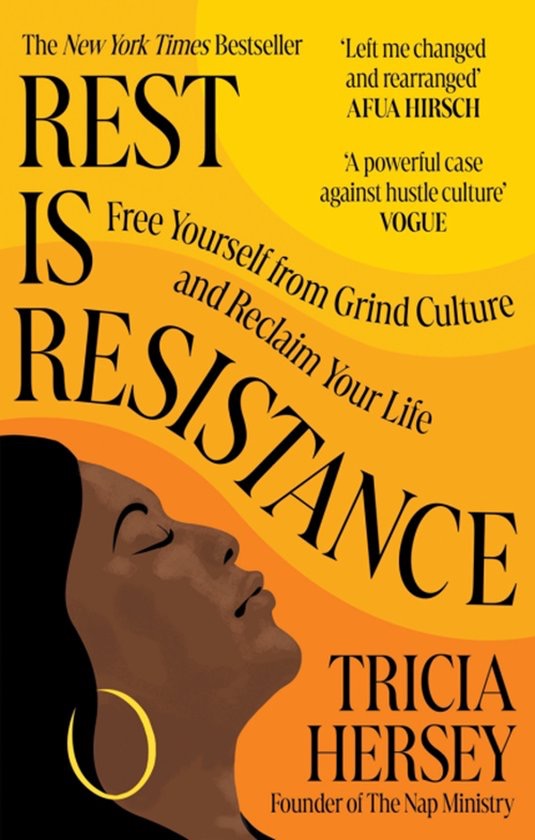
I recently shared a book with one of my dear friends and a fellow collaborator. It’s a book that came across my timeline and the title of the book drew my attention because it speaks to something I hear coming from workers in different spaces.

“I am tired.”

“I feel like I need more sleep.”

“I want to recharge.”

I hear different variations on this theme of needing rest. So when Rest is Resistance by Tricia Hersey came across my timeline, I felt moved enough to put it into my basket.

Hersey’s book is a quick read, but it is a good read. Reading it, I found myself thinking of how easily a body can be trained to forget about rest. For instance, when I first moved to The Netherlands, I still practiced siesta time (like we do in The Philippines). My in-laws were rather shocked/surprised and I was shocked/surprised to find that Dutch people do not do siesta unless you’re old or sick. I had to un-learn siesta pretty quick because being caught in siesta resulted in that disapproving look that made me feel like I had committed a crime. Nowadays, I’m like: I do not care…I will siesta if I feel like I need a siesta.

Hersey’s story about her father–his life of work, in service to God, in service to family, in service to community, reminded me so much of my father. My father was the youngest of three brothers, all three who were raised by my grandmother who became a single mother when her husband left them for someone else. There are many ways to justify a man leaving his wife and family. My Grandma was quite a character and I have been told repeatedly by other people that living with my grandma was hard for my grandpa and so when he met this lovely young woman who became his second wife, it was understandable that he chose to leave my grandma. I know how much my Dad valued my grandma and how much his Dad’s leaving hurt him. I don’t doubt my Dad had heard all the reasons. He didn’t blame the woman his Dad left them for, but it didn’t make his pain less and it doesn’t make his pain invalid.

All throughout his life, my Dad was determined to be there for us, even as he also lived his life in service to the community and in service to God. He was a doctor, and a lot of times, he would be opening the door to patients when it was way past midnight. Later on, he organised medical missions to places where medical care was inaccessible. Free clinics for those who couldn’t afford it. He was always on the go.

On the day he died, he was preparing for another medical mission.

I think of how the life of my father was punctuated by constant movement. He was so invested in providing for us and protecting us. He wanted to keep my Mom free of stress and worry. He was taking care of so many people and so many things, he didn’t tell us he had a heart condition.

I thought of how the pattern of my life ran similar to my Dad’s because my Dad was my hero and I wanted to be just like him. So, I almost never said no to anything. I found it hard to refuse help. I found it hard to set boundaries and to say: I can’t or until here and that’s it. Then I had a burnout where my body literally refused to function. Then, Jan died. Then, the diagnosis happened. And I was forced to rethink my life and say “no, I cannot”. “No, I don’t have the energy for that.” “No, I have to prioritise something else first.”

It took my body breaking down for me to re-learn rest.

The funny thing is–once you come face to face with it, you understand that the human body isn’t meant to keep going like an engine. Rest and sleep are essential to the recovery process. When I was going through treatment, I thought of how the emphasis is often on the parts of us that are sick or that carry disease. So, I thought to myself. So, there’s this small nodule somewhere. But it’s not everywhere. I can’t do much about the nodule, but the parts of my body that are well, can be made stronger. Can be made stress-resistant, can be helped to be healthier. So, no one knows how much time I’ve got, but no one else on earth knows that either. So, what I can do is be as alive as I can be right now. When my body was weak from chemo, I remembered what gives life to the body is not the body itself, rather there is that source that is beyond human explanation. We are, after all, more than these vessels we occupy and the spirit that is inside us travels on a path undefinable and unconfined by human parameters.

After my last treatment, there was moment where I could feel life gaining momentum. I was working more, I had more energy, I was more focused. I thought: I can do this. Oh, I can do that. Oh, yes. But I also felt this jealous guarding of my alone time–the downtime. Time to recuperate. Time to gather my thoughts. Time to be alone with a book. Time to nap. Time to tune in to that other space–to that other timeless space where dreaming happens.

A lot of what Hersey writes about is recognisable. My hope is that those who read it won’t just read it as this best-selling book where after reading it, they can put a checkmark beside the title. Read that. Liked it. Next book. (That would so defeat the purpose of it.)

I am reminded that my body is a vessel that carries me through life. I can’t accomplish what I want to do with this life, if I’m not taking care of my body and taking time to rest, recuperate and dream.

Writing this, I am reminded again of The Sabbath and Heschel’s thoughts on time and how time is like this cathedral we live inside of. Time isn’t going anywhere. We just need to dwell here and be here and do what we need to do where we are right now.

Maraming salamat for reading. May blessings and peace go with you as you journey on.

How is it Wednesday already?

Weirdly, I find myself thinking about the phrase ‘time flies’ and how there must be a better phrase to express how quickly we move through time. As Treebeard from LOTR says: us two-legged creatures are always rushing about and wanting to hurry things up.

And so, I find myself in Wednesday and thinking of how my Monday and Tuesday were so quickly filled with things like seeing my youngest son to the airport. I still keep seeing him as this curly-haired mischievous toddler, only now he’s taller than I am. He still is curly-haired and thankfully, he is still mischievous.

Yesterday, I was looking through some old photos from when the boys were little beings. I came across pictures of us taking picnics in our backyard. I thought of that one summer when we couldn’t take a holiday, so we set up the tent and our eldest spent the better part of a week camping. I sent these pictures to my eldest and he sent me a message saying how those were some of the best times ever.

We think it’s giving our kids everything that will make them happy, but I don’t think they noticed how our holidays were always truncated–not two weeks away like other families but one mid-week (which was more within our budget). Once, we managed to score a great midweek at this out of the way holiday park with a whirlpool bathtub. That was a feast for the boys. I think I stressed about how to get there, but now that I look back, I can’t help but smile. Good times.

On Tuesday, I had my regular CT-scan and they also took some blood. Bah. I know this is all part of it and I did sign up for this trial, but I am looking forward to when these appointments become more of a quarterly or twice yearly thing. (Here I am thinking again about time)

I want to write about Sunday’s celebration, but at present, I’m finding it hard to find the right words. I think about why I feel I should write about it and realise that this is a thing I have put upon myself. And so, it’s something I can let go of. I recognise that some things aren’t meant to be written about so quickly. I can move back and forth in time, thinking on this and that. Dipping into a book, thinking again, writing down notes, going back in memory. Breathing. Listening to my heart. Paying attention to what’s going on in the body and in the spirit. Time isn’t rushing forward. It’s just there waiting for me to step into it.

I breathe again.

I hope that you who read this will step into that pocket of time where you can breathe. Listen. Pay attention. And then breathe again. Blessings and peace. Maraming salamat for stopping by.

I wish it were Sunday already

It’s been quite a hectic week as we head towards the closing event for the LIMBO workshops. FramerFramed is hosting LIMBO for this event and Maison the Faux has invited LIMBO to make use of their podiums. When we first talked about this closing event, we thought of creating a similar atmosphere to the LIMBO workshops–intimate and cozy, with time to check in individually and converse. But as the programme bloomed and volunteers raised their hands, we now have a full-blown programme complete with a Waacking Dance Workshop and a pole dance presentation from one of LIMBO’s participants.

I do hope that there will be space for cozy conversations as being in FramerFramed does mean that it’s always possible to wander away from the main space for a tete-a-tete.

I heard back from one of the PhD students who visited LIMBO sometime ago with the hope of creating a space with a similar vibe to LIMBO. I remember that we had a lovely call where we talked about possibilities and what can be done to make the space feel welcoming and safe and how presence and intentionality are key elements to such spaces. It was lovely to hear about the success of their project and also to hear that this particular student was able to complete their thesis. I’m hoping we meet again as I would love so much to hear what it was like for them and also to compare notes.

LIMBO’s future is a bit up in the air at the moment as the last grant request wasn’t successful, but I’m sure that whether it’s in this form or another form, LIMBO will continue on and the people who make up the community will find ways to keep meeting and supporting one another.

I also think it’s good for facilitators and organisers to have room to self-reflect, to recuperate and to think on what kinds of spaces we might want to be in and how we would like to continue working and supporting communities in the future.

While I am looking through the fiction work that I have on my drive, my main thought at this period is thematising and gathering together the nonfiction writing that I’ve done. Part of which is almost done as I finally managed to divide the themes into five sections. There remains the matter of collecting the pieces that belong with each theme and then perhaps editing/expanding/completing them.

There have been times when I’ve felt like I was less than because I haven’t completed my novel yet. I sometimes felt that my voice was of less value than the voices of those who had won awards or been recognised as great authors. But a beloved friend of mine sent me such a heartwarming message reminding me that it’s not writing a bestselling book that makes our voices matter in the world. Dear reader, I cried listening to that audio message.

I was reminded of the joy that blossoms in my heart when I hear someone share a story or a poem or a piece of art accompanied by story. There was this one woman who shared how they’d never imagined they would be able to write and express themselves because they’d constantly been told their grammar was always wrong. I was like: “screw grammar. That part you can worry about if your objective is getting published. But now, at this point where you only want to share a story, just write.”

Often, we believe that we can’t because we’re told we haven’t mastered the language well enough. But I can testify to how if you can write in the same way that you would say it, a good editor will help you polish and refine your work so what you want to say comes across in the way you meant it. Don’t use chatgpt or whatever google translate. It won’t get your meaning across. Write it in your own words. We keep talking about decolonisation, but we still keep wringing ourselves into spaghetti forms to fit into something we are not.

Let language (esp the English) flow in the way it flows in your head. When I’m writing in the space of my stories, I’m not thinking English the way USians or British people think or write English. I’m thinking and writing English the way I hear the people in my head speak it. And that’s English that reflects the different influences on my tongue. Like how my son will say: You have a very Filipino accent. But my brother will say: your accent is no longer Filipino. And a Dutch friend says: Oh, you sound American. Lol. Yes. I have a mongrel tongue and I also do have a tendency to absorb the way friends who have grown up in different non-white settings speak. Those are the people on my tongue and in my ears. So yeah. It’s different.

At the first workshop I gave for LIMBO, I said to the participants–as we all do not come from the same language stream, don’t make yourself write in English. Don’t make yourself write in Dutch. Write in the language that comes to you naturally. We will understand the emotion. And we always do.

Anyway, I was intending to write about LIMBO’s upcoming booklet launch and somehow this post has turned into an all out discussion of me with myself as I think about writing. During the Spring School Co-creation Lab at the VU (Vrije Universiteit Amsterdam), I asked Saba Hamzah who is a Yemeni poet to read to us from work she’d written. It was a memorable moment to be listening to her read a piece she’d written in the three languages in which she lives. Yemeni, Dutch and English. To me such work is a reflection of the world we live in. We are multi-language, multi-culture, multi-faceted. Our work reflects that too. (Please click on Saba’s name to get to her website.)

Thank you for taking time to read this “hak op de tak” post. May you find joy in the small moments of everyday.

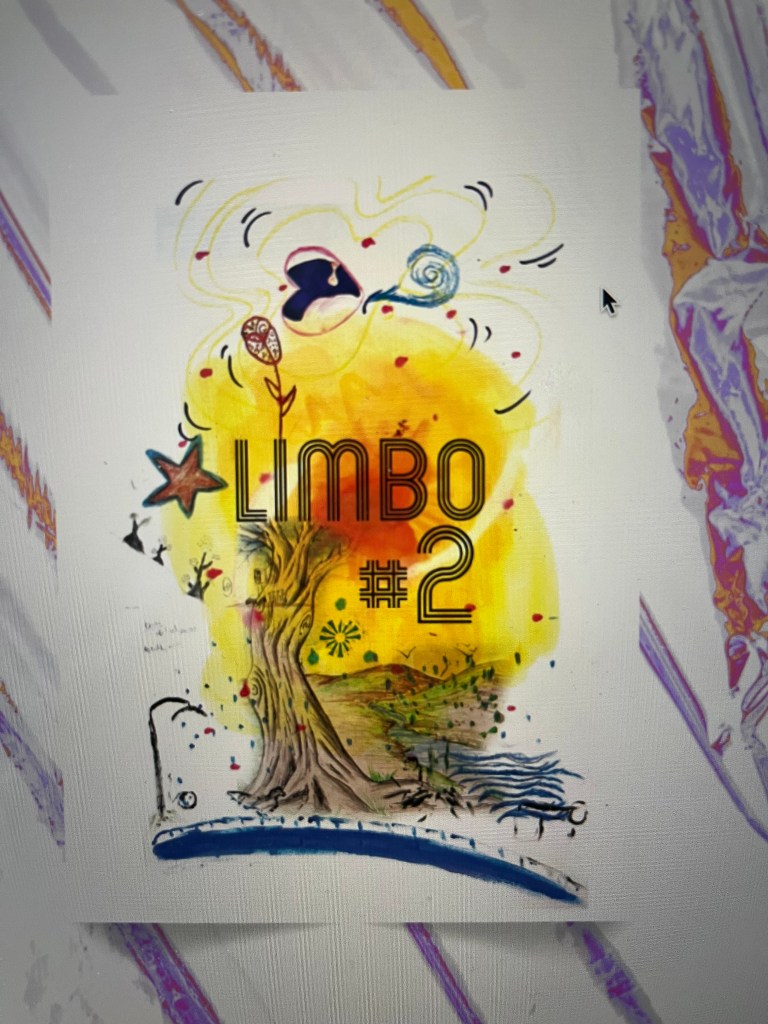
LIMBO’s booklet launch is this coming Sunday, 20th of July. Click on the image to get to the announcement.

This cover for LIMBO’s second booklet was designed by the wonderful visionary artist Ariya.

**I’ve picked a new book to read and possibly write about. Check the sidebar.

Today is my sister’s birthday

I’ve been thinking about my sister in the in-between hours, all throughout the day. Perhaps it’s one reason why I felt somewhat agitated. It’s not until I took the time to sit down and think about the day that I realised it’s because I didn’t get to talk to my sister.

My sister and I were born almost exactly a year apart. Both of our birthdays fall in April. Hers falls earlier in the month and mine closer to the end of it. I think about my sister and the unexpectedness of her passing and what a gift it was that she was able to come to us and spend time with us in the months after Jan passed away. Little did we know that she would leave us too.

For a long time, I couldn’t put a name to what it was that I felt when my sister died. I was able to carry on after Jan’s passing, I was able to push through and still keep going, but when my sister died it was like the world stopped and I sank into a deep dark place. I’m not exactly sure how I got out of there, but time helps a lot and it helps when someone picks you up and says: you don’t have to do anything for a while, you just have to keep on living.

In the days when I was going through treatment, when chemo was rough and I didn’t want to even get out of bed, I thought of my sister saying: Come on, Rochita. Don’t just lie there. Fight.

And I would get up and I would make myself go downstairs and eat breakfast even if I didn’t feel like eating. I decided I wouldn’t die, but I would live.

Because there was so little of a gap between us, my sister and I were often mistaken as twins when we were kids. And my Mom liked to dress us up in twin clothing. There are loads of black and white pictures of the two of us twinning. For a long time, there was just me and my sister. We had to wait another seven years before the first of my brothers was born. My sister and I were each other’s best friends and confidantes. We could fight like cats and dogs, but we were each others’ allies. (It’s kind of impossible to remain hostile when you’re sharing a room.)

I want to honour my sister today. To remember the sound of her voice and the way she smiled. I’m thankful my sons have memories of her. That they know who I’m talking about when I talk about Tita Weng.

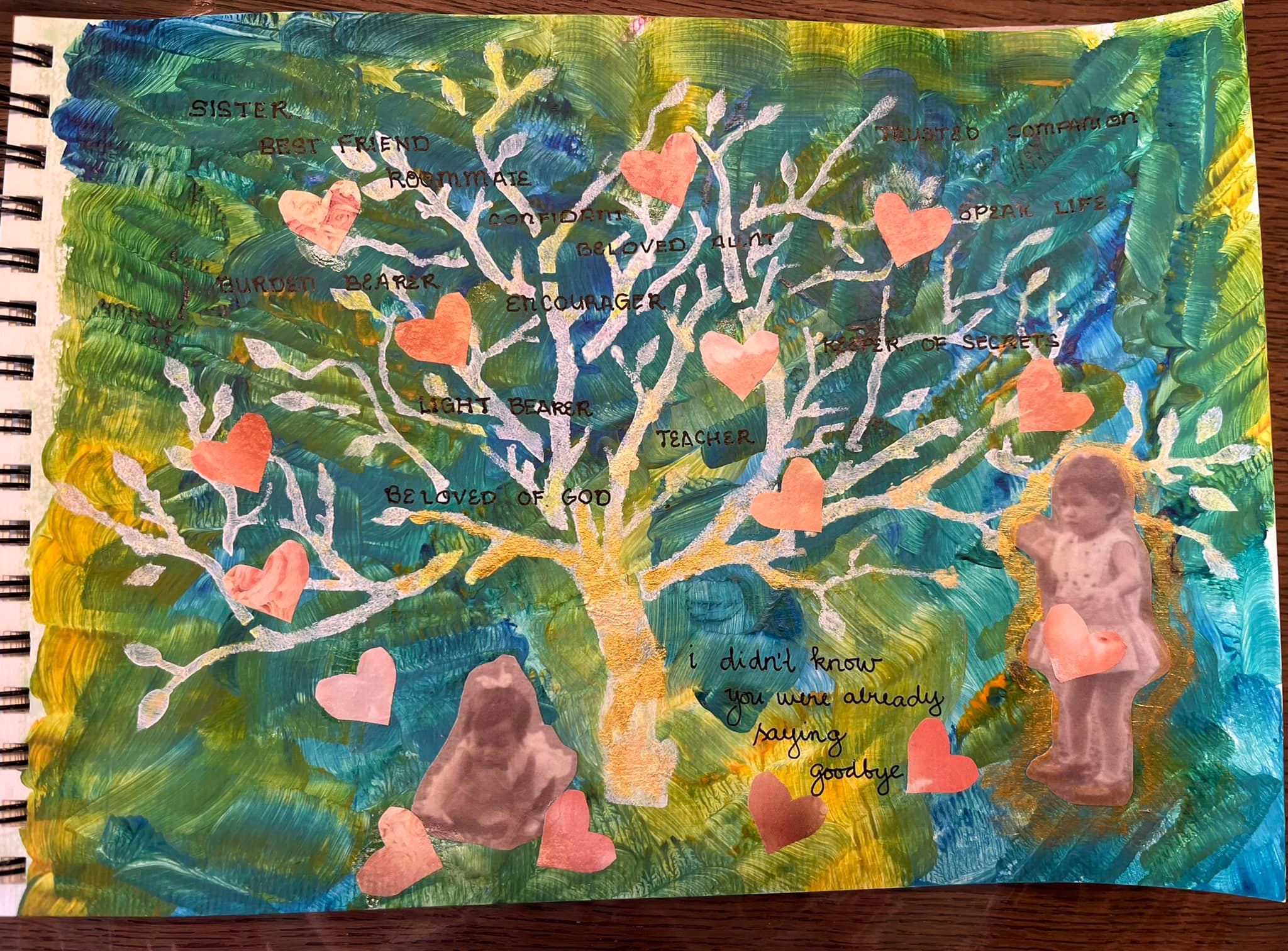
In 2022, when I was preparing for surgery, I had a dream about my sister. We were playing together under a big tree in the garden, and I was so preoccupied with what I was doing that I didn’t notice that she’d stood up and walked away.

Today, I remember my sister whose light I carry with me.

(Collage made in 2022)