Returning to the world of the Body Cartographer

Sometime in August, the English version of the story published in De Komeet is going up on Philippine Genre Stories. I’m very grateful to Mia Tijam for her patience with me as replies have been often delayed. I have a tendency to think I have done things and find out I haven’t. Chemo-brain sounds like an easy excuse, but this tendency is common with a lot of people who’ve gone through chemotherapy. It gets better with time and the longer you’re away from the last chemotherapy treatment, the more clarity you get as well. So I am very thankful for the gentle nudges and the patience coming from editors during the period I was in treatment as well as the period of recovery.

The publication of this story works like a jumpstart of sorts. I started thinking about the works in progress that I still had on my drive and when the call to join the Clarion West Write-a-thon landed in my inbox, I carefully considered whether I would be able to do it. A conversation I had with Marielle (Wegbree)made me think that the write-a-thon would give me an easy way to slide back into writing with some accountability. I thought that I could at least do some book reviews on the blog as a measure of how much work I was doing. But in the process, I found myself returning to my one drive. I had this idea that the drafts I’d been working on were still quite messy.

My first thinking was to go back to writing in the world of Raissa and Anghe. But somehow I found myself pulled back into the Body Cartographer’s world. (If anyone wants to read Song of the Body Cartographer, it’s still available online.) After my first round with radiation therapy, I started working on this long piece again except somehow it felt almost confronting. Mainly because it starts with the main character waking up after a moment of crisis, after a near death experience that changes her so much that she is no longer exactly as she was. Yep. I wrote those parts before I was diagnosed and continuing to write those parts felt too close, I had to put it away.

But now, six months after being declared in remission and after being told that the last treatment worked, I find myself drawn back into that world and I recognise the place my main character is at. Having a deeper understanding of what it takes to recover from crises and how life-altering that can be helps me to also see where I was making the journey to recovery too smooth for my character. But I also see how this crises doesn’t define my character. It has to become part of her life if she’s to really live her life. And I am reminded again of my oncologist telling me: you are more than cancer.

We are more than the physical challenges that we face. We are more than the crises we have had to overcome. We are more than our traumas and our illnesses. We are more than that. And so I want my main character to reach that realisation too because loss has been very much a part of this character’s life but those losses do not define her. Instead, I hope that she emerges stronger and more herself.

I’m thinking about worlds today because I’m going back to the team I’m working with and I think we are going to set world parameters or at least I hope we are. I would very much like to get away from the D&D model and I am hoping that this is a shared vision. If it’s not then I have to think on whether I’m okay with that and how to go about that. Of the games that I’ve played, the one that appeals the most to me is a game built on Belonging outside Belonging. I love it for the spontaneous creativity that it gives rise to–and yes unpredictable silliness which even if you know it’s silly, you just go with it because it is fun to be silly with friends.

So I suppose July is building up to be a month of lots of thinking and reading and writing happening. Something I would not have been able to predict a couple of months ago when I was down in the dumps about not being able to write. I am evidence that the Recovery and Balance programme pays off in spades.

Finally, if you’d like to support my quest to raise funds for Clarion West, please feel free to visit my fundraising page and press the donate button. I would love for us to go over our combined goal as that means more support for the workshop and the writers who will be going there. WordPress doesn’t seem to support embedding my page, but here’s the link to it:

https://givebutter.com/2025cw-writeathon/rochitaloenenruiz

Thanks so much for taking the time to read. I am quietly surprised when I discover people have read what I write here. I hope it offers some food for thought, some inspiration or anything that you can take with you on the journey. Blessings and peace and thank you for dropping by.
What I have read and what I am reading

Now that I’ve regained enough focus to read whole novels, I find myself missing the conversations I used to have with my sister. A lot of our conversations used to revolve around books we’d read and what we thought about the story or how the writer managed to do something well or not well enough. I think my sister was the original bookworm in our family and I simply followed in her footsteps because whatever my sister read, I had to read too. Anyway, I’ve started reading the books I downloaded onto my reader and I thought I would write a little bit about the one I’ve just started reading as well as the one that I just finished reading. I thought I’d switch between fiction and non-fiction. Non-fiction often takes me longer as I like to reflect on what I’ve just read.

Fiction Read:

I’ve just finished Tade Thompson’s excellent Far From the Light of Heaven. I’m pretty sure Tade has written and published a bunch of novels since this one, but I just got around to reading again and the title of Tade’s excellent murder mystery called to me. It took me a week and a half to finish reading (this is my current reading speed for novels) but I never once lost track of the thread of the story. I’m also glad that I decided to get a tablet because it’s made it easier for me to just open a book and read when I’m on the train or when I remember that I am in the midst of reading a book.

I understand the importance of titles now because for some reason, that title just kept jumping out at me each time I clicked on my reader and I decided that once I had enough focus I would read that novel first. Far From the Light of Heaven makes use of elements of space opera and science fiction but at the heart of it, Far From the Light of Heaven is a murder mystery. The stakes are high and I liked how the characters feel real. I have to admit a fondness for Shell Campion’s Uncle Larry. I could relate to that feeling of wanting to protect someone younger who you consider part of your family. I found myself quite intrigued by the Lambers as a race and I want to know more about them. Reading this book, I also had to think about conversations around AI and the use of AI. I like how Tade doesn’t take sides on that, but tries to show how AI can be useful but also how it has its vulnerabilities and can be subverted in a way that it becomes a danger. I don’t know if this was intentional, but it felt very much so.

One of the things I loved about this novel is how we get to see how what happens on and to Ragtime affects the world the characters live in. It’s a reminder of how actions taken reverberate in the world. The question becomes this: do those actions lead to understanding that brings lasting change or do those actions lead to polarisation and division in the society around us? I may very well be putting my own interpretation on it, but this is something I thought about when I got to that part. Another memorable scene for me is the communal rite of grief/processing trauma.

I won’t say anymore as I might spoil the book for those who haven’t read it yet, but if you enjoy murder mysteries that are more than just murder mysteries, this might be just the book for you. Highly recommended.

I have a rather lengthy TBR list and I think I would like to try and write about as many of them as I can. I’m pretty sure there are things I’ve read in the past three years and a half that I forgot to write about.

Current Non-Fiction reads:

As I tend to dip into multiple non-fiction books at one time, I might write about my impressions from those books every now and then.

I’ve started on Karen Barad’s Meeting the Universe Halfway. I don’t even know who recommended this book or why I decided to buy it, but I’m pretty sure the person who recommended it made an impression on me. Anyway, I’ve just started reading it and there’s a line in the preface that just resonates so much with me. In the preface, the author writes about entanglements and how to be entangled is not simply being intertwined but it’s more than that. It’s a really great preface and if you’re interested in quantum physics, it does look like an engaging read.

A recent book I’ve recommended and gifted to fellow community workers is Aminata Cairo’s Holding Space. Aminata was one of the guest facilitators for LIMBO and the workshop she gave was joyful and beautiful and one that opened up space for stories to be shared and told. In this book, Aminata talks not just about holding space, but shares her own journey towards holding space. It’s a book that calls for reading and re-reading and for dipping back into when you feel the need.

Just yesterday, I had a lovely conversation with a friend who shared this line with me from a conversation she had with an older Dutchwoman. In that conversation, the Dutchwoman spoke of her husband, not as passed away or dead, but as someone who had stepped out of this timeline. I rather liked that phrase and it makes me think that entries like these are like missives sent to where my sister now lives–in a timeline that is outside of this timeline. It’s a lovely, lovely thought.

What are you reading now and what from those readings do you choose to keep with you?

Things I’m thinking about today

The past week has been quite intense and quite busy as I traveled back and forth from home to Amsterdam. The travel is a little more than an hour and when I get to the station I’m supposed to be at, it takes another 10-12 minutes before I’m at my destination.

Last week, I was at the Vrije Universiteit Amsterdam for most of the week where I participated in the Spring School Co-Creation Lab. This was the first Spring School held at the Faculty of Social Sciences and I believe the intention is to have a repeat of this every year for a period of time. The effect of what’s taking place in the US was quite visible at Spring School as events over there made it impossible for one of the invited guests to travel to us in Amsterdam.

It did give me a chance to talk about science fiction, visionary worldbuilding and science fiction as an instrument that can be used for thinking through issues that concern us and then we did a collaborative world-building exercise.

In asking the questions around collaborative exercises, it reminded me once again that in the work we do where we want to bend the needle towards justice and equality, it’s necessary to remember what our community’s vision is. To consult and collaborate and work together even when the outcome is not what we expected. It reminded me too that in the kind of work that we do where we seek to advocate for and are working for communities on the margins, listening and paying attention are some of the most important things that we can bring to the table. (There are a number of other things too like love and acting on the principle of seeing each other as Kapwa, as connected, as human.)

For myself, attending Spring School made me realise that I have to face up to my own responsibility to my written work. One of the comments I read somewhere said that a lot of the links on my website led to dead-ends and it looked like I hadn’t updated in a while. This is, in fact, true. For a long time, I didn’t have the energy or the focus to update this space. I knew the links were dead-ends, but I kept thinking: who cares anyway?

From listening to the conversations around me, I realised that it was important to keep an accounting and a documentation of things I’d written and published. Not only for me, but also because it might help someone else down the line. So, I found myself searching through my disorganised drive, trying to locate as many of the columns that I wrote for Movements as well as other non-fiction work that I had written around change, decolonisation practice and women’s work. (I’m compiling them to create a pdf that can be downloaded for anyone interested in reading. Suggestions are welcome as to how I can make it available as I’m new to this.)

As I was reviewing the work I’d written, I found myself quite emotional. I remembered how a lot of the non-fiction work that I did is what supported our family through the most difficult periods when Jan didn’t have any work and often pay from whatever writing I managed to get published was what helped keep the children fed. Interestingly, my kids don’t seem to remember that time as a time of hardship. It was more like: we ate noodles for a week and it was great!

Writing this my heart aches because I know there are parents at this time who despair because there is nothing to feed their children with. There are parents who don’t even know if their children will survive to see another day, and there are children without parents to worry over them. Having noodles for an entire week sounds like heaven when food supply has been cut off or withheld by the powers that be. What’s happening in Gaza, what’s happening in Sudan, what’s happening in Ukraine, what’s happening in all the places where war and oppression are taking place happens to all of us and we cannot allow ourselves to become numb or to look the other way.

For those of us who live in places of privilege where there is no war or famine or fear of rockets detonating over our heads, while we may not be able to jump on activist boat like Greta Thunberg, we can still do something. We can listen. We can advocate. We can bear witness.

Blessings and peace to you who read this. May we ever be striving to move the needle towards what is just and true and may we recognise how we are connected in our humanity.

Updatery and such

It still continues to be busy. In some ways, it’s busier than it was. In other ways, it’s a bit more quiet. I like that I get to have alone time when I can do whatever I like but the house has its demands and there are things that need to be done.

This past month, I finished working on an essay I’d promised Maurice Broaddus. I think of the encouragement that comes to me in emails, in publications (Magnifica Angelica Superable was published on Lightspeed this month), and in conversations had with beloved ones. It may sound strange but I feel like I am coming back from a long way away.

I think of Laura telling me how deaths of those close to us change us. I think of one of our friends telling me that when his father died, the world narrowed down and became somehow sharper. Different.

I think of what it’s like to fall in-between cracks and how there is that moment between losing someone and being alive when it feels like the left behind are hovering somewhere in a place like indefinite limbo while the world goes on.

It feels just right that I am reading a Terry Pratchett’s The Amazing Maurice and His Intelligent Rodents with my youngest son. Youngest son can read the book all by himself, but we borrowed this book expressly to read together. A bedtime ritual where he listens and imagines while I try to make the story feel as real as possible with the reading of it.

There is death in this book. In the past two nights, two of the intelligent rodents have died. Pratchett doesn’t turn away from those deaths. Rather he lays it on the page, factual and clear. It happened. A rat died. We stand still for a moment, thinking on that death and then Pratchett moves us onward–the story continues. It’s not that the death doesn’t matter. It does, but life goes on and characters move forward and think about what happens next.

On some days, it’s a dilemma. How to make it so that a child doesn’t sink into the quagmire of sorrow and despair.

Tearing a book out of Pratchett’s page, I acknowledge my child’s sorrow. It’s sad and it’s a terrible thing, but tomorrow is a promise. Let’s think about what we want to do tomorrow. Where do you want to go? What do you want to see? What about next week? What about next month? What about next year?

I understand very well that grief doesn’t ever go away. That grief is not a neat and orderly process but it comes in waves and flags and sometimes at the most inconvenient and untidy of moments. It is as it is. There is no changing the reality. But we go on. We hang together. And then, I find myself thankful and glad that I can still be here for my children.

The work-in-progress, Eightsquaredcon and blogs I read

It’s been ten days since I last updated here. I’ve been engrossed in the work-in-progress which is coming along quite well. When I wrote the first draft of this novella, I was very concerned about the war and how it would go and how it would end.  As I was working on the rewrite, I realized that revolutions aren’t just about the war and the road to freedom is more complex than winning a battle. Extensive rewrites are taking place and I’ve added another dimension to the WIP that wasn’t there in the first draft. I’m really hoping I finish this soon. But as with most of what I do, it’s going to be a lot more than just getting from point A to point B.

I’ve been catching up quite a bit online and I thought I’d share some blogs that I visit from time to time:

Decolonization:Indigeneity, Education & Society has lots of thoughtful and thought-provoking stuff. Go read.

For critical Dutch readers, I can’t stop recommending Roet in Het Eten.

And Tiger Beatdown always has thought-provoking stuff.

I’m also trying to catch up on my TBR as part of my preparation for Eightsquaredcon. I’ve offered to moderate a panel on non-western SFF and will be participating in several other panels.

There are regular updates at the Eightsquaredcon blog.

Reading and Interview on Radio Redmond

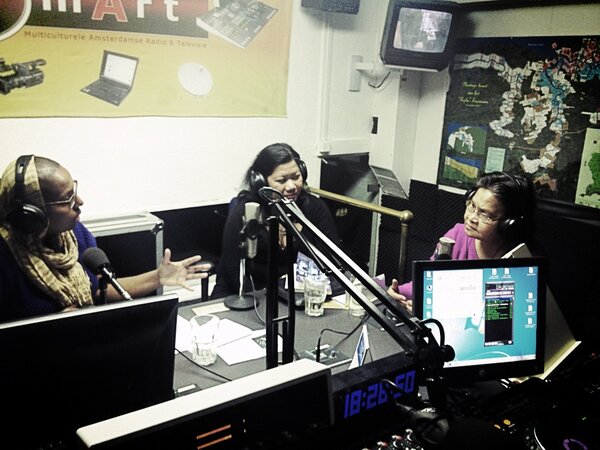
It was wonderful to meet the brilliant and talented crew of Radio Redmond and Roet in Het Eten. I read from Dancing in the Shadow of the Once from the Bloodchildren Anthology. Here’s a link to the reading and the interview. The reading starts a little bit after 18 minutes. The rest of the broadcast is in Dutch. In short, we talk about the Octavia Butler Scholarship Fund, the need for diversity in the field of SFF and the themes that appear not only in Dancing in the Shadow of the Once but also in my other work.

After that first hour, another guest came on the show. Coring de Los Reyes. We discussed the state of undocumented migrant workers in the Netherlands and why it’s important for the Dutch government to ratify ILO Convention-189. Ratifying the convention will grant protection to the undocumented migrant workers and ensure protection for them.

Considering how progressive Dutch government and society claim to be, it will be interesting to see whether they live up to their reputation of being forward-thinking and humanitarian. I say, the Dutch government should recognize the contribution of these migrant workers and offer them the protection and the recognition they deserve.

Image

(From L-R: Hodan Warsame, Rochita Loenen-Ruiz and Coring de Los Reyes. Photo via @roetinheteten )

(Also posted on http://rcloenen-ruiz.livejournal.com)