Create and co-create

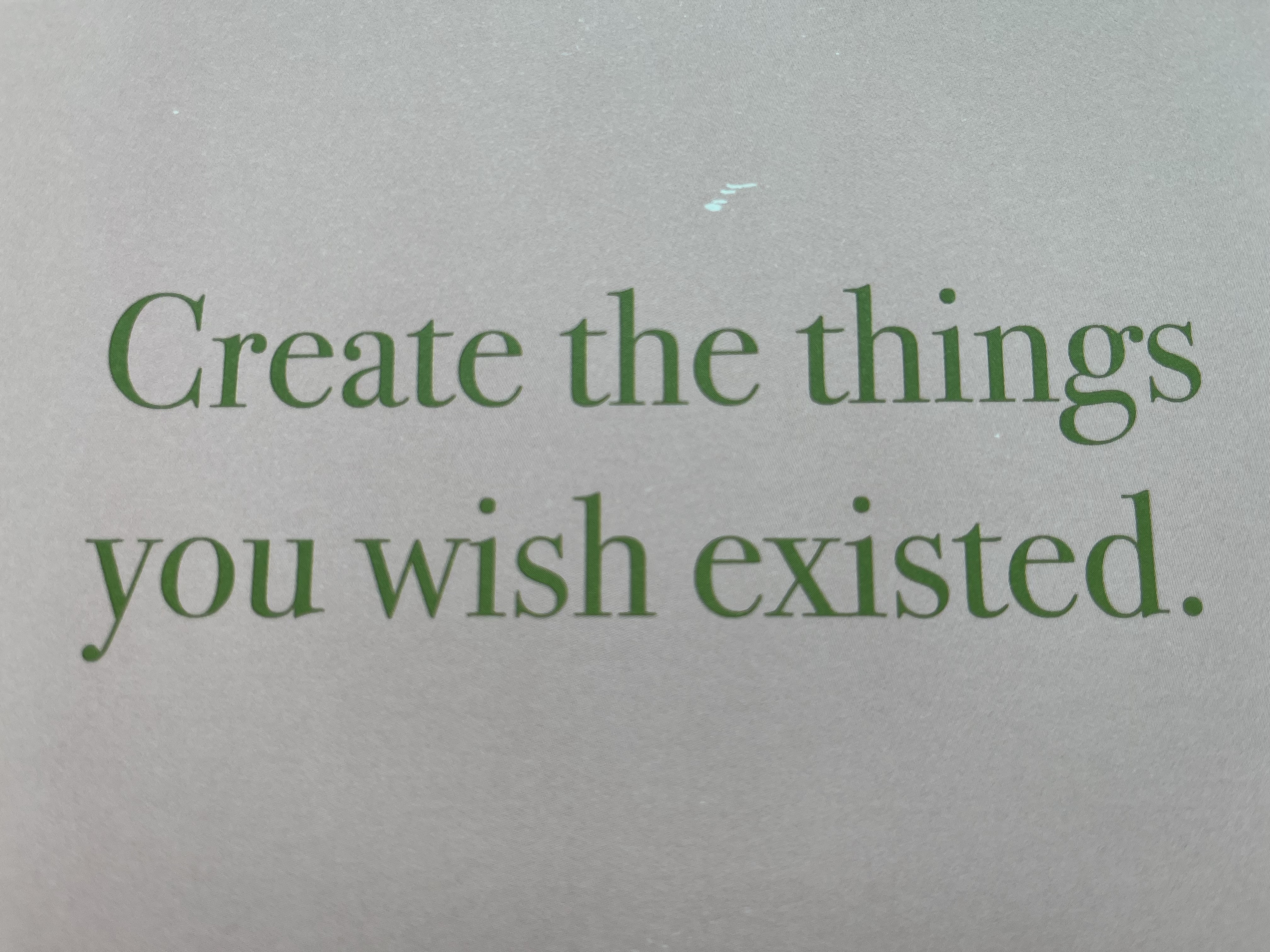
On my wall, there’s a postcard with the words: Create the things you wish existed. It’s a card that came with an order of art supplies and I loved the words so much I pasted it up where I can see it as a reminder.

From one of the mailing lists that I subscribe to, there’s a link to the work of an amazing artist named Leilah Babirye. If you have time, click on the link leading to the video as it’s so inspiring and a great reminder that when we are engaged in art, we can’t be afraid.

I’m thinking about this as I think about LIMBO and the participants who come to share and create together. More than the things that we produce or make during the time together, it’s about how we hold space for one another and create together the kind feeling that exists in that time. When it’s my turn to give the workshop, I step into the space and think about who’s here and what do they need. Where Leilah talks about reading and listening to the piece, facilitating means listening to the space and reading with the heart. I bring to the workshop all the things that I have learned from other practitioners and I bring also what I have learned from my own journey.

Yesterday, we engaged in making rhythmic combinations, dance steps and improvisations as well as song. I had in mind this idea that we needed to give an answer to the wishlist that had been presented by participants sometime at the start of the season–the wish to create a LIMBO dance as well as a song that comes from us and expresses us.

There was laughter, there was singing, there was lots of body movement and dancing and there was a beautiful musical rendition gifted to us that afternoon by one of LIMBO’s participants.

I love how moments like these give rise to spontaneous sharing. It’s a testimony to how participants feel safe to talk about what they’re going through and what they’re feeling in the moment. To me, it’s this precious quality that we need to take care of when we talk about community.

Today, I am thankful for the privilege of being invited and included in this community. One of the things I’ve learned and continue to be reminded about in LIMBO is how it doesn’t matter that there are moments of discomfort and unease–that sometimes topics can become fraught–that people will have differences. But this is okay. I think of Aminata Cairo talking about family gatherings and how there may be that uncomfortable relation who can get argumentative and you think: Oh, I will just keep a distance. But even so, if we believe we are all connected, then there is still space for discomfort. We don’t always need to resolve it, but we can acknowledge it.

(I want to note here that I do think it’s important to draw a line at abusive and harmful behaviour.)

At present, I’m already looking toward our next gathering which will be on the 1st of June. I’m thinking of how to approach this workshop as we prepare for the launch of LIMBO’s second booklet. For the launch, which will be on the 20th of July, we’ll be going back to FramerFramed as a podium has been offered to us for use against the backdrop of an exhibition about transformation. It’s so very apt. I’m thinking of festive feelings. Of glitter make-up and shiny clothes, of dancing and singing and color and joy. We’ll be creating this programme together, creating this launch, creating this space and holding it for one another.

To you who read this, take time to listen to a beat and move your feet. Thank you for stopping by. Blessings and peace be with you.
some thoughts on boundaries and flow

Yesterday, I attended a workshop called Envisioning 2024 which was organised and led by my LIMBO partner, Lana Jelenjev. I didn’t make the first part of the session as I have students to teach but I was able to join the second half of the workshop in which we were led to think on what Flow and Boundaries mean to us and what kind of response thinking about Flow and Boundaries produces in our bodies.

Thinking on boundaries, I was surprised to discover how my feelings towards boundaries had shifted and changed and how I’d come to see boundaries like an embrace that keeps me from using up all that I am. Boundaries are there to protect and not restrict and so when someone tells me where their boundaries are, it also makes me see that this isn’t a rejection of myself, but it is the other person asking me to recognise what I can do to take care of them too.

I think of boundaries in terms of the culture that exists within the Filipino community where there is often a tendency to cross over and push beyond boundaries set by a person. ‘Sige na’, we tend to say or ‘kahit saglit lang’. It’s harder when the person pushing is an older person because respect for our elders is so ingrained in us that sticking to our boundaries can be made to feel like disrespect. I want to say here that it is not disrespect to say “these are my limitations”. And saying yes to every ask or crossing our own boundaries can be more harmful than helpful to us and to others.

During the course of my treatment, I’ve had someone ask me to be present at gatherings and in response to my “no”, I’ve sometimes been told that just showing my face should be enough and I should remember this is my community. It’s a response that isn’t worth an answer because it tells me enough about the person saying it. I do not always have to be present and if my absence means I am no longer part of the community, then perhaps the community never considered me part of it. It may sound harsh saying it like that, but my community and my family are those who understand why I can’t always be there. Why I can’t always say yes. Why retreating into my shell is necessary for me and how not being present is also part of my healing.

There is a beauty about the way in which the community I am in, right now, approaches this. An offer is made and it is up to the person who needs to come up and say: now, I need. Or now, I want to be present. Or now, I am ready to speak or to be in the group. It’s not that you are forgotten when you don’t speak or are not present–people do check-in from time to time just to ask how are you today. But the beauty of this is how it is absent of pressure that often leads to stress.

Thinking on this, my thoughts circle back to LIMBO and how much being in this space has enriched my understanding of the kinds of worlds that are possible if we allow ourselves to let go of existing learned systems. I think of communities where care is central–not just care for another but care for the self.

You don’t always have to have the answer. You don’t always have to solve the problem. You don’t always have to be present. You can always say: I hear you. I acknowledge your need. But in this moment, I need to not be present. In this moment, I don’t have the answer. I don’t know. I don’t have the answer. And maybe not knowing or not having the answer or not being able to do anything makes us feel vulnerable, but maybe this kind of honesty opens the door to the other so they too can be vulnerable and free.

Blessings and peace to you who read this and Agyamanac Unay for stopping by.

Looking towards Dysprosium: an open confession

Here’s where I admit to suffering from a serious bout of pre-convention anxiety. I’ve been to Imagicon and that went well, but it was a convention based in the Netherlands and I went there knowing that most of the folks I’d meet have no connection to anything that went on last year. For a while I considered backing out of going to Dysprosium–and as the convention drew near I’ve vascillated between extreme moments of anxiety and trying to hide in my bed while trying to maintain the household. It’s just that I’m taking my eldest son to Eastercon for the first time and I know the con experience has given him the confidence boost that he’s sorely needed–it’s like he’s found a space where he’s free to be the person that he is.

But anxiety…it haunts me. Regardless of the fact that I know I will be surrounded by friends who care for me, I have heart palpitations and am filled with the same kind of terror that I had when I was preparing for Nine Worlds last year.

There’s this thing about having experienced hostility in places that you once felt at home in. During my sessions with my therapists, I talked about the struggle I’ve faced as I try to prove wrong all the stereotypes leveled against third world women in a relationship with a white person. It’s a damned hard struggle because I’ve already been confronted with it–because some folks have judged me as being that third world woman who latches onto a white person for economic gain. And that isn’t even counting the in-your-face racism where people tell you exactly what they think of people coming from your part of the world–but “oh, I don’t mean you.”

The greatest source of my pre-Dysprosium anxiety comes from this being a London convention. It comes the possibility of being in the same area as people who have judged my right to my choice of friendships and my right to form my own opinion and my right to support what I wish to support–for not being angry enough or outraged enough–for being robbed of the choice when to speak and how to speak. This outright act of racism, coupled by the experience of knowing that I am “a piece of shit” to certain people–it’s what makes me feel anxious and unsafe.

Why now? People may ask. Why write about this now?

In writing this, I want to bring home the truth of what it feels like to be a person of color who has been treated like “the shit” certain people think I am simply because I did not fall in line with some unwritten party policy.

At the height of last year’s incident, someone questioned my right to write what I have been writing–after all, I am not a person with academic credentials, no MA’s no doctorates–only passion. Today, I grab hold of courage and remind myself that I am not here because I have the right degree. I am here because I have something I want to say and regardless that I’m not considered a “proper scholar”, I am committed to change in my lived life, in the society I occupy, and in the field I work in.

There are those who’ve questioned too, the depth of my relationship with Tricia Sullivan. Holding up this relationship and using it as an excuse to say I identify as white. What people don’t see and what people have never seen is how during my second year at Eastercon, when I still knew nobody and when I was barely anybody, Tricia Sullivan opened herself to me and treated me as an equal–not because I had attained something but simply because she saw me. It’s hurt me deeply to see Tricia vilified and made to appear as someone who is a villain–but in all these things, I have always seen Tricia’s heart and that she’s been made to feel unwelcome and unsafe where she only sought to create a wider space–that the beloved friend of my heart should be treated as if she were nothing more than trash–I cannot put into words how it’s made me feel.

I find myself wondering how people cannot see the double standards that are applied in this case. How is it that people do not understand that it is possible for a woman of color to stand up and choose to stand by a white person? How hard is it to comprehend that I would rather be hurt, because I know my own heart and I would rather take that hurt than to see my loved ones harmed? My choice. My decision. My stand. To me these are the things that have been on the line–my right to be a self-governing person who makes the decisions I make and to be treated as an equal when I choose to speak and to say what is on my mind.

I think it’s hard for most people to understand this pain and I am writing now from a place of pain and deep grief and I have to put this out there because to paper over this pain, to pretend it isn’t there–that’s something I can no longer do.

For some, deep friendships between white folks and people of color seem an impossibility. I will tell you, it’s not. It’s not impossible to love a white person so much that you see their flaws and their faults–to see their heart–to understand and embrace that person flaws and all because love sees and embraces all things and understands.

I think too of how narrow our vision is if we cannot see that.

I certainly can not and could not have come this far without my beloved friends, without my companions, without kadkadua and dear ones who have embraced me as I am, flaws and all.

So yes, I am anxious–terribly and incredibly anxious. But I am going to Dysprosium. I will be there. I will be doing barcon and will be sitting and catching up with beloved friends and companions on the journey. I will be there because I am doing what every woman of color has done before me–I’m facing down the dragon of anxiety that comes after you come to realize that not all those who call themselves ally truly see you as a person in your own right.

I refuse to become invisible. I refuse to be erased. I refuse to go away. No matter how anxious I may be, I will be there. I will not be silent.