On Reading Kate Elliott’s The Witch Roads while travelling

I read Kate Elliott’s The Witch Roads while travelling in Norway and I feel like this was the perfect companion book for my travels as each time I looked up at the mountains or hiked a path, I would think about Elen and her crew travelling through the lands of the Tranquil Empire. Of course, the roads we walked and the paths we hiked were not at all as rough or as challenging as say the crossing Elen and company make at Grinder’s Cut (also there is no pall in Norway). But still, it gave me a sense of satisfaction to observe how time passes when your main form of transportation are your legs. Of course, there are also carriages and horses in this book, but the pace of travel is perfectly done and also a perfect way for the reader to get to see and know this world and its perils (mind you, it’s not just all peril. There is also sense of wonder in walking through this world). I found myself quite enchanted by the pacing of this novel which wasn’t a quick read because I had so much going on that I also had to keep putting it down. I’ve had some books where I eventually give up because I have to start all over again, but this wasn’t a problem with The Witch Roads. Picking up where I’d left off wasn’t a problem with this novel. Rather, it felt like picking up the thread of a journey once again and going: Oh, yes. We did this yesterday and so we’re going onwards.

If I’m giving the impression that The Witch Roads is a tame read, let me disillusion you. The Witch Roads is far from tame. There is an imperial prince and there is a haunt. There is danger because the company must stay wary not only of possible ambush, but also they need to stay wary of spores and the pall. There is magic and there is all kinds of love, from filial love to love born of allegiance to the kind of love that transcends. There are also lots of secrets and I feel like there is even more intrigue and danger waiting in book two.

There are so many deep and speaking lines in this novel. I thought I should post some of them, but I’m just gonna say: go read the book and highlight your favourites.

The Witch Roads is not just Elen’s journey or the haunt’s journey or the Prince’s journey, it’s also Kem’s journey and there’s something so beautiful about how Kate Elliott weaves all these things together and by the time I reach the end of this novel, I find myself thinking again about the question of who is the centre and where is the centre and from whose perspective narratives take place and it’s beautiful how Kate Elliott reveals the ways in which this journey has changed the different characters in different ways. Bringing them to places where they understand theirselves and those around them better.

Yesterday, I was at the Bryggen’s Museum, observing tapestries made by the tapestry artist Ragna Breivik (currently on exhibit at the museum). While observing the loom on which she worked and thinking about all the different threads and shadings and the amount of detail and work that went into making tapestries that continue to speak to this day, I thought of the way Kate Elliott’s work does this kind of tapestry making with her words where all the little threads come seamlessly together forming a story with different shades of meaning and texture.

The Witch Roads gives us a world that’s rich and full. Complex characters, each with their own path and their own priorities. We get the narratives around inequalities and the different relations that exist between different strata in society within the world but these are done not in an intrusive or shouty way. Thread by thread, shade by shade, with intention, Kate Elliott gives us this world that is rich and full peopled by complex characters who we can identify with and love.

For all that this first book ends with a foreshadowing of what might come in book two, book one leaves me feeling satisfied. I’m a bit impatient to know what happens next (of course), but there’s a lot to reflect on and think on about the first book and I’m very happy about making the choice to pick up this novel and read it (even though I tend to try and not read unfinished series).

On the dedication page, Kate Elliott writes about how The Witch Roads duology reignited her love for writing during a rough period when she wondered if she should just quit. I am so thankful she decided to keep on writing and I hope she will continue to do so because the world is a better place for having her books in it.
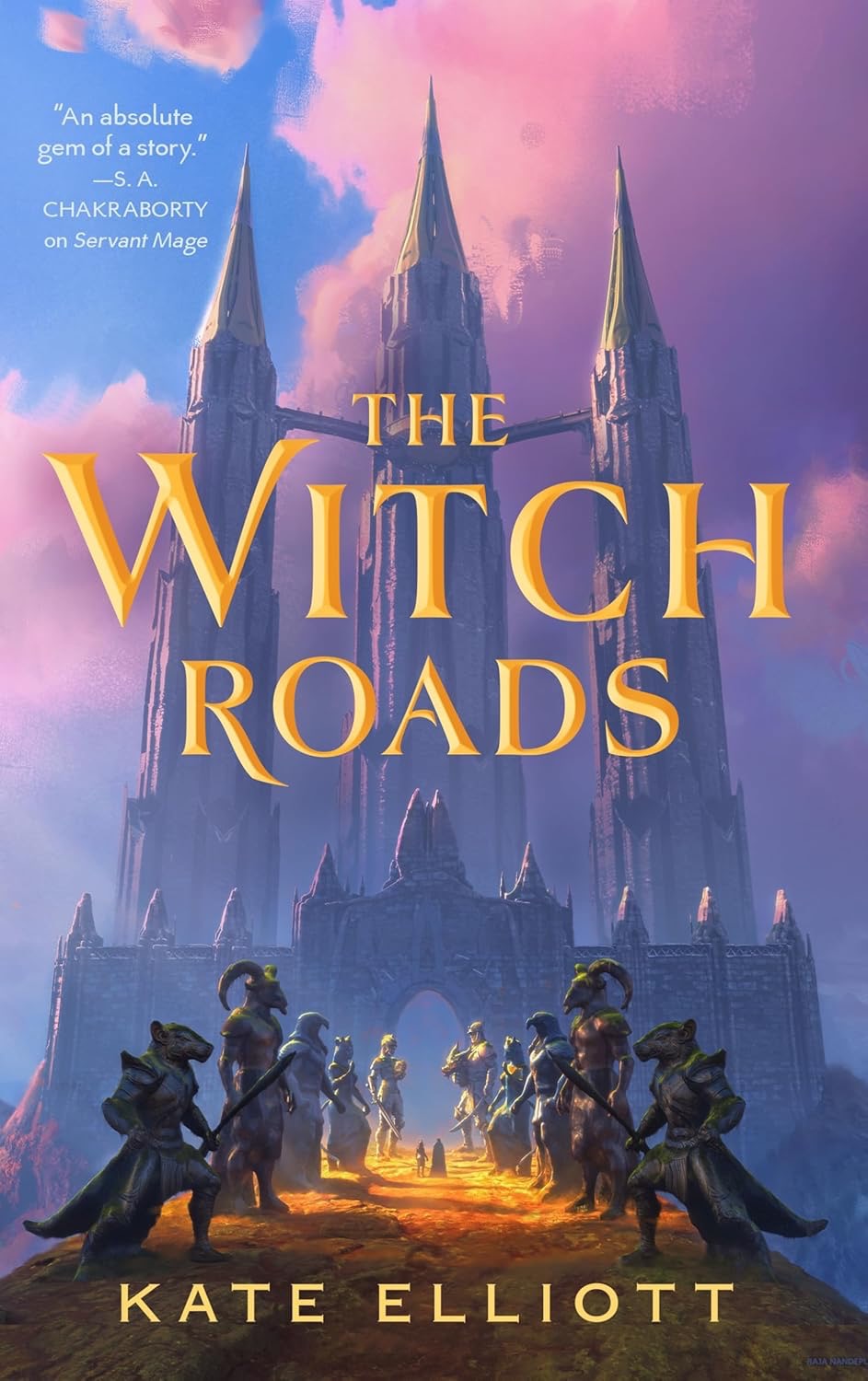
The Witch Roads is published by Tor Publishing Group.

Important note: I purchased my own copy of this novel, as I have done with most books that I write about. Reviews or thoughts on these books appear as time and energy permit.
On my mind today

One of the marks of a good leader, my father said, was the capacity to encourage others to make full use of their talents and to make others grow into their gifts. It’s not about having the loudest voice or being the most visible, it’s about thinking on how we can help others discover and become their best selves.

My Mom also used to tell me that the sign of being a good teacher was when your student outgrows you and no longer needs you.

I think about these things because one of the writers who came to attend the six week workshop I gave for Other Futures (and who I’ve been mentoring a bit since then), was accepted to the Clarion Workshop. It is quite a milestone moment and I feel like a proud mama bird watching a fledgling spread their wings.

Last Saturday, I got to do one of the things that brings me joy. I got to work with young people again. This is a thank you to Lana Jelenjev and the Neurodiversity Foundation for inviting me to give a workshop to young people between the ages of 11-17 as part of celebrating Neurodiversity pride day.

There’s something about the way young people approach the act of creating together that makes me so hopeful. I saw the will to encourage one another, the willingness to compromise and make space for each other, and the readiness to help when the other person gets stuck. As Lana’s husband said afterwards, we could all learn a lot just by watching the kids work together.

It makes me think of how we all have that capacity to create and work together within us. Maybe it’s just that some of us didn’t know that we could just go about it, or we’ve been so programmed with this idea of individualism (mine is mine and yours is yours), we’ve been trained to think so much in boxes that we forget the joy of collaborating. And then, there is this soul-killing thing which I’ve sometimes observed in the grown up world where people think the important thing is to be better than someone else, win the most awards, have the most fans, make the most money, sell the most books…that sort of thing.

Life and art and the creation of story are not a competition. It’s not about having the best words or the coolest ideas, it’s about feeling safe enough to share what you love that make life and art and creation beautiful. What I loved about Saturday’s workshop was how I got to see young people bounce ideas off of one another in a space where they feel safe from being judged or found wanting, they just went ahead and talked about things they loved or were passionate about and they made space for each other to include those things in the worlds they were creating.

This method of creating together is a practice not only in worldbuilding but also a practice in bridge-building, in compromise and collaboration.

We could certainly do with more bridge-building and collaborating in these turbulent times, because it often feels like we have forgotten concepts like meeting each other halfway and compromise. We think we have waited a long time for change to happen and we would really like for change to have happened yesterday. The problem is, we live in a world that’s run by systems and systems are slow and resistant to change. As a good friend said to me: “you think maybe by being in the system, you can change the system, but it’s such a complex thing because by being in the system, you somehow become part of it.” I really don’t know what the answer is. We can only do what we can to the best of our abilities and hope that the little that we do will create some change no matter how small.

This week, I was in conversation with a dear friend, we also talked about this same thing. She told me about how she learned to think in terms of “good enough”. Perhaps it’s not the ideal change, perhaps it’s not the big change that we wanted, but maybe it’s good enough for now. How change happens in increments of time, by checking in and finding out whether a recalibration is needed. Maybe we can move forward a little bit more or it could be that we have to just be satisfied with good enough until the next check in moment.

I think about the words “good enough” when I have the conversation with my oncologist later in the day. I ask my questions and she patiently explains her interpretation of the data. It’s not yet where we want to be, but it’s good enough for now. And while the ideal would be to be completely rid of all the tumors, nodules, lesions and bad cells floating around, a stable or chronic state for a long period of time would be good enough.

It may sound like a strange comparison but I make these jumps in my head because that’s how the brain works. I think: it’s okay to not achieve the ideal all in one go. It’s okay to take it step by step. The important thing is to remain open and curious, interested and ready to look into options and points of compromise. Yep. I’m making the body and world parallel again.

Today, I’m speaking to my body. I’m thankful because I have a strong and sturdy body that has withstood a massive operation and all the treatments so well. I am thankful that I am able to work at regaining the strength and fitness that I had before it all started. I am thankful for the spirit that lives in me, that reminds me to take it one day at a time. I am thankful for today. Thankful that I can hug my son and tell him how proud I am of him (he’s having a bit of a tough time atm). I am thankful for friends who have reached out to me, for loved ones and for people from surprising places who tell me they are sending healing thoughts or praying for me. There’s always something to be thankful and joyful about.

As long as we have life in us, we are not without purpose. We are here to make as much of a difference as we can make. Sharing our stories, passing on our experience, strengthening and encouraging others to spread their wings and fly–discovering things, making memories (all those other things) remind us we are alive. As long as we are in the world, we can make every moment count.

Agyamanac Unay for stopping by. Blessings and peace to you who read these words.

What does it mean to flow without borders?

I have had in my mind this thought which I came back to me and seems to become more concrete as I try to put it into practice: what do we mean when we talk about a world without borders? Or what do we want to see? Or how might that experience be like if there were only superficial restrictions in place and if we could — as Glissant expressed it, move through to taste the atmosphere of a place. I have to go back to reading Glissant because a lot of things are mixed up in my memory (chemobrain) but this definitely stuck and remained with me and I was reminded of it again when in one of our latest LIMBO meetings, some of the participants asked why is it that we have to put borders in place? Why all these restrictions? Doesn’t the world belong to all of us?

I went home thinking about borders. How do we see borders? Are they protection? Who is protected by these borders? And who are we protecting ourselves from? And why do we need to keep others out in order to feel protected or safe? What do we mean by safety? What do we mean by security?

I asked these questions of myself because I live in a country to which people from other countries migrate to or flee towards to ask for asylum. I live in a country in which the discussion around migrants and asylumseekers is so fraught that one actually risks losing friendships in the process.

I don’t have the power to make change happen on a big scale and I don’t have the power to go out into the large arena and make discussions happen but I thought on how to bring that practice of flowing through borders into a very small space.

For this month’s LIMBO, I thought of asking participants to work together to fill up white space with writing or drawings, with lines or curves or symbols, with whatever they can think about to express their presence in the world. The invitation being this: if someone puts down a mark, how will you interact with it? How will you cross the borders? How do you enter space where you didn’t put a mark first?

It’s an exercise that I find myself wanting to repeat with others. Without our realising it, we have our own concept of borders, even on something as small and simple as a piece of paper. Creating on a space reserved and marked yours feels different from creating in a space that says–this is for all of us. Leave your marks, interact with other marks, there is no one artist, no one author, no one creator, it belongs to all of us.

There are questions that arise from this exercise that I also want to think about and which I find myself curious about: how does it feel to cross over into another space? What changes once you make that decision to leave a mark there? To interact with something that’s there? How does it change the way you perceive the work?

I didn’t get to ask this of the group, but I find myself wondering: How do exercises of collaborative creation change the way we see the world and the way we interact with one another?

In talking about this with a dear friend who is a fellow artist, activist and also a writer in the field, I expressed a vision of a room that becomes filled with doodles and maps and words and drawings. And how, it would be interesting to discover how willing we are to layer on top of what is already there and how that space would not be a work attributed to any one person but it would be attributed to all who collaborated whether the person is invited or comes upon it by happenstance, where those making marks can also be living creatures that we take care of.

Writing this, I realise that I am writing about the world we live in. We are all in the process of creating or re-creating, making or re-making, building or re-building–perhaps we layer over what is already there–we bear witness. We see how systems put in place have shaky foundations and how those who benefit from these systems try to prop them up. We bear witness, we offer criticque. But is offering criticque enough?

Marking the empty page to make something together can involve some risk. Stepping out into the world, making a decision to make or leave a mark involves much deeper and more thoughtful movement. What kind of mark do I want to leave? How will the mark that I leave affect those whose spaces or whose lives I live a mark on?

In any case, for me, the question strikes closer to home and makes me think that if I have marked my children with love and care and the ability to be thoughtful and considerate of others, then some of what I am meant to do has been done.

I wish I could share the picture of our collaboration, but it belongs to the group. But perhaps it’s an exercise some of you who read this blog might want to try on your own. Just take the step. Make the invitation and see where it takes you.

Agyamanac Unay for stopping by. Blessings and peace to you who read this.

Bucketlist

There was a time when I was a struggling university student that I used to go with a girlfriend to one of the high-end shops in Ayala. My girlfriend was tiny and fair-skinned and looked like a princess and while she had to make do with her allowance (just like I had to) it was quite obvious that she was from a well-to-do family. In the Philippines, fairness is associated with wealth and my darker complexion as well as my non-fairylike appearance made that people tended to associate me as coming from a lower economic bracket. Not that I cared. But well…anyway…my girlfriend liked window-shopping and so we would window-shop at those high-end stores.

We had a planned dialogue, my girlfriend and I. She would try something on, come out of the changing room and ask me what I thought and I was supposed to say that I wasn’t quite sure if it was really her thing. Of course, she would later on squee about how much she liked it but as we were struggling students, just being able to see what it looked like on her was just as good as buying things.

During one of these outings, she proposed making a list of things to buy. She showed me her list and said I should write one too. To humor her, I also made a list of things which included a watch from some upscale brand. We later parted ways and as tends to happen, we lost touch.

I have to laugh today because I just sat down to write a bucket list (entirely different from the list of things to buy…but it had me thinking of her). She had a pretty long list by the end of one year and I never found out if she went back to buy anything.

The bucket list I’m making seems to keep on growing and I find myself wondering how many people have bucket lists and what happens to those lists should they go uncompleted?

Just this week, I had a long talk with my GP. It was a great talk because we talked about my diagnosis and the implications of where I am in right now. One of the things she said to me was that I had the happy characteristic of being someone who was able to see the good in life no matter the circumstance. I suppose it’s true. I can’t control or change the circumstances, so I don’t really see the point or the use of crying or complaining about it (although I do sometimes grumble about it).

In the meantime, I’ve started on my bucket list and it’s already got thirty things on it. I think of something someone said to me–this is someone who went through a cancer scare and had the works and is now clean. He told me that his partner made a portrait of him while he was in hospital. It was a portrait in pencil, but his eyes staring out from the portrait are striking and full of life. He said to me that his partner had said: Oh, your eyes are good. They’re full of life. You’re going to be okay. I think to myself: but look, I am still full of life, aren’t I? And I think: I am still okay.

Today, I am preparing for tomorrow. Today, I am writing a list. Today, I have the energy to go out and bring things away. Today, I can pick up groceries and cook and prepare for the weekend. Today, I can be present for my youngest son who is still at home. Today, is full of possibility and there is still a lot of today left.

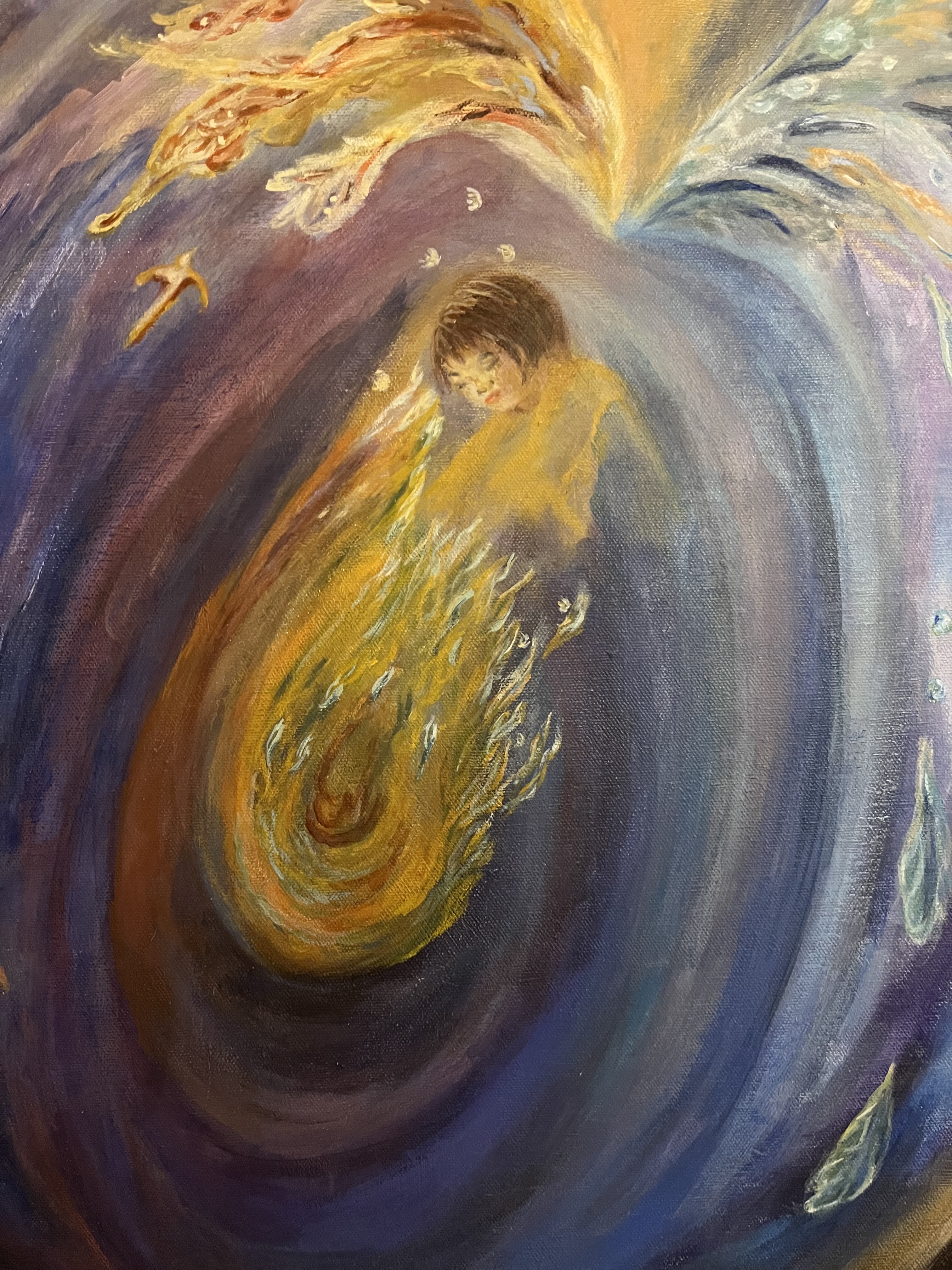
So, today I decided to share on here a close-up detail from one of my paintings. I liked this unexpected detail because it made me think of how while we only see the now moment, we don’t know how today affects everything that unfolds around us. So, let’s just keep on living and doing all that we can today.

Blessings and peace and Agyamanac Unay for reading.