A very short update

I have been quite immersed in the novel draft since end of August and it’s a bit of a surprise to look up and realise that we are already in November. That’s almost three months of non-stop writing at varying speeds and wordages, but I am happy to say that I am heading over the halfway mark as I hope to achieve 65k sometime within the next few days. I’ll likely hit 70k sometime end of the month or early December, but I am steadily moving onward. As my friend, Tricia, reminded me: I must finish.

I acknowledge that one of the things I love the most about writing is when I get to create new worlds. I love exploring different worlds and dimensions, the idea of creating different kinds of being in the world–sometimes similar to, but also other than how we are in the world today. It leads to some complexity when my head is thinking around matters like decoloniality and decolonisation and also when I contemplate kinship and connectedness and how might I bring this all into my on the ground workshop practice.

This November, a project I’ve been involved with for a little while, is starting up with a programme put together by different facilitators and arranged in such a way that we build up towards where participants can create their own micro films. It’s been quite a satisfying experience and I’m looking forward to the start of the workshop when we get to see all of these things manifest in practice space. When the time is right, I might share links to the eventual exhibit of the works that come from this project.

I shared with some participants during the co-creation lab, how putting together this programme was a satisfying act of collaboration and co-creation as we brainstormed together and also asked members of the community what would benefit participants the most. At the heart of the matter are the needs of the community whose voices we want to amplify. So, we want to create this space where it’s more than just the project space, but also beyond that there are possibilities to grow further as a creative, as a storyteller or as a filmmaker. I think that’s one of the aspects I love about this vision: where participants are empowered and given access to the networks so they can move and grow as they wish to.

I shared how one of our facilitators expressed how they wished this kind of programme existed back in the day because of how the programme speaks to the experience of us who are traditionally marginalised. One of our team members said: perhaps this too can be part of the impact of the project.

And because I am a world-builder, I started to imagine a world where curriculums are built and composed differently from how curriculums are today. My science fictional brain and my real world brain collide and I remind myself we are living in the present.

Reciprocity when we go to communities means we are also thinking of how we can encourage people to hope beyond the present. To see a vision beyond now and even if we cannot fund everything, the knowledge that someone has your back and is there encouraging and supporting your vision could already be enough. (To this day, my sister’s voice continues to encourage me even if she’s no longer physically here in this world.)

I still have lots of things I want to write about, but I will end this here as I still have to work on my novel. I am thankful to celebrate a year without treatments. A year wherein the report has come back still in remission and stable. For this I am very grateful.

Maraming salamat for taking time to read. May blessings and peace be with you as you continue on your journey.

At World Fantasy

Here at World Fantasy, I am learning how to balance my energy in a more intense way than I have had to since my last treatment at the end of 2024. I’m not exactly sure what made me decide to come to World Fantasy, but I think it might have had to do with wondering if I could still go to conventions on my own. A convention closer to home felt safer than a convention somewhere like in the US. After all, I managed to complete the co-creation summer workshop, which was also pretty intense, but in a different way. So when Aliette de Bodard told me that World Fantasy was in Brighton, I thought: Oh, I think I can go. It’s also a plus that I get to share a room with Aliette.

World Fantasy is quite intense in the way most conventions are intense. I had quite forgotten the noise level and how draining that can be. It brings home the fact that while I may be recovering really well, I am not yet at 100%. I’m very thankful then for friends who have introduced me to their friends. I was very happy to reconnect with Julie Philips who wrote James Tiptree Jr., The Double Life of Alice Sheldon and The Baby on the Fire Escape. Julie lives in Amsterdam, but it’s been a long time since we last met, so I was so happy when she told me she was coming to WFC. Julie introduced us (me) to Theodora Goss who just as lovely and as elegant as her prose is. I was quite starstruck and speechless for a moment. Like what are words? I remember reading In the Forest of Forgetting when I first learned that such a thing as genre existed and being quite blown away by the beauty of it. I’m pretty sure I’m mangling something up in the process of writing this, but I feel like I want to write this short blog before the feeling of now fades and I run out of gas.

An interesting new writer to me, is M.K. Hardy. I met the M of M.K. and enjoyed listening to her talk about their novel and the underlying themes in their work. I’m quite intrigued by the aspect of co-creating and writing together as it feels like an enriching process and I hope to get to ask about that part one of these days. I was very much engaged in Morag sharing about how the novel thinks around matters related to Scotland’s history as part of an Imperial project. I wished again that my sister were here because they would probably have got on like a house on fire.

While reflecting on this feeling of missing, I realised that even though my sister isn’t with me, she is still with me. I wrote a short piece reflecting on it and will share it here. Early on, after I realised that my ability to socialise is still at recovery stage, I decided not to rush out in the mornings. The panels I circled on my programme are wishlists not must do’s and it’s perfectly fine to spend time in the hotel room writing or wandering along the shorefront or doing other things not convention related. In the meantime, the manuscript has grown beyond 50k. I am embracing it and recognising how ambitious this project actually is and so I do need to take more time with it, to let it breathe and become what it is meant to be.

I have this hope that thinking around these ideas will lead to connect with others who are also thinking around these ideas of kinship and entanglement and not looking away from, but staying with the trouble as Donna Haraway would say.

There’s still more to write, but I need to end this post here. Sharing this short reflection on Grief and presence in the hope that it will mean something to you who have stopped by to read.

Grief makes us awkward. 

We are carrying these wounds with us, but we have no way to heal them because we have imbibed the narrative that tells us we must keep moving forward. 

But grief is also healing. 

In remembering, we make alive again the ones who we have lost. Their presence walks beside us in a different way. We can gain strength from that presence. From the knowledge that we have loved and are continuing to love. We have been entangled and continue to be entangled. They are not really gone from us. It is simply that idea of presence as being physical that we need to let go of. 

My sister is here, present with me. Just as present with me as she was when I could touch her hand. 

Blessings and peace to you who read this and Maraming Salamat for passing by.

Current doings

I’m waiting for CT scan results and I thought it would be good to post this before I get distracted.

I’ve been writing and rewriting the work in progress which expands in size, decreases in size and expands again as I write on it. At the same time, I’ve found myself asking questions of myself as I write. For instance: I think I might have fallen into the trap of trying to write something that’s commercially in line with what’s already out there. You know: a nice hooky opening. Action and bam we are in the middle of the story. It’s not bad, but a part of me was raising an eyebrow and going: what did you want to achieve with that?

I am a bit of an over thinker and I found myself asking what I really enjoy about writing science fiction and fantasy. The answer really isn’t very deep. One of the reasons I enjoy science fiction and fantasy is how there’s this wild space where you get to imagine all kinds of strange or weird worlds that may or may not be related to this world.

Of course, I write about the things I’m passionate about and I write about matters that are on my mind and things I want to work through. But most of all, I love the freedom to create outside of the expectation that I will be writing about my culture or about my experience of displacement or as someone once said at a symposium I attended: I don’t want to tell you another story about my pain.

Perhaps the most freeing thing we can do is to unshackle ourselves from the having to be something and instead embrace what gives us joy and freedom. For example, I’m invested in the furniture of strange worlds and I enjoy the experience of wandering through it in a documentary film kind of way. Oh look, shiny curtains. What are they made of? Oh wow. They’re alive. These plants can tell stories: I’ll sit here and let the trees talk to me now. (I confess, I also do this in real life.)

But as I progressed, I realised that my first draft wasn’t really all that great. It was fun, but it was kind of meh. So, I asked myself a few more questions: Oh hey, Rochita, I know your subconscious does this for you most of the time, but let me ask you if you are aware of who the stakeholders are in your world? I had a short laugh at how I progressed from “yay, sentient furniture” to “here’s my project proposal”. But also, I find myself thinking of how it’s not just about the motions of living, it’s the why are you living there and how are you living there. There’s a part of me that thinks back to the conversations had around the table as we discussed TTRPG creation and where I asked out loud if villains or enemies or oppressors were a necessity in story. (I know I’m gonna eat my question because I’m not sure if a big world story is possible without one of those things coming up and even if the conflict comes organically from the direction of ‘player A does not recognise your innate ability to become an amazing superhero’, there is still going to be an acting opposition, right?)

In the midst of all this wrestling, I read an article penned by someone (I forgot who) where they write about this experiment they did with an AI writing machine while working on a column. They were using a particular program and they fed it with a prompt and with an instruction to check out their blog and write something in the same style and voice. The machine spit out something which the writer then proceeded to rewrite and adjust and by the end of it the only things left over from what the machine had given her were articles like a and the. It was rather fascinating to observe the writer defending the use of an LLM because they ended up writing their column in under an hour instead of more than an hour. A part of me was like: Uh…I’m not so sure why you did this exercise, but it seems to me sitting down and writing the entire thing on your own would have been better. (Also, damn girl, you are a good writer. Why would you do that to yourself?)

I think about the journey I’m taking with this work in progress and how I’m discovering the world as it unfolds on the page and how there are bits of the world that I’m writing now that will likely not make it to the final cut, because I’ve already put them in my notepad under the header: cuts. But I really really like those bits and I had so much fun writing them. (I’m having some thoughts around waste and intentionality and how using an LLM in this way makes me think of landfills and fast fashion. I know. It’s how my brain works.)

After my last posting (How thinking of language leads to thinking about other things) a friend asked me how we could possibly escape the machine if the machine also copies our imperfections. I thought about this for quite a while and then I was reminded of the various movements in the art world and how all of these movements were a fighting against and a coming up against and a wrestling with what is established. History tells a story of invention and reinvention, of how there are always ways of escaping something that becomes establishment and the norm and also I find myself thinking about impositions and how artists don’t really like impositions. So I find myself rather invested in what our answer to this question will be. (If you have any thoughts on it, I’d be interested in them.)

In the meantime, I thought I’d share the link to a weirdly wonderful story which involves playing with language from my lovely friend Weegbree. If you have time, do click to read Brood/Pain/Pan: A Breadtale in Three Movements.

Blessings and peace to you who read this and Agayamanac Unay for passing by.

thoughts that could be random but also connected

While the summer break is now behind us, I still have a couple of days before regular scheduling fills my calendar and I’m taking these days to think around what I hope to do for the rest of 2025. There is some tentative and hopeful planning around 2026 as well. Being in Norway made me realise just how much I need to be intentional in freeing up time to focus on the kind of thinking and writing that I want to do. Going back home to the Philippines is still on my wish list and I am hoping that when we hit the one year mark, my hospital visits will be spaced out a lot more so I don’t feel like time is being squashed and I can only do so many things before my headspace is cluttered by hospital anxiety.

I ended up writing a lot on a manuscript that I’d been working on before I was diagnosed. It surprised me to discover that it was almost full-fledged. All that’s missing is the ending which I am working toward. I have no idea how long this story is going to end up as, but I like that I’m not falling asleep while writing it and that it remains on my mind in a way that I’m poking at it and thinking about it and still thinking: I am enjoying this.

At the same time, because I was reading a lot and thinking a lot about and with Mignolo’s work and Glissant’s work, I found myself also asking who in the Philippines or from the Philippines is thinking along similar lines around decoloniality and decolonial practice. I was very happy to find a recent paper written by Simoun Magsalin. Notes towards a Decolonial Anarchism for Creoles who are Neither Indigenous nor Settler is thought-provoking and makes my mind wander in all sorts of directions as I think around the subjects of history making, uprootment, nomad life and also as I think about my own history.

Reflecting on Filipino identity, I’ve thought on the waves of migration, intermarriages, the interweaving of different cultures resulting from that, and then as an added layer, the different occupations and colonisations that happened and how that changed and influenced not just our genetics but also how it has affected and impacted the DNA of our culture.

It feels very much like serendipity that all these thinkings are emerging, meeting at junctions, connecting like lattices or (as someone has said) like fractals. I like the word Creole and how it speaks of that kind of blending and mixing. It feels also so much like the universe conspiring to bring up food for thought at this time when I am thinking on my father’s history, my mother’s history and how that relates to us who are descendants of them.

I am also attracted to Glissant writing about uprootment and circular nomadism as opposite to arrowlike nomadism and I find myself pulled towards thinking around creolization and how that has worked through in Filipino culture and identity. There is so much to think about and I feel like I want to sit with this for a while.

In Notes towards a Decolonial Anarchism for Creole who are Neither Indigenous nor settler, Magsalin writes and lays out what decolonization is not while thinking around decolonial anarchy and what it would mean for the Philippines. ( It would be interesting to hear what people think after they’ve read this writing.)

In particular, I liked this line: Importantly, we do decolonial anarchy as creoles and as post-colonized subjects, not appropriative of Indigeneity.

I’m always surprised and happy when people tell me they’ve read what I write on this blog. I hope it encourages conversations and thinking around things that matter to you who read it.

Daghang Salamat for taking the time to read. May blessings and peace be with you.

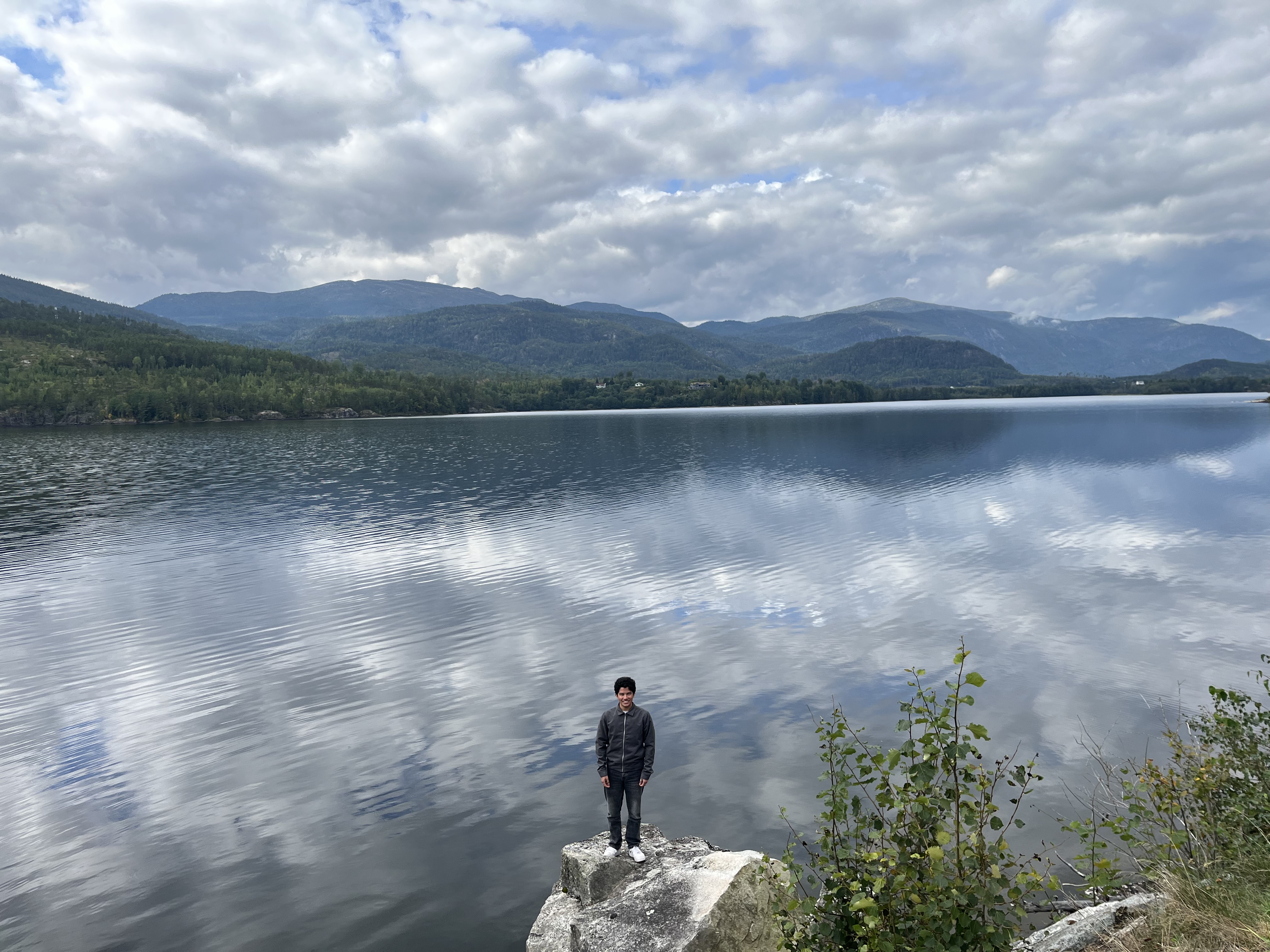
My son stands on a rock, between sky and water. I feel like it is a poetic description of my son’s mixed-race identity. Taken during one of our roadside stops in Norway.

Fruits of my write-a-thon

If you’ll look at the sidebar (or if you’re on the phone, it’s probably going to be the footer), you’ll notice that I’ve posted two lovely badges from the Clarion West Write-a-thon. It’s been a while since I felt up to participating in the write-a-thon, but this year felt like an important year. I wanted to find a way to write about books again. For some reason going back to the bookblog felt too raw. The place she left behind is still right there and I had a jolt when I realised that it’s been nine years since we last talked about books.

Every memory I have of me and my sister is related to us reading books together, arguing over who would read what book first, complaining about how slow the other person was at finishing a book (no backtracking allowed), arguing over what kinds of books were best, discussing the pros and cons of a book, disagreeing over characters and how things unfolded in a book–and a really bad phase when I was so snobbish about my sister’s love of romance books that I got her some of those body rippers for a present. (She really hated me for that and I regretted it a lot because it wasn’t a very loving thing to do.)

I couldn’t understand the appeal of Mills & Boons romances with men treating women like trash and women still going back to those kinds of men because of ‘melt’. We argued about that too and discussed alternative endings where women would look down their noses at those men and say: ‘I am perfectly fine on my own and who needs love if it means being treated like you are less than just because.’

So, when I got my reading mojo back and tentatively started reading novels again, I missed being able to send her an email and ask her what she thought. I imagined us having face time conversations about details in books that we noticed. What we liked and what we didn’t like and what we wished were different or what we wished we could see more of.

Perhaps it was my sister nudging this bright idea towards me from where she now lives. Why not just blog about the books I was reading alongside blogging my thoughts on the work I was doing? Why not make that a write-a-thon goal alongside revisiting The Cartographer and finding out what I needed to do to make it work this time? Make it not too stressful because writing a thousand words a day might not be doable after not writing for a long time.

It took me reading and writing about Nisi Shawl’s book to find a way to keep the conversation going with my sister. In some way, Everfair unlocked that space where I could write without feeling pressured to review. It was like writing to my sister and trying not to give away spoilers about this novel I’d read. I loved it so much and wanted so much to talk about it with her that I wanted her to read it too. I might give away bits and pieces but not all because she would really scold me if I did that in the real. Writing about Everfair connected me to that part belonging to my sister and the history of books between us.

In between EverFair and preparing for LIMBO’s booklet event, I decided to go read other books on my reader. Long train rides are really great for catching up on reading. I finished R.S.A. Garcia’s The Nightward in less than a week while traveling back and forth to Amsterdam. I finished reading Martha Wells’s City of Bones even quicker because i was traveling almost everyday. Along the way, I noticed how my reading speed seemed to be improving along with my ability to keep focus. (I do have notes and plan to write that reading post sometime soon.)

Perhaps one of the realisations I’ve had is how when we love to read, we tend to take it for granted. I started reading at an early age, so did my sister. I never imagined that I would be not able to read until chemo affected my ability to focus and hold onto things I’d read. I had to learn to be kind to myself and also I grieved a little bit because I didn’t know if I’d get my reading mojo back. Now, reading feels like a miracle. It’s something I’m so thankful for and it’s a reminder not to take things for granted.

I didn’t realise that today was the last day of the write-a-thon until I got the email. It was also stunning to get the mail telling me that a good friend had pushed my write-a-thon goal way past my original funding goal. I am incredibly moved.

During the worldbuilding workshop that I gave for the Springschool Co-creation Lab, I talked about the potential of science fiction to help us think around possibilities. How science fiction at its very best challenges us to think of different ways of being in the world. Science Fiction has this potential for us to dream of different kinds of worlds, different ways of being in community and in relation to and with one another.

It’s my hope that we continue to encourage one another not just to think about how to write great stories, but more importantly to think on how we can create small movements that could lead to change in the spaces we move in. Let’s encourage each other to keep asking questions, to think of different ways of being in the world, to question why we do what we do when we do them and to live and create with intentionality.

Thank you for passing by. Maraming salamat and may blessings and peace be with you.

*Big shoutout to my dear friend, Vicki, who pushed me way past my writeathon goal. Thank you so so much.

**If you want to help us achieve 100%, the fundraiser is still open. Click on this sentence to visit the writeathon page.

Returning to the world of the Body Cartographer

Sometime in August, the English version of the story published in De Komeet is going up on Philippine Genre Stories. I’m very grateful to Mia Tijam for her patience with me as replies have been often delayed. I have a tendency to think I have done things and find out I haven’t. Chemo-brain sounds like an easy excuse, but this tendency is common with a lot of people who’ve gone through chemotherapy. It gets better with time and the longer you’re away from the last chemotherapy treatment, the more clarity you get as well. So I am very thankful for the gentle nudges and the patience coming from editors during the period I was in treatment as well as the period of recovery.

The publication of this story works like a jumpstart of sorts. I started thinking about the works in progress that I still had on my drive and when the call to join the Clarion West Write-a-thon landed in my inbox, I carefully considered whether I would be able to do it. A conversation I had with Marielle (Wegbree)made me think that the write-a-thon would give me an easy way to slide back into writing with some accountability. I thought that I could at least do some book reviews on the blog as a measure of how much work I was doing. But in the process, I found myself returning to my one drive. I had this idea that the drafts I’d been working on were still quite messy.

My first thinking was to go back to writing in the world of Raissa and Anghe. But somehow I found myself pulled back into the Body Cartographer’s world. (If anyone wants to read Song of the Body Cartographer, it’s still available online.) After my first round with radiation therapy, I started working on this long piece again except somehow it felt almost confronting. Mainly because it starts with the main character waking up after a moment of crisis, after a near death experience that changes her so much that she is no longer exactly as she was. Yep. I wrote those parts before I was diagnosed and continuing to write those parts felt too close, I had to put it away.

But now, six months after being declared in remission and after being told that the last treatment worked, I find myself drawn back into that world and I recognise the place my main character is at. Having a deeper understanding of what it takes to recover from crises and how life-altering that can be helps me to also see where I was making the journey to recovery too smooth for my character. But I also see how this crises doesn’t define my character. It has to become part of her life if she’s to really live her life. And I am reminded again of my oncologist telling me: you are more than cancer.

We are more than the physical challenges that we face. We are more than the crises we have had to overcome. We are more than our traumas and our illnesses. We are more than that. And so I want my main character to reach that realisation too because loss has been very much a part of this character’s life but those losses do not define her. Instead, I hope that she emerges stronger and more herself.

I’m thinking about worlds today because I’m going back to the team I’m working with and I think we are going to set world parameters or at least I hope we are. I would very much like to get away from the D&D model and I am hoping that this is a shared vision. If it’s not then I have to think on whether I’m okay with that and how to go about that. Of the games that I’ve played, the one that appeals the most to me is a game built on Belonging outside Belonging. I love it for the spontaneous creativity that it gives rise to–and yes unpredictable silliness which even if you know it’s silly, you just go with it because it is fun to be silly with friends.

So I suppose July is building up to be a month of lots of thinking and reading and writing happening. Something I would not have been able to predict a couple of months ago when I was down in the dumps about not being able to write. I am evidence that the Recovery and Balance programme pays off in spades.

Finally, if you’d like to support my quest to raise funds for Clarion West, please feel free to visit my fundraising page and press the donate button. I would love for us to go over our combined goal as that means more support for the workshop and the writers who will be going there. WordPress doesn’t seem to support embedding my page, but here’s the link to it:

https://givebutter.com/2025cw-writeathon/rochitaloenenruiz

Thanks so much for taking the time to read. I am quietly surprised when I discover people have read what I write here. I hope it offers some food for thought, some inspiration or anything that you can take with you on the journey. Blessings and peace and thank you for dropping by.

Thinking about co-creation

Traveling to and from destinations is helping me catch up with my reading list. I find it sometimes surprising when I recognise how much traveling I’m doing. I live very close to a train station and from here it’s easy to catch a train to Amsterdam or Utrecht or Rotterdam or The Hague. I haven’t been to The Hague in a while and my library card has lapsed, but I want to return to writing and reading in the Royal Library sometime late in July after the projects I’m involved with have moved into the summer holiday phase. I also want to think more around what I want to do when the season starts up again. What is necessary to me? What do I want to keep on doing? What do I need to let go of and what do I need to prioritise?

I’m currently working together with a team that was put together with the goal of creating a table top rpg. It’s a process that’s new to most of us, but one of our team is an experienced Game Master and that helps the process along as we think around gameplay and building something that is interesting, fun and hopefully thought-provoking. We’ve been thinking around themes that we want to see as well as the kind of world and stories we hope to explore.

It’s a process that I needed time to wrap my head around as perhaps the biggest difference between writing alone and writing in the team is the work of coming to agreement. There’s also the process of making space for how we will not always agree and how we are fine with that.

We might fall into thinking that co-creation is some harmonious zen process. It can be, but by large it depends on the size of the team, it depends on the kinds of participants and the dynamics in a group, it depends on a lot of factors so co-creation can be as zen or as gnarly and messy as all get out, but it needs to be what it needs to be and there is no way to go around that and effectively co-create. I realise that going through the gnarly mess is a good thing. It’s good when we are able to show our faces to each other, to say: I don’t agree with you on this and I don’t want things to go in this direction and I actually would like to go elsewhere. When that kind of freedom exists, that holds a promise of something extraordinary coming into being.

Co-creation is a process that takes time because when we are creating together, it means we have to give a little and be willing to compromise in order to reach our common goal. I don’t think it can be hurried along and I think the best thing we take away from such engagements is how creating together allows us to quickly move away from surface and shallow niceties into spaces where we feel safe and seen and where we know that just because our thoughts and ideas are not shared by everyone, it doesn’t mean they are of lesser importance.

[Some questions I’m thinking around in relation to the work and the projects I’m working on: Do we want to build community? Do we want to share stories? Do we want to heal ourselves? What do we need and what do we want and how do we get there?) ]

At the heart of it, co-creation has to do with relationships. It’s related to how we’re entangled and connected to one another. If we are open and ready to make space for ideas and ways of thinking that are not the same to how we think and if we are willing to let go of control or if we are willing to step into the gap when we recognise a gap. Does this then mean that there is no space for individuality or for the individual choice?

I like to think that there can be room for both. That we can share and compromise and adapt while leaving space and room for ourselves to do and to create and to work around what speaks to us individually. I think that leaving space for individuals to come to terms with what works and what doesn’t is necessary if we want to come to satisfying conclusions.

I’m ruminating on this because creating world in a team feels very actual to the discussion around co-creation and I also am interested in how that translates into community building and creating together outside of fiction spaces.

Where ttrpg is concerned, we can try to think of directions in which we want players to go towards, but we can’t control or predict and while we can prepare for some scenarios, it’s quite possible that players will go towards outcomes we don’t expect or even want and that’s perfectly fine. I like to think that’s a good thing because there should definitely be room for insights and outcomes other than what we want.

Perhaps the most important takeaway for me from this process is to let go of the self that goes: ‘oh but actually’. Instead, I should just let the part of me that carries on snarky and whacky conversations with my other parts come out and play.

Throughout this writing, I keep thinking of that phrase from Donna Haraway from Staying With the Trouble: “It matters what matters we use to think other matters with; it matters what stories we tell to tell other stories with; it matters what knots knot knots, what thoughts think thoughts, what descriptions describe descriptions, what ties tie ties. It matters what stories make worlds, what worlds make stories.”

Blessings and peace to you who read this and maraming salamat for passing by.

Staying with the Trouble is available from Duke University Press and from other booksellers.

(editing to add my thanks to Aliette de Bodard and Vida Cruz-Borja for listening to me while I worked through this process.)

De Nederlandse Norm van Gezond Bewegen or the Dutch standard for healthy activity

After the exercise portion of our physiotherapy class today, we spent time thinking on what healthy activity meant to us and what plans we could make for ourselves now that recovery and balance classes are coming to an end.

All through the various phases of treatment, from surgery to recovery from surgery through radiotherapy and chemo and immunotherapy, I had more or less been able to maintain some form of exercise. Whether it was walking 10,000 steps a day or going to physiotherapy class, I was able to do that. But the last round that I had with chemo depleted my stores so much that I sometimes felt frustrated by my inability to be stronger. I kept telling myself that I would get stronger.

For more than a year, oncological physiotherapy served like a tether or a safety net. Sure, I wasn’t very strong, but I was doing something and that gave me a feeling of some control.

At one point, I said to our physiotherapist: I probably just have to accept that it is what it is.

Thankfully, she didn’t agree. Thankfully, she suggested that I go on to recovery and balance class which was more intense, but she believed it was the best class to get me to where I wanted to be.

As recovery and balance class nears a close, I am thankful. Even when I grumbled about how hard the class was, I now have the tools I need to balance myself. Today, I was surprised to find that I can do a full plank again. Doing the plank helped me recognise that I can trust my body to carry me and as long as I listen to what my body is saying, I can know that it will continue to serve me well.

Writing this, I have to think about a feisty woman who must have been just a little bit older than me. She was in my first physiotherapy class, but opted not to continue with classes focused on oncological patients.

“It becomes comfortable,” she said. “You get stuck in that grove of belonging with patients who are in recovery, but you have to get out of it. You have to move out of that comfortable space.”

While our physiotherapist didn’t say the exact same words today, they had a similar resonance.

“You’ve built up your core strength, we’ve talked through how to balance and where to go if you need support. Another three months of oncological physiotherapy won’t benefit you more than going out and taking up the challenge of being active again on your own.”

So, even though the option exists to continue in a similar space, I have decided to leave the comfort of being in a space where everyone has been through similar experiences. In some ways, it’s scary. But in other ways, I realise this is a natural progression. As we leave our comfortable spaces, we discover new things. Our horizon expands. We discover new strengths and we learn that we have the capacity to continue to grow and to become even stronger than we are now.

It’s okay to retreat into our cozy spaces from time to time, but we’re not meant to dwell there. We’re meant to be out in the world. Living and thriving and growing and sharing and becoming all that we are meant to be.

(NNGB: 30 minutes a day of active movement whether brisk walking or biking with a normal bike or briskly walking up and down the stairs when done 5 days a week are considered healthy activity. There are other parameters of course, but basically 30 minutes of daily movement is good for you. Movement makes you more resilient and studies have shown that it prolongs life expectancy.)

Blessings and peace to you who read this and thank you for stopping by.

Stable

Everyone who’s had a brush with cancer is familiar with scanxiety. Last week, I had a new scan but I was able avoid being anxious about it as last week’s schedule was so packed. It wasn’t until I was reminded that my oncologist would call with the results that I started to feel some of the usual tension.

Traveling back and forth from Amsterdam, and going to the VU for Spring School was so inspiring and invigorating. I felt like I was back to being more like myself before the diagnosis and all the treatments.

But yesterday came around and I felt a little bit of tension waiting for the phone call. To keep myself from checking my file and making my own interpretations of things that aren’t my expertise, I proposed traveling to an art shop to pick up more paper. I have a thing about paper. Even before I ventured into artmaking, paper has always been a fascination for me. I have a bit of thing for notebooks and have a preference for unlined ones that don’t have bright white pages. I can’t explain why, I just do.

Anyway, my oncologist called towards the end of the afternoon. By the time the call came, I was so engrossed in trying to make sense of my messy filing system that I was a bit surprised. So when she told me that it was good news and my scans were stable, I was a little bit unsure how to feel about it. I mean…last time the news was surprising and wonderful. Despite being out of treatment for almost five months, the remaining nodules continued to shrink. Now, six months later, we are stable.

What does it mean?

In a practical sense, my oncologist said that we’ll just go on as we are and she’ll schedule another scan towards end of July. My scans take place every two months as I am being monitored in the context of a clinical trial.

A friend said to me that it’s a good thing to be constantly under medical supervision. That they have another friend who pays out of pocket to have scans done every six months because they’ve been declared cured and dismissed out of the system. The thing is, being declared cured doesn’t really mean much because you never know. I can understand this. I was declared cured once, except a few months later, I wasn’t really.

Stable.

It’s good news and yet I wept a little bit. I want so much for the remaining nodules to be just gone. But stable is good. It means there is no growth. It means I can slowly start to dream again. I can think of enrolling in another art class. I can think of committing again to the work that I’m doing with LIMBO. I can think of doing more for the community and I can give more in terms of attention, focus and energy. I like this me who is present and focused.

And so, I’m piecing together the histories of my life and I’m thankful that even though the files on my computer are messy, my work is there to remind me that I was reaching for something before cancer happened. I can’t go back, but I can move forward.

Nothing in life is guaranteed. We can only do what we can do in this moment. In this now. My encouragement is to live life to the fullest. Be present now and (cliche as it sounds) be the difference that you want to see in the world.

Blessings and peace to you who read this and thank you for stopping by.

From my desk: A small relaxing play with watercolors.

Letting go of perfection

After a while, the portrait I’d been wrestling with made me feel so dissatisfied, I decided to turn its face away from me. Maybe it was the colours I’d been using, maybe it was because I needed a break, but the more I worked on it, the more I felt as if I wasn’t getting anywhere near where I wanted to be. It’s funny to write this when during my last entry, I felt as if I’d had a breakthrough.

So, I decided to step away from the portrait. I didn’t work on it for a couple of days. I didn’t even look at it. I played with my watercolours and didn’t require myself to do anything that was like a project.

There wasn’t really much time to dwell because I had the regular check-up which consists of a bloodwork and a CT scan. I didn’t have time to dwell on the CT-scan because my youngest son was leaving for the traditional end-of-school holiday (it’s a Dutch thing where young people go on holiday with their mates at the end of senior high). It’s kind of difficult to stress about a scan when you’re making sure that your son won’t miss his flight and it’s kind of difficult to stress about a portrait when you remember you have to go to the hospital.

After a busy couple of days, I decided I needed a break. I made a date to meet up with my eldest son in the city and we went shopping for some things (in my case it was art supplies).

The great thing about taking such a break is how there’s time to think while on the train ride to and from the big city. I thought about that little voice that makes tiny sounds of disapproval in the back of our heads. We don’t register it as disapproval because we’re so used to hearing it. It’s a voice that says: Oh, that’s not good enough. Oh, that nose doesn’t look right. Oh, are you sure you want to use that shade of red? Oh. Now you’ve done it. You’re overworking it. You’re doing it all wrong. You’ll never be good at this.

It doesn’t matter whether it’s a painting or a story or a book report, our first and harshest critic is that tiny voice that causes us to tense up and become so focused on being perfect we end up helplessly throwing our hands up in the air and saying: I cannot.

There’s a great little clip I stumbled upon on youtube where a pianist is playing one of Chopin’s etudes (I forget the name but it’s one my mom played a lot). Over a section of the clip with the beautiful cascading tones of the piano, there’s a caption: What the audience hears when the pianist plays this piece. Right after this, there’s a section where the notes are clanging together in disharmony. The caption says: what the pianist hears when playing this piece.

It’s a funny clip, but it’s so apt. It doesn’t matter what art form we practice. Whether it’s making music or making art or writing, somehow we tend to hyperfocus on that one thing that just isn’t working. And it’s all that tiny little self-critical voice will let us focus on.

I laugh as I write this because it seems like this is a lesson that keeps returning to me. In the chase after an elusive perfection, we lose sight of what makes us love the things that we do.

Blessings and peace to you who read this. Thank you for dropping by.