how it’s going

I’ve been going to physical therapy with a group of oncology patients for a couple of weeks now and have noticed that while mornings are often much better in terms of energy, afternoons are now improving. I’m not as tired as I was during the first afternoon training. I take this to be a good sign.

Upon my return home from Gladstones, the eldest son told me that I could transform his former bedroom into a writing space. Something I hadn’t even thought of doing because it was always his room, a lot of his things are still in it, and perhaps it’s that mother thought in my head that held the space for him just in case. But, as I was reminded, it’s been a year since he moved out. Birds spread their wings, they leave the nest, and go discover the sky.

So finally, after more than twenty years of writing at the dining table and having to move my mess when it’s time to eat, I have this space where the books I am reading can be left as they are. Where my pens and pencils don’t have to be tidied up and where when I am done for the day, I can close the door and let the projects I’m working on percolate.

I can’t help but think again about Virginia Woolf talking about a room of our own and how women who write need this kind of space.

Before I went to Wales, I downloaded a book by Joanna Penn. In the past, I’ve read books on writing that made me go: Oh, that’s nice. But it doesn’t work for me. Joanna Penn’s “How to Write A Novel” is perhaps the first book on novel writing that’s made me stop and say: I recognize that. For one, Joanna Penn calls herself a discovery writer. She talks about how overwhelming the process of writing a novel can be when you’re like her(like me). It was like a letter from a friend saying: look, I get it. Now tell me why you’re not finishing that novel. For me the greatest thing was a sense of overwhelm. I’d get bogged down in the details and before I knew it, I was lost. (I have a bunch of novels with great beginnings where the middles and ends are all squashed together because I got caught in a tide of overwhelm and couldn’t see where things were going anymore.)

But here I am. It is the beginning of the week. I have returned from my therapy class feeling energized and thinking: you know, you’ve come this far. Look at the horizon. Can you see where this story is going? Can you see how it’s going to end? Can you see what the story is about? Coming on close to 50,000 words, it’s really getting there. (Alarming thought.)

I think of how my sister would tell me to write whatever I wanted to write and to never give up. If my sister were still here, this is the novel I would give her. I would tell her, this is the novel I wrote because of all the conversations we’ve had and which we continue to have in my head. There are moments I just wish I could turn to her and say: what do you think about this?

What’s kept me from finishing novels in the past? At the heart of it has always been fear. Fear I wouldn’t have the right words. Fear I wasn’t up to the task. Fear I would screw up.

It’s funny how my sister’s legacy continues in the words she used to speak to me. My youngest son has had some difficult moments at school (understandable in the light of everything) but I’ve said these words my sister used to say to me: “It’s your dream, do something about it.”

Since I got this room, I’ve been coming up everyday to write words because when we see each other again, my sister will probably ask me what I did about my dreams and I don’t want to say that I was too scared or too overwhelmed to do something about it.

Blessings and peace to you who read this. Agyamanac Unay for stopping by.
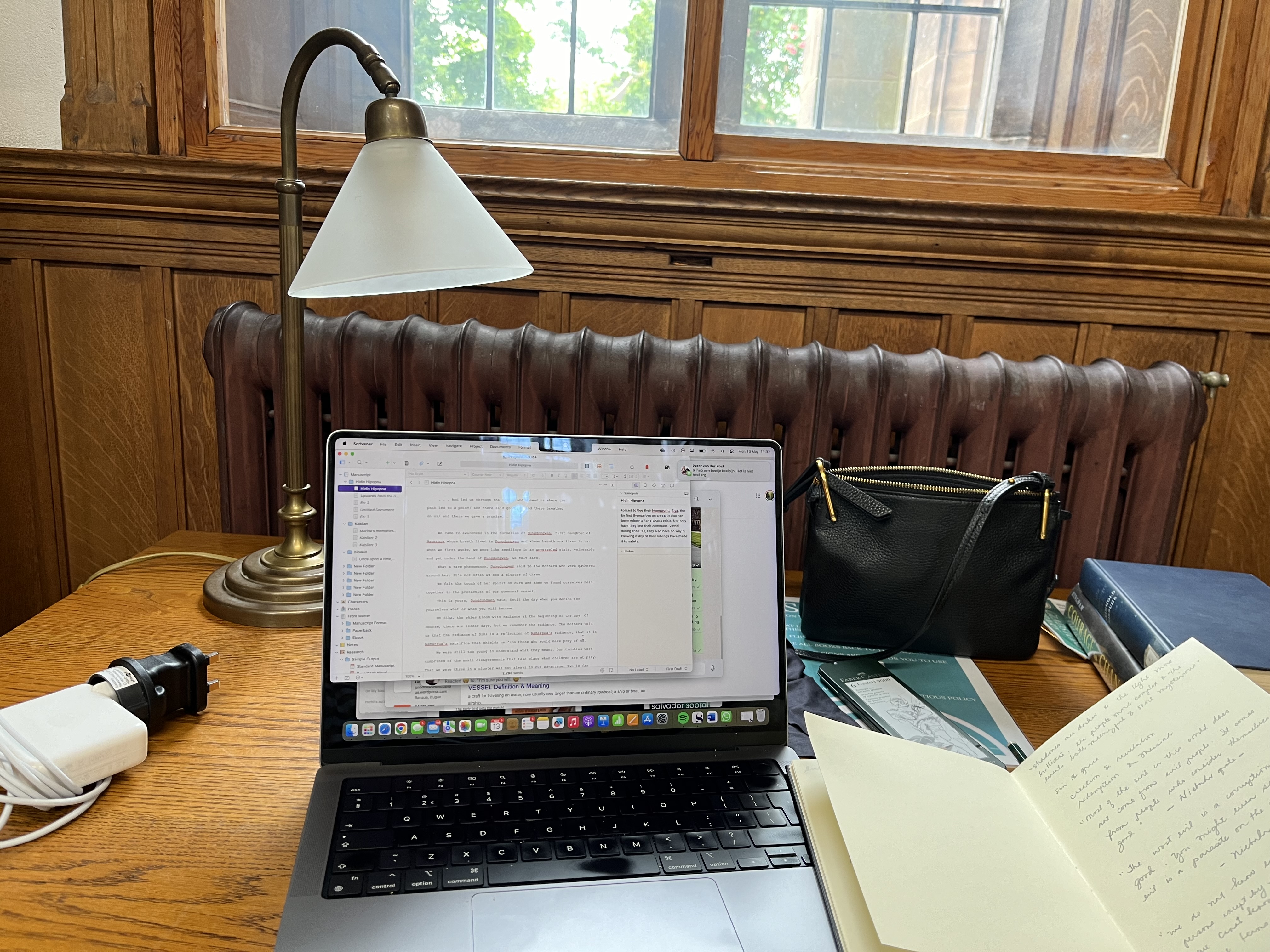
At work in Gladstones

Here I am in Gladstones Library in Wales for a week of writing at the Milford Writer’s Writing Retreat. It has been a while since I’ve done something like this and I had quite forgotten just how enervating taking time out to write can be. It’s more than carving out time during the regular day, but just being here among so many books with other writers and just focusing on the work of writing has proven to be quite helpful in my process.

Before the diagnosis in 2022, I had been working on a couple of projects which I quite forgot all throughout treatment, so finding them again early in 2024 made me realise that I actually still liked these projects and they were stories that deserved to be finished. But coming to the Milford week, I was still torn on which project to work on.

In the end, I found myself drawn quite strongly to what I call the En story. I had been avoiding finishing it because the scale felt just so large. I realised that I have to acknowledge that it really is a novel. Not a novella, not a long short story, but a novel. It also means that writing in Gladstones works perfectly. I am in the process of putting together all the bits and pieces which I feel belong in this work and there it was staring me in the face…climate change. And what joy to be able to look through the library catalogue, head to the stacks, take all the books you think will be helpful and find exactly what you need for the huge thing you have been terrified about. It also helps a lot that one of my writer friends is a geophysicist and so I could send her a message saying: “uh…I have a question, help”.

It’s interesting to me too that the desk I’m seated at right now is located between two stacks of philosophers.

There is something about the moment and place of creation and how tapping into the source will bring you to the places/people/sources that you need in order to keep moving.

Working on the En story, I understand what it is about this work that terrified me. Now that I have the proper focus, I see how the world has always been comprised of opposing forces. Forces at a constant push and pull and forces that threaten to overwhelm each other. There is the nature that uses up worlds without thought or without care. It’s the kind of nature that discards without thought because when something is used up, there will always be another to take its place. It is the assumption born of privilege. There is another nature at place here too. It’s the nature of lifegiving and restoration and nurturing. Because the second nature is not brutal in nature, it’s often trampled on or made little of. But without the second nature, what would happen to our earth? What would happen to humankind? There is another nature somewhere in there and this is one wherein I hope balance takes place. I am working on it and my head is constantly busy with it.

A little while ago, I had a conversation with one of my Dutch friends. We talked about the balance between the realm of the spirit and the real world and how it’s easy to get caught up and lost in the spiritual, but we need to remember that we are also here in the real. It is the same with writing. My first drafts tend to be vague and starry eyed and not too grounded…more floaty and slippery than solid.

I started writing again in 2024 and it feels to me like I am learning all these things all over again. But what a joy to be able to do so. To be able to write and tell the stories I want to tell. Isn’t that a blessing?

Blessings and peace to you who read this. Agyamanac Unay for stopping by.

Because all work is the result of a collective

The work that I do would not be the work it is without the influence of those working and writing in my community. One of those whose work never fails to move me profoundly is the Filipino-American poet, Barbara Jane Reyes.

It feels very serendipitous to be featuring an interview with her right at this moment when I am thinking about language, decolonisation and what it means to be working in a field where we are a minority.

I hope that this interview will be an inspiration for all who read it. May we all continue to produce thought-provoking, challenging and mindful work.

An Interview with Barbara Jane Reyes is now up at the bookblog.