Create and co-create

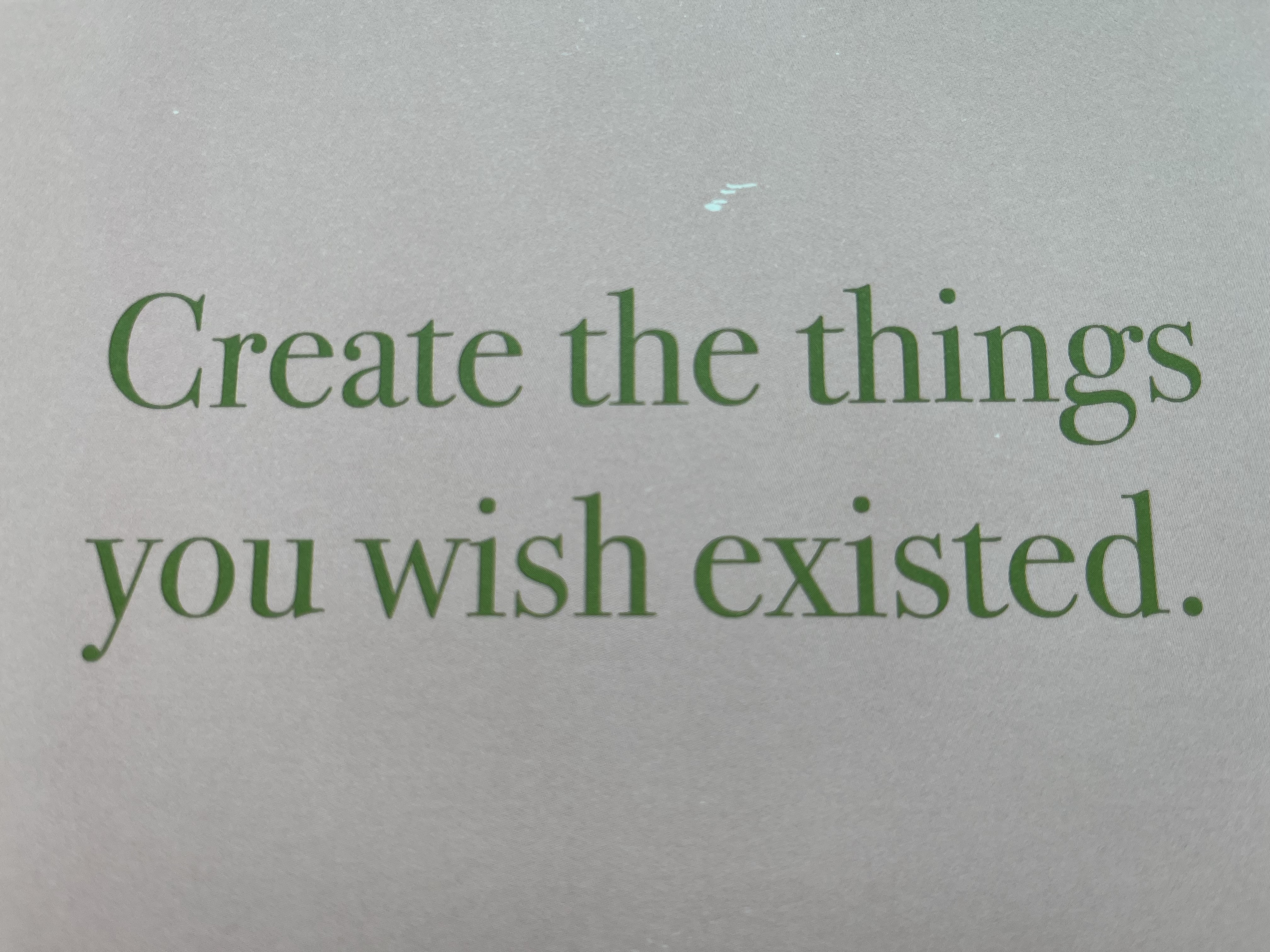
On my wall, there’s a postcard with the words: Create the things you wish existed. It’s a card that came with an order of art supplies and I loved the words so much I pasted it up where I can see it as a reminder.

From one of the mailing lists that I subscribe to, there’s a link to the work of an amazing artist named Leilah Babirye. If you have time, click on the link leading to the video as it’s so inspiring and a great reminder that when we are engaged in art, we can’t be afraid.

I’m thinking about this as I think about LIMBO and the participants who come to share and create together. More than the things that we produce or make during the time together, it’s about how we hold space for one another and create together the kind feeling that exists in that time. When it’s my turn to give the workshop, I step into the space and think about who’s here and what do they need. Where Leilah talks about reading and listening to the piece, facilitating means listening to the space and reading with the heart. I bring to the workshop all the things that I have learned from other practitioners and I bring also what I have learned from my own journey.

Yesterday, we engaged in making rhythmic combinations, dance steps and improvisations as well as song. I had in mind this idea that we needed to give an answer to the wishlist that had been presented by participants sometime at the start of the season–the wish to create a LIMBO dance as well as a song that comes from us and expresses us.

There was laughter, there was singing, there was lots of body movement and dancing and there was a beautiful musical rendition gifted to us that afternoon by one of LIMBO’s participants.

I love how moments like these give rise to spontaneous sharing. It’s a testimony to how participants feel safe to talk about what they’re going through and what they’re feeling in the moment. To me, it’s this precious quality that we need to take care of when we talk about community.

Today, I am thankful for the privilege of being invited and included in this community. One of the things I’ve learned and continue to be reminded about in LIMBO is how it doesn’t matter that there are moments of discomfort and unease–that sometimes topics can become fraught–that people will have differences. But this is okay. I think of Aminata Cairo talking about family gatherings and how there may be that uncomfortable relation who can get argumentative and you think: Oh, I will just keep a distance. But even so, if we believe we are all connected, then there is still space for discomfort. We don’t always need to resolve it, but we can acknowledge it.

(I want to note here that I do think it’s important to draw a line at abusive and harmful behaviour.)

At present, I’m already looking toward our next gathering which will be on the 1st of June. I’m thinking of how to approach this workshop as we prepare for the launch of LIMBO’s second booklet. For the launch, which will be on the 20th of July, we’ll be going back to FramerFramed as a podium has been offered to us for use against the backdrop of an exhibition about transformation. It’s so very apt. I’m thinking of festive feelings. Of glitter make-up and shiny clothes, of dancing and singing and color and joy. We’ll be creating this programme together, creating this launch, creating this space and holding it for one another.

To you who read this, take time to listen to a beat and move your feet. Thank you for stopping by. Blessings and peace be with you.

All the things and how do I choose?

In my previous life, goal setting was a little bit like this thing I would do in intervals. Like at the start of the year, I might set a couple of things for myself and at a certain point a sense of panic would creep in when I realised there were still things I hadn’t done.

Yesterday, as I was reading through the life after treatment module, the goal setting part of it had me thinking. For instance, if I say I want to travel more. What exactly do I mean when I say that? If I say I want to spend more time with my family, what do I really mean by that? And what about getting back to writing and finally finishing that work in progress? What about leaving a legacy and creating space for others? How and where do I even start? That familiar sense of panic came over me–that sense of I’m not sure I have enough time to do all the things.

To be honest, I didn’t actually think about these things when I first listed things down. I basically just filled in whatever and went on my merry way. But yesterday, I realised that I had a rather long list of things I want to do and it’s probably one of the reasons why I’m feeling a bit out of breath because how does one choose and where do I even start?

Thankfully, the module provides the following questions in support, some of which are:

How far along are you in regard to this goal?

What do you need to accomplish this goal?

Do you have all you need to get there?

One of the things on my list is to plan at least one weekend every year when all of us spend time as a family in one house. Last year, we went to Spa in Belgium. We are rather fond of Formula One and I’ve always wanted to visit a race track. Not only is the Spa circuit legendary, it’s also a beautiful track surrounded by lots of nature.

As I was in treatment at the time, my youngest spent most of our visit to the famous Spa circuit pushing me in the wheelchair. I didn’t get to climb up to the viewpoint tower but I loved that the kids got to do that and see it for themselves. It was only for a weekend, but we had a lot of fun with time together as well as time separately.

This year, I’m thinking of a place closer to home with more possibilities for going out into nature and taking walks because I’m more mobile than I was last year and I have more energy than I had.

But while I can plan things and organise things, while music and artmaking and teaching are proving to be quite friendly and within my grasp, I’ve discovered that getting back to writing is a lot more challenging than I had imagined.

Do I struggle with the writing because my brain isn’t quite up to it yet? Or do I struggle with the writing because writing (even when it’s fiction) feels very close somehow and I’m not yet ready to go there? It’s telling that I’m writing about not being ready because that’s actually probably what it is. Will I be ready to go there?

Writing even when it’s fiction has often been a way for me to work through whatever is weighing on my mind at the moment. I doubt that my work is commercially appealing because writing to an audience has probably been the last thing I’ve thought about. I’m not sure if that makes me a bad writer–but basically I write things that tug at me and call to me and make me take that deep dive and a lot of times the dive is personal and involved with the body and how the body moves through society and navigates all these questions that arise. What impact does space have on the body? How does society impact the body? And can one body have an impact or influence in the space they occupy? If so, in what way? (Yep, that’s one example of the process my brain goes through and maybe it’s helpful that I’m writing about it because this is probably a step towards getting there.)

I wish that answers were easy, but often answers are complex and require time and patience and a lot of times solutions to problems are never easy. The concept of good or bad and black and white is simplistic when we live in a nuanced world where many different shades go into what we imagine is one color.

So, this leads me back to goal setting and the objective of it.

Perhaps it’s so we don’t get this feeling of empty hours or days that we must feel. Maybe that’s it. Maybe it’s to give us a sense of purpose. Perhaps it’s to make us feel useful or accomplished. Oh hey, I did this task and that. I cleaned the bathroom without breaking down and I still had the energy to iron some clothes. That’s a win.

Now that I think about it, this sense of time running out is an illusion. We get caught up in the rush of “I must do this” and “I have to accomplish this” or “I must be useful” or whatever narrative we say to ourselves.

I think that we all have the time we need/ to do what we need to do/ and /time never runs out/. We may think that time runs out when we close our eyes in final sleep, but actually time keeps on running and what we accomplish as warm bodies reverberates even after our bodies are gone from the timeline.

Writing about this has helped me shed the rush. What needs to be done will be done and if it’s not done perfectly or as exactly as I imagine it could be, it will be enough. When I look at the timeline, I realise that actually what matters is now. From a minute ago to this minute to the minute that follows after this one. These are the moments that I can make count. Maybe I can give my son a hug or by practice my brush strokes (I’m learning how to use watercolour), or I can go out and find rocks to use for an exercise with the group. Maybe it’s something else. There’s no rush, there’s no panic. Time isn’t running out. I am moving exactly as I am meant to move within the time I occupy.

As usual, this is me thinking out loud on the page. I hope that it’s helpful to someone. Take time to do what matters to you now and if you’re feeling rushed, breathe.

Thank you for taking time to read this. I wish you blessings and peace. Maraming Salamat.

Oh hey! It’s another Tuesday post

Sometimes the words just flow and sometimes they don’t. Today, I was working on the module that comes with the a new program from the physiotherapy class that I signed up for. This class is an intensive three month program which usually is offered after active treatment and it includes not only the physical rehabilitation part of things, but it also offers a module which walks you through a process of reflecting on what’s happened and what you would like to happen moving forward. It’s a module divided into six sessions and signing up for the module includes a page where you list down everything from the moment of diagnosis up to your last active treatment.

It was rather something to look back and realise that from 2022 up to the end of 2024, I was in constant treatment and my days were marked by hospital visits. It’s also good to recognise that I’ve been out of active treatment for five months.

I find myself no longer planning in terms of “if treatment will allow” to thinking in terms of “Oh hey, I can do that thing and take that course and I can play together with the band and go to workshop”. It seems like a small change, but it is actually a huge change from not knowing to some sort of knowing and where planning can now occur in two month stages instead of the one week when I feel good stage. I actually had this idea that I’d dealt with the stages of grief during those three years, but having looked at the dates reminds me that it wasn’t nothing. So here I am thinking on it and feeling thankful that I made it through all those treatments. I am thankful that I’m still here.

I’ve learned that even when we think we can’t, we still can and there is nothing more precious than today and if there’s something worth doing, there’s no sense in delaying the doing of that something.

There was a short period after treatment when I had a sense of “Oh, my days are stretching out now” and “so what do I do?”

Lately, I’ve been filling my days with watercolour practice. As I said to my therapy mates, I didn’t have the opportunity to learn how to use all these different materials when I was young, but I’m learning them now and it’s like a world has opened up in front of me. I didn’t know, for instance, that getting a good result in watercolours has a lot to do with the materials that you use. Of course, it’s the same for all other things, but watercolours are pickier than pastels and acrylics and if you use bad paper, it’s a given that your watercolours will look more grisly than if you used something that’s a better grade. I’m practicing on Aquapad paper which is thick enough and satisfying enough. (Arches are the best, but I feel like I need to get to that point where I can justify spending lots of cash on Arches.)

I’m happy that I have art making to keep me company, because it seems my fiction brain isn’t quite ready yet. I did the thing last week where I decided to just grit my teeth and open the work in progress and after reading the first page, I just had no idea. The sense of overwhelm was such that I decided to close the document and re-think my strategy. Maybe I’m not ready yet to face a work I left at 70k words. Maybe I need to section it up into smaller units that my brain can focus on in small bursts. I’m not sure yet. The work is niggling on the edges of my awareness, it’s just getting down to it that costs more than I can spend at the moment.

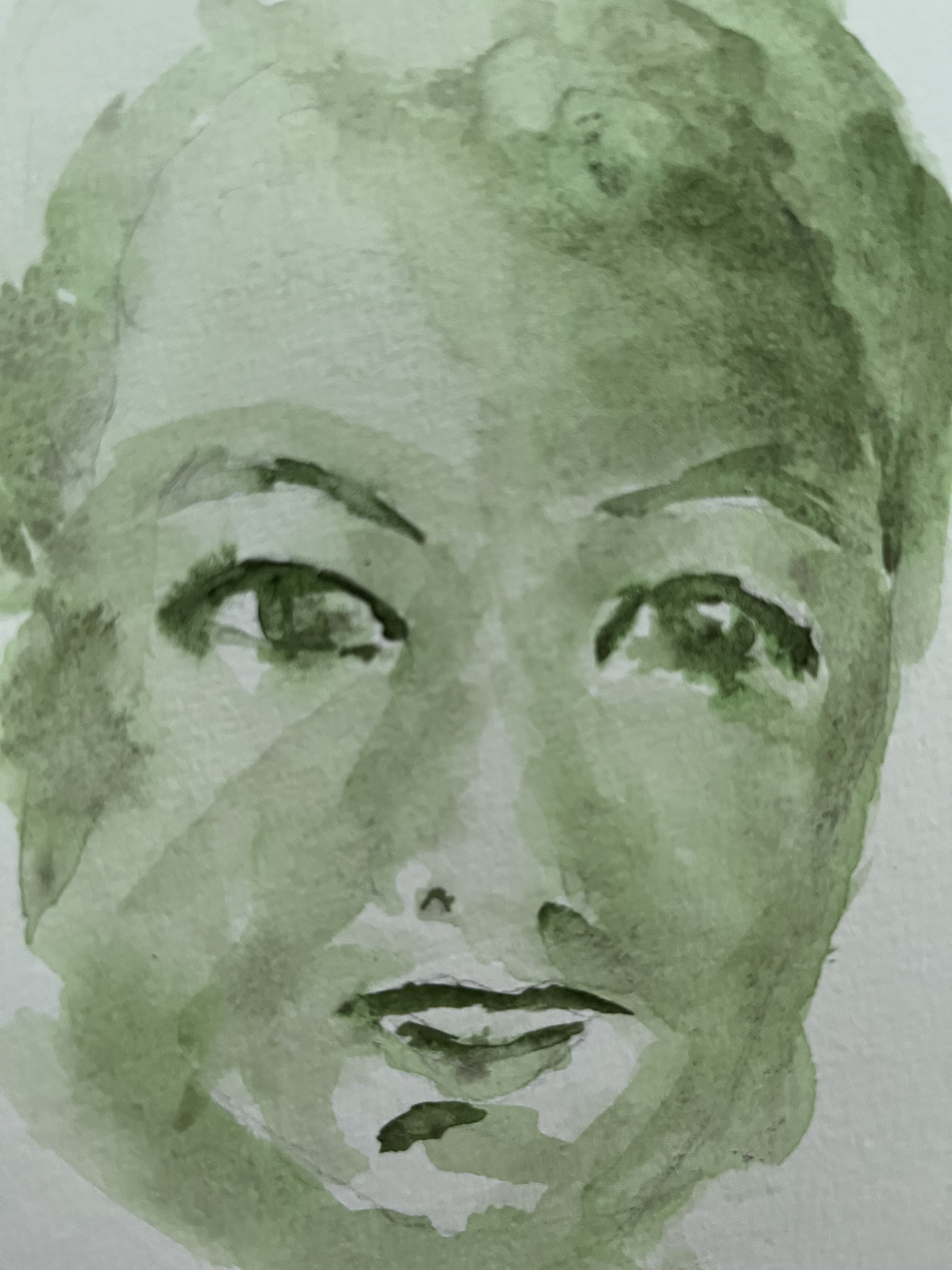
In the meantime, the watercolours are spread open on my desk. Brushes and pens and paper with some grisly attempts at portraiture. For the first time, I did manage a reasonable study in values. Not bad, I thought. I put a date at the top. Maybe I’ll look back at it in a hundred days and say: Oh wow. I started there, huh.

For you who have taken the time to drop by and read this, I want to say thank you. Blessings and peace and may your days be filled with good things.

I’ve fallen quite in love with Daniel Smith’s Green Apatite Genuine.

Spring is in the air

It’s been quite a busy period as not only is it exam week for the youngest one, it’s also been a week of appointments and events. I visited the municipal hall last week and handed in my application for a new passport along with a new id picture. It’s probably the first time since I’ve had a passport made that my passport picture doesn’t look like I’m running from the law.

A few days before I went to the municipal hall, I had new pictures taken. On my walk to the shop, I found myself ruminating on my previous passport picture and I decided to ask the photographer if it was possible to have one that was somewhat friendlier. As tends to happen, I walked into the shop and blurted out my thoughts to all and sundry including two surprised customers who burst out laughing when I announced that my last passport picture had me looking like I was a fugitive from the law.

It made for a lighthearted moment and I can happily say that for the first time, I have a passport picture that is somewhat friendlier.

At the municipal hall, there was some difficulty registering my fingerprints. I learned that intense treatments like chemotherapy has this effect of where fingerprints become a bit more hazy. It made me wonder if we ever lose our fingerprints.

“It happens with old people too,” the lady behind the counter says to me. “Not that fingerprints are ever erased, it’s just they don’t register anymore. But we also see this in people like you who have undergone chemo.”

And it somehow strikes me that she hasn’t tagged me as an old person but as someone who has undergone intense treatment.

On Saturday, I travel to Rotterdam. I’m headed there to support the project called Project Take Away. Take Away started as a neighbourhood initiative led by friends Marielle and her partner at ook_huis. It’s a lovely initiative which started with refugees and neighbours coming together to share coffee and talk about coffee and different ways of making coffee and as time progressed it evolved into something more. To celebrate their third year, Take Away released a book documenting three years of work. It’s an impressive volume with beautiful images but most importantly it reflects the vibrant life of this group of people who have been working together, caring for this community and for the neighbourhood and growing into this rich and beautiful art collective.

I think of how we forget the power of small movements like these. How practicing care in the community setting is a radical act in a society that’s grown more and more disjointed and disconnected. It’s not the size of the movement that matters, that we are doing a movement with intention is what matters. The intention drives the movement, drives momentum and leads to change.

I think of how these small movements are so vital when it comes to changing perceptions. When it comes to changing how we see each other and when it comes to making space and holding space for one another. I understand the antipathy that exists on one side of society towards asylumseekers, but I also want society to understand that if it were possible to live humanly where they are, people would not be seeking asylum. Living means more than surviving, living means being able to grow and thrive and fulfil your potential as a human being. This is why we can’t turn our backs or close our eyes to the circumstances that cause people to flee the countries of their birth.

It’s callous to say: ‘go back to where you came from’, when we don’t know the full story.

After the meeting at the Take Away space, we traveled to where Marielle was holding a reading/talk around a book she’d collaborated on together with the artist Chen Yun. This book, titled 51 Personae:Tarwewijk was five years in the making. It’s a unique and beautiful work documenting walks around the Rotterdam neighbourhood of Tarwewijk. What I love most about this work is how in the final publication, it contains the text from these walks in Dutch, English and Chinese. Not on separate pages, but these texts exist side by side on the same page or as extensions of each other.

It made me think of how it’s beautifully representative of the multicultural nature of society and how the world is made up of many different people speaking many different languages and there is room for all of us to live side by side.

Copies of this book are available at Available & The Rat.

I feel like I should write a little bit more about Available & The Rat, but I will do so another time. It’s a space that’s definitely worth visiting.

Spring is in the air. Out in the garden, things are growing. Our prunus tree has grown a bit more sturdy and is spreading out its arms. From the small seat by the water, I have a lovely view of back gardens with tulips coming up, a magnolia tree in bloom and a cherry blossom tree.

I have resolved to go and sit out beside the water as much as I can. For now, I’m ending this lengthy post.

Take some time out of your busy schedule to just sit and reflect on how you want to greet this new season. Life brings with it unexpected things, but when you take time to connect to what’s strong in you, you won’t be easily shaken.

Blessings and peace to you who read this and thank you for dropping by.

It’s only Tuesday and yet . . .

Not that I post with any kind of regularity or schedule, but here I am on a Tuesday. I’ve enrolled in a five session course on portraits with acrylics and the first session went pretty well. The advantage of acrylics is the drying time and how it’s much easier to take it home to continue work on it. Compared to pastels where the work has to be carefully transported, acrylics are easy. I’m enjoying these courses which are in series of five sessions each time focusing on a particular medium as I feel like I want to understand how different mediums work.

I do enjoy portraits a lot and I want to try and see what different things I can do with it once I get the basics down.

When I was a young girl, my mother once showed my notebook of writings to the daughter of a friend of hers. I think my Mom was proud that I was writing, but I was quite embarassed because her friend’s daughter was (at that time) already playing the violin for a big orchestra. I was like: Eh…Mom. Why?

But instead of dismissing my work, this young woman looked at it carefully, then she said something to me which I’ve carried around much like a puzzle that I keep trying to unfold.

“An artist,” she said. “Can see beyond the leaf.”

I never got around to asking her what she meant because soon after that this violinist went abroad to play with other orchestras and our paths never crossed again.

I think of her words every now and then, though.

Today, those words came bubbling up again and I thought of the following reply:

Beyond the leaf is a world (maybe more than one)

Lives are lived. Not all are told or written down in story.

Not one is insignificant.

To you who read these words, may you be surprised by small moments of daily joy. Thank you for stopping by.

Here’s one of my favorite exercises from this week. On a background of sennelier soft pastel, an impression of branch and leaf.

how it’s going

I’ve been going to physical therapy with a group of oncology patients for a couple of weeks now and have noticed that while mornings are often much better in terms of energy, afternoons are now improving. I’m not as tired as I was during the first afternoon training. I take this to be a good sign.

Upon my return home from Gladstones, the eldest son told me that I could transform his former bedroom into a writing space. Something I hadn’t even thought of doing because it was always his room, a lot of his things are still in it, and perhaps it’s that mother thought in my head that held the space for him just in case. But, as I was reminded, it’s been a year since he moved out. Birds spread their wings, they leave the nest, and go discover the sky.

So finally, after more than twenty years of writing at the dining table and having to move my mess when it’s time to eat, I have this space where the books I am reading can be left as they are. Where my pens and pencils don’t have to be tidied up and where when I am done for the day, I can close the door and let the projects I’m working on percolate.

I can’t help but think again about Virginia Woolf talking about a room of our own and how women who write need this kind of space.

Before I went to Wales, I downloaded a book by Joanna Penn. In the past, I’ve read books on writing that made me go: Oh, that’s nice. But it doesn’t work for me. Joanna Penn’s “How to Write A Novel” is perhaps the first book on novel writing that’s made me stop and say: I recognize that. For one, Joanna Penn calls herself a discovery writer. She talks about how overwhelming the process of writing a novel can be when you’re like her(like me). It was like a letter from a friend saying: look, I get it. Now tell me why you’re not finishing that novel. For me the greatest thing was a sense of overwhelm. I’d get bogged down in the details and before I knew it, I was lost. (I have a bunch of novels with great beginnings where the middles and ends are all squashed together because I got caught in a tide of overwhelm and couldn’t see where things were going anymore.)

But here I am. It is the beginning of the week. I have returned from my therapy class feeling energized and thinking: you know, you’ve come this far. Look at the horizon. Can you see where this story is going? Can you see how it’s going to end? Can you see what the story is about? Coming on close to 50,000 words, it’s really getting there. (Alarming thought.)

I think of how my sister would tell me to write whatever I wanted to write and to never give up. If my sister were still here, this is the novel I would give her. I would tell her, this is the novel I wrote because of all the conversations we’ve had and which we continue to have in my head. There are moments I just wish I could turn to her and say: what do you think about this?

What’s kept me from finishing novels in the past? At the heart of it has always been fear. Fear I wouldn’t have the right words. Fear I wasn’t up to the task. Fear I would screw up.

It’s funny how my sister’s legacy continues in the words she used to speak to me. My youngest son has had some difficult moments at school (understandable in the light of everything) but I’ve said these words my sister used to say to me: “It’s your dream, do something about it.”

Since I got this room, I’ve been coming up everyday to write words because when we see each other again, my sister will probably ask me what I did about my dreams and I don’t want to say that I was too scared or too overwhelmed to do something about it.

Blessings and peace to you who read this. Agyamanac Unay for stopping by.

At work in Gladstones

Here I am in Gladstones Library in Wales for a week of writing at the Milford Writer’s Writing Retreat. It has been a while since I’ve done something like this and I had quite forgotten just how enervating taking time out to write can be. It’s more than carving out time during the regular day, but just being here among so many books with other writers and just focusing on the work of writing has proven to be quite helpful in my process.

Before the diagnosis in 2022, I had been working on a couple of projects which I quite forgot all throughout treatment, so finding them again early in 2024 made me realise that I actually still liked these projects and they were stories that deserved to be finished. But coming to the Milford week, I was still torn on which project to work on.

In the end, I found myself drawn quite strongly to what I call the En story. I had been avoiding finishing it because the scale felt just so large. I realised that I have to acknowledge that it really is a novel. Not a novella, not a long short story, but a novel. It also means that writing in Gladstones works perfectly. I am in the process of putting together all the bits and pieces which I feel belong in this work and there it was staring me in the face…climate change. And what joy to be able to look through the library catalogue, head to the stacks, take all the books you think will be helpful and find exactly what you need for the huge thing you have been terrified about. It also helps a lot that one of my writer friends is a geophysicist and so I could send her a message saying: “uh…I have a question, help”.

It’s interesting to me too that the desk I’m seated at right now is located between two stacks of philosophers.

There is something about the moment and place of creation and how tapping into the source will bring you to the places/people/sources that you need in order to keep moving.

Working on the En story, I understand what it is about this work that terrified me. Now that I have the proper focus, I see how the world has always been comprised of opposing forces. Forces at a constant push and pull and forces that threaten to overwhelm each other. There is the nature that uses up worlds without thought or without care. It’s the kind of nature that discards without thought because when something is used up, there will always be another to take its place. It is the assumption born of privilege. There is another nature at place here too. It’s the nature of lifegiving and restoration and nurturing. Because the second nature is not brutal in nature, it’s often trampled on or made little of. But without the second nature, what would happen to our earth? What would happen to humankind? There is another nature somewhere in there and this is one wherein I hope balance takes place. I am working on it and my head is constantly busy with it.

A little while ago, I had a conversation with one of my Dutch friends. We talked about the balance between the realm of the spirit and the real world and how it’s easy to get caught up and lost in the spiritual, but we need to remember that we are also here in the real. It is the same with writing. My first drafts tend to be vague and starry eyed and not too grounded…more floaty and slippery than solid.

I started writing again in 2024 and it feels to me like I am learning all these things all over again. But what a joy to be able to do so. To be able to write and tell the stories I want to tell. Isn’t that a blessing?

Blessings and peace to you who read this. Agyamanac Unay for stopping by.

Challenges

So, I decided to take the challenge and keep on writing in Dutch. When Liang de Beer asked me if I would like to take a shot at writing something for Modelverhalen, I thought–let’s say yes. How hard can it be?

Well. I am here to tell you that writing in Dutch is hard and challenging. Dutch isn’t an easy language and I actually caught myself turning English words into Dutch by changing the spelling. I know. Thank goodness for the native Dutch speakers who live in my house and who are pretty tough when it comes to my use of the Dutch language.

Even if my story doesn’t make it into the anthology, I have learned so much from the process of being edited by Liang. From fuzzy first draft, through tangled experimental versions, to the draft that I ended up submitting today, I can see the process the story has gone through and how the draft I ended up submitting tells a more cohesive story than the draft I submitted first. (Plus, I also feel like I learned to use the language better than before.)

Writing in Dutch also made me realise that while I may still have a journey ahead of me, I actually do enjoy writing in Dutch. I like the rhythm and the sound of the language and I want do discover how to use it to tell the stories I want to tell.

I think about life and how life is a journey and a process and learning to write in Dutch is for me part of my journey and part of my process of becoming a better inhabitant of the Earth. I am learning too to be more patient with myself because process cannot be rushed and neither can you rush the journey. Perhaps this is why it takes about 100,000 words.

I’m thinking about process and journey as I also recently took another step in the journey towards becoming stronger. I recently signed up for a physiotherapy class which is focused primarily on cancer patients and the needs of cancer patients.

Back before my diagnosis and all the treatments that followed, I pushed my body to the limit and I could lift and carry and do a lot of things which my body can’t do as well as it used to. What’s often frustrated me is how I seem to just run out of energy even when my brain tells me: we have lots of things to do.

During the intake my physiotherapist gave me the word “doseren”. In translation, the goal is to learn how to budget and make use of my energy so I don’t end up constantly with a deficit. Not giving your body time to recover energy results in a constant deficit until you are no longer capable of doing anything. The objective of physiotherapy is to make sure that your energy level eventually gets back to the point it was before all the traumatic stuff happened to your body.

I learned this lesson during my second class. I had had a broken rest and wasn’t feeling in tiptop shape, but I still came to class. My physiotherapist observed that my energy was low and told me not to make use of the weighted vests. When I insisted that I could, she said: remember what I told you about doseren?

It was a humbling moment. I had to admit to myself that in that moment, if I took the weighted vest, I might be able to finish the class, but at the end of the class, I would not be able to do anything else. Acknowledging the limits of my energy, allowed me to recover well and the day after class, instead of taking my usual quickstep one hour walk, I decided to take a gentle half hour stroll.

I think of how we’re often focused on the goal–on getting there–on achieving something–on becoming whatever it is that we want to become. But I am learning that process is important. Maybe even more important than the goal.

I have this tendency to be so focused on getting somewhere, that I forget to pay attention to the things that matter most. Being rooted in now. Focusing on what my body is telling me. These are things that are easy to forget when life is going at its usual pace. In a manner of speaking, it’s a blessing to be taught to slow down.

I am in the process and I am learning and what I am learning is all helpful. Nothing in life is ever wasted.

Blessings and peace to you who read this and don’t forget to take time to be in the moment.

What does it mean to flow without borders?

I have had in my mind this thought which I came back to me and seems to become more concrete as I try to put it into practice: what do we mean when we talk about a world without borders? Or what do we want to see? Or how might that experience be like if there were only superficial restrictions in place and if we could — as Glissant expressed it, move through to taste the atmosphere of a place. I have to go back to reading Glissant because a lot of things are mixed up in my memory (chemobrain) but this definitely stuck and remained with me and I was reminded of it again when in one of our latest LIMBO meetings, some of the participants asked why is it that we have to put borders in place? Why all these restrictions? Doesn’t the world belong to all of us?

I went home thinking about borders. How do we see borders? Are they protection? Who is protected by these borders? And who are we protecting ourselves from? And why do we need to keep others out in order to feel protected or safe? What do we mean by safety? What do we mean by security?

I asked these questions of myself because I live in a country to which people from other countries migrate to or flee towards to ask for asylum. I live in a country in which the discussion around migrants and asylumseekers is so fraught that one actually risks losing friendships in the process.

I don’t have the power to make change happen on a big scale and I don’t have the power to go out into the large arena and make discussions happen but I thought on how to bring that practice of flowing through borders into a very small space.

For this month’s LIMBO, I thought of asking participants to work together to fill up white space with writing or drawings, with lines or curves or symbols, with whatever they can think about to express their presence in the world. The invitation being this: if someone puts down a mark, how will you interact with it? How will you cross the borders? How do you enter space where you didn’t put a mark first?

It’s an exercise that I find myself wanting to repeat with others. Without our realising it, we have our own concept of borders, even on something as small and simple as a piece of paper. Creating on a space reserved and marked yours feels different from creating in a space that says–this is for all of us. Leave your marks, interact with other marks, there is no one artist, no one author, no one creator, it belongs to all of us.

There are questions that arise from this exercise that I also want to think about and which I find myself curious about: how does it feel to cross over into another space? What changes once you make that decision to leave a mark there? To interact with something that’s there? How does it change the way you perceive the work?

I didn’t get to ask this of the group, but I find myself wondering: How do exercises of collaborative creation change the way we see the world and the way we interact with one another?

In talking about this with a dear friend who is a fellow artist, activist and also a writer in the field, I expressed a vision of a room that becomes filled with doodles and maps and words and drawings. And how, it would be interesting to discover how willing we are to layer on top of what is already there and how that space would not be a work attributed to any one person but it would be attributed to all who collaborated whether the person is invited or comes upon it by happenstance, where those making marks can also be living creatures that we take care of.

Writing this, I realise that I am writing about the world we live in. We are all in the process of creating or re-creating, making or re-making, building or re-building–perhaps we layer over what is already there–we bear witness. We see how systems put in place have shaky foundations and how those who benefit from these systems try to prop them up. We bear witness, we offer criticque. But is offering criticque enough?

Marking the empty page to make something together can involve some risk. Stepping out into the world, making a decision to make or leave a mark involves much deeper and more thoughtful movement. What kind of mark do I want to leave? How will the mark that I leave affect those whose spaces or whose lives I live a mark on?

In any case, for me, the question strikes closer to home and makes me think that if I have marked my children with love and care and the ability to be thoughtful and considerate of others, then some of what I am meant to do has been done.

I wish I could share the picture of our collaboration, but it belongs to the group. But perhaps it’s an exercise some of you who read this blog might want to try on your own. Just take the step. Make the invitation and see where it takes you.

Agyamanac Unay for stopping by. Blessings and peace to you who read this.