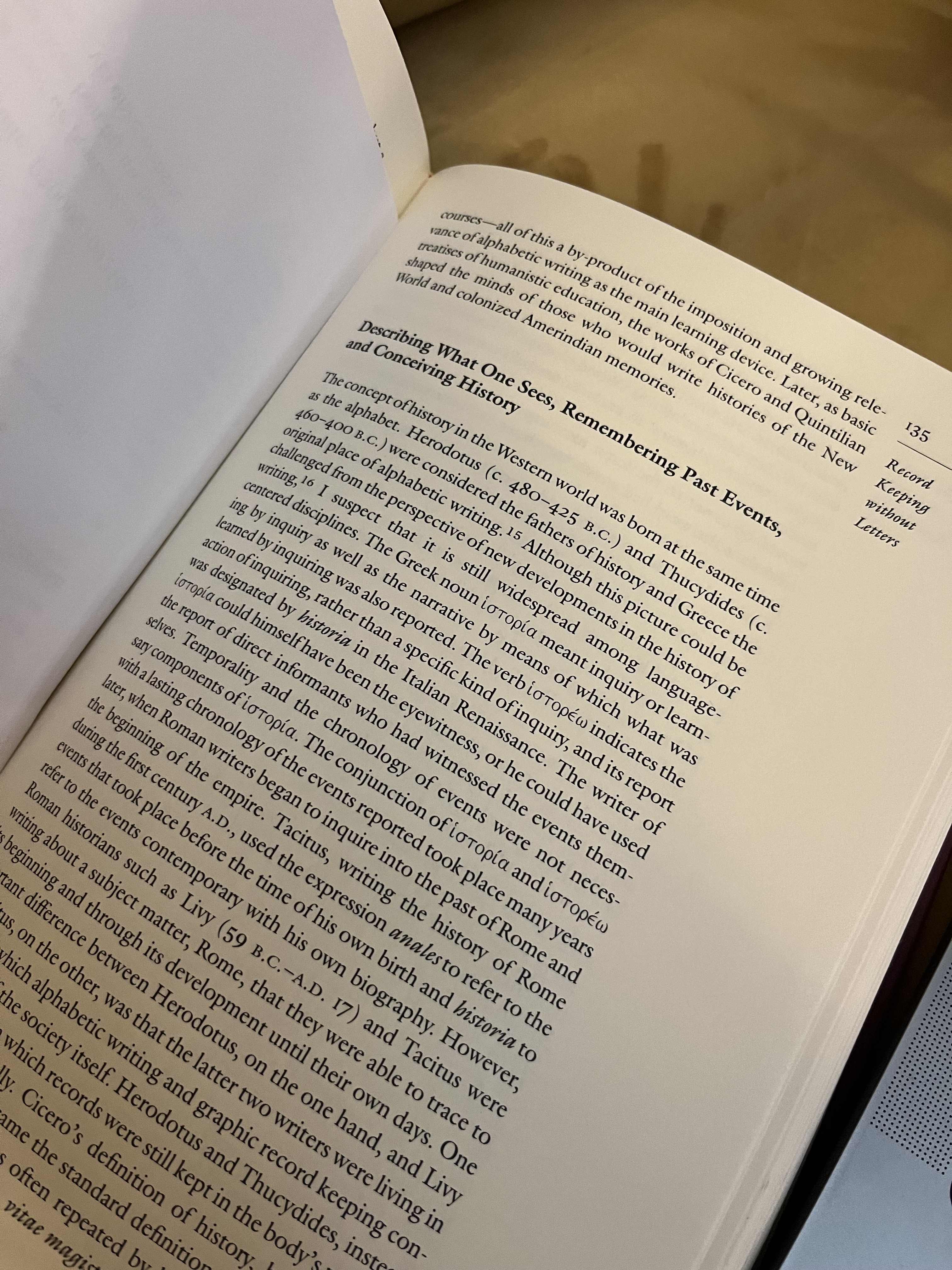
I’m chatting with a person who’s writing about my father’s life while reading this section called Describing what one sees, Remembering Past Events, and Conceiving History in Walter D. Mignolo’s The Darker Side of the Renaissance: Literacy, Territoriality and Colonization. I am seated in the lounge of the Royal Library of The Hague and it’s nice and cool with the small sounds coming from different occupants of the library. In a corner of this lounge, someone is snoring. The seats are comfortable and conducive to a siesta and I am seated on a comfy sofa with my belongings around me–it’s kind of like being at home but being able to focus in a way that’s more library-like (if you know what I mean, you know what I mean). I think about history–family histories–the things that are said and that aren’t said–what we pick up without words having to be said and how we carry these histories with us and how we don’t speak about the painful or dark parts of familial pasts.
Reading Mignolo, I reflect on how histories are made and passed onward from generation to generation. Mignolo writes about histories being kept in the body memory, of histories being transmitted orally. And somehow, I find myself thinking of history that we keep in our bodies.
Recently, a friend of ours spoke of finding out that the father she’d grown up with wasn’t her biological father and the pathway to connecting with her biological family from the side of her biological father all came down to taking a DNA test that matched her with a niece who for some unknown reason decided to also take a DNA test. This connection eventually led to her finding the sister who had been searching for her for a long time.
A whole puzzle with unmatched edges fell into place. Character traits she’d wondered about finally made sense, once she spoke to her sister. Conversations that were cut-off mid-sentence. Hints of something secret–dates that didn’t match. Unspoken tensions that she somehow registered. She had this feeling that maybe there was something hidden, but it wasn’t until it was time to clear out her mother’s attic that she discovered the secret of her paternity.
In an age where histories are being re-shaped, re-written and erased, it feels urgent to think about the position from where histories are being told. Who is telling this history? Under what terms is that history being told? In what form and in what shape and with what words or means is that history being put in place?
It feels necessary too to keep a record of what is happening in the world around us as we keep a record of our own histories.
I think about my father and I wonder what he would say about the ongoing conflicts in the world today. I want to think he would also feel urgency and the need to speak out against injustice. The truth is, I don’t know what his response would be were we in conversation today. That’s because my last memory of him is one of heated conversation where we disagreed on what was just and what was unjust and how we left it in the middle as something we would come back to later on.
Familial history often feels episodic. When we talk about memories and things that happened in the past, we remember in bits and pieces and then we look to each other for confirmation.
I’m going back to reading Mignolo. I want to think about memory and the fallibility of memory and how we tend to remember people in a different light once they are no longer in the world.
Blessings and peace to you who read this. May you find joy in the journey.
 From the Beloved Country
Pingback: Websites via Bluesky 2025-08-14 – Ingram Braun