art and narrative

Last Thursday, I moderated a panel discussion on the Fractal Art of Julius Horsthuis at NXT Museum. It was quite an interesting event as not only was the artist on panel, but we also had Dr. Margriet van der Heijden on panel–a physicist who specialised in particle physics at CERN. I’d never thought all that much about fractals before–I mean, if someone said the word fractal, I would understand that they’re talking about self-similar patterns which we often see in nature, but I probably wouldn’t be able to tell you what it is in-depth. For math people, talk about fractals will often lead to thinking about the Mandelbrot equation, but did you know that before Mandelbrot, there was the Julia? (Yep. I learned all these things while doing my prep.)

I also found myself thinking on the question of what makes art. What do we mean when we say a thing is a work of art? And what function do we ascribe to art? Julius Horsthuis says that his focus on Fractals lies in the fact that he hasn’t gotten bored by it yet.

For Julius, documenting or discovering the 3D worlds opened up by the input of various equations is what makes it fascinating for him. He talks about the films Baraka and Samsara which don’t follow a conventional narrative and how these films were an inspiration for the 3D films that he makes.

I certainly think that experiencing this kind of art by being in a space where you are surrounded by it is a different one from that of seeing it onscreen (on your laptop, your pc or your television). There is a mesmeric quality to it, but at the same time there is (as one of the audience said) a feeling of loneliness. Perhaps because there is an absence of characters interacting with the landscape. (Perhaps the person in the space becomes a character interacting with the landscape or could it be the maker himself?)

I watched Baraka and thought about that difference (the absence of humans in Julius’s work) and found myself thinking of how a landscape changes with the presence of humans. As Margriet said to me later on: Humans are not fractals.

I do like the concept of non-conventional narration and how it ties in with how story doesn’t have to conform in order for it to matter.

Later, Julius speaks of how the absence of narration is deliberate, although as he explores the possibilities of bringing his creations to VR, he realises that the absence of narration may not be conducive to people engaging with the art, particularly if they come to the experience for the first time.

Is story an experience? Is art an experience?

I think about these as I deliberate on my own work and process. I think of how as writers of story, there is a certain expectation arising from centuries of stories being told. What happens when story doesn’t conform to expectation? What happens when a story simply wants to show a world in the same way a documentary maker would show the world?

But is showing the world enough? We could argue that the majority of science fiction and fantasy books are about showing the world.

Piranesi, one of the books I read when I finally got my reading brain back, feels very much like that. It’s basically Susanna Clarke showing us the world Piranesi occupies. Piranesi’s voice compels us to come along and see and learn more about the world they live in. The cast of characters is barely there, but we’re seeing the world through Piranesi’s eyes and it’s beautiful and fascinating and a lot of times it is lonely. Piranesi eventually conforms to a story expectation but then not really and the feeling of fascination remains long after the book is finished.

Does Horsthuis’ art work in the same way? I can’t help but wish I had thought to ask how exploring the world of Fractals has changed or enriched the artist as a person. I’m not even sure if this is what the artist is after. Does it even matter? Should our work change us or reflect us or enrich us even? Does a work have to mean something in order for it to have value? Is fascination and sense of wonder enough?

In the light of discussions around the lives of creators, to what extent does the character and life of a creator influence our engagement with the work that they create? And can we separate things made from the people who make them? (Probably something for another post…my brain tends to wander off in tangents and this is my blog. 🙂 )

I think there is room in the world for different kinds of artmaking because every form of creation will find its own audience and will speak to audiences in different ways. Thursday’s event reminded me of that. It reminded me of the beauty of physics, the endless mystery of the world we live in and that joyful feeling that arises when people come together with a desire to create bridges of understanding and knowledge.

If you’re in Amsterdam, I would recommend checking out NXT Museum (check out what’s on exhibit first as it varies). Not only is Julius Horsthuis’s Fractal Art on display, but they also have a fascinating exhibition by the postdigital art group Random International.

Blessings and peace to you who read this. Daghang salamat for passing by.

Last Night in Rotterdam

Last night I was on a panel celebrating the launch of De Komeet. It was a lovely evening hosted by The Base Bookspace and Bosch and De Jong in the Fenix Food Factory in Rotterdam. I’m mentioning the location specifically, because when I got to the place, I was just blown away by how cool it is to find a bookshop in a Food place. I wish I’d remembered to take pictures, but Trip Advisor has cool pics of the location in case you want to get an impression of what it’s like. I love that there is this independent bookshop in a space where people meet to have a bite and I totally made an agreement with writing friends to meet up at that place and do some writing together. ( I also had some amazing oesterzwam bitterballen so I am definitely going back for that too.)

She may not read it, but I want to send a shout-out to Lianne from The Base Bookspace for an amazing job as moderator. I think the space itself contributed a lot to that feeling of warmth and energy and safety. On panel were Vamba Sharif and Martijn Lindeboom who were both editors and contributors to the anthology, Shiantie Singh, Weegbree, and myself. We discussed SFF, what editors Vamba Sharif and Martijn Lindeboom hoped to achieve with this anthology, and also what our experience and hopes were as contributors to this anthology. My dream, as I shared it with those who’d come to the panel, was that we would in the future see a blurring of borders between genres so we move away from thinking in terms of labels.

I now find myself reflecting on how labels are more harmful than we think they are and how wanting to put labels on creative work is an outward expression of humanity’s need to be in control. We can’t always label or control creative expression, and this is why work that moves out of the expected or work that refuses to conform or submit to a particular label can be viewed by some as threatening. There’s a lot to unpack around how the fear of losing control and our discomfort with not being able to predict or control an outcome contributes to the increased polarisation we see in today’s society, but there are a lot of folks way smarter than I am who can do that. My job as a creative person engaging in different forms of art making and creation is simply to tell the story of how refusing to be bound to labels frees us to discover what’s truly joyful, what is truly kind, what it is that heals us where it matters the most and what can give us hope when the world brings hard things our way.

In the meantime, I have resumed writing again (thanks to my precious friend, Marielle). I admit that at one point I told her, I probably won’t write ever again because my sff brain seems to have gone with the chemo. But Marielle just kept on speaking out her hope that I would pick up the writing again and so I am writing again and Marielle is keeping me honest and writing. She may or may not read this blog as she’s pretty analogue, but I just wanted to put this out there.

I want to say thank you to the lovely people who showed up for the book panel. I may show up at a future panel for De Komeet, it all depends on proximity and energy. But in the meantime, I will try to update this blog as much as I can with thoughts on writing, art, reading and life.

Blessings and peace to all who read. Agyamanac Unay for reading.

An invitation . . .

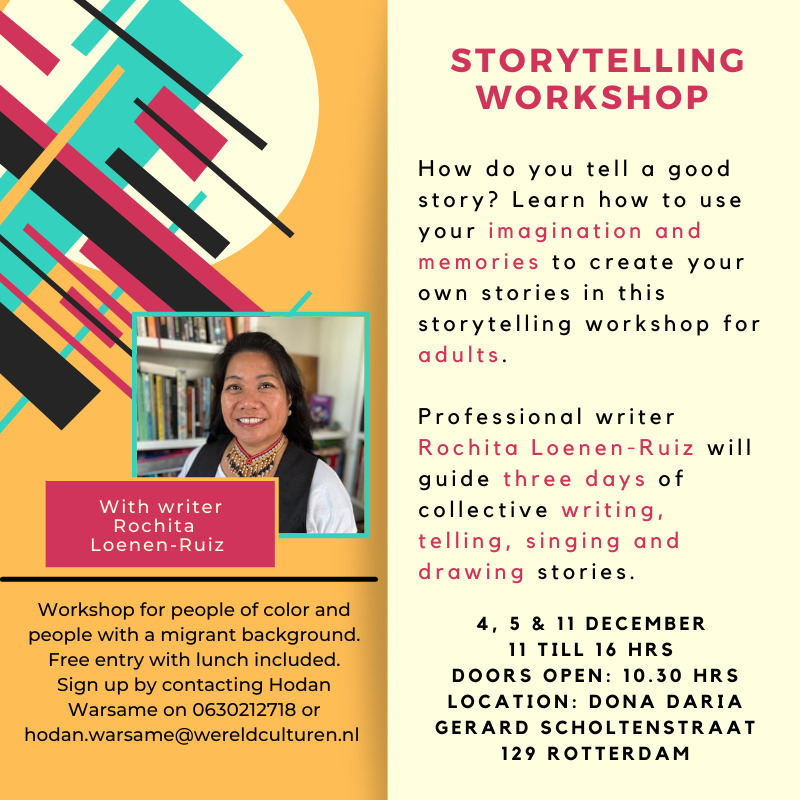
Posting the flyer for a mixed media story creation workshop that I’ve been working on and developing with the migrant BIPOC community in mind. Thanks to the lobbying efforts of Hodan Warsame, we will be able to share this workshop with the people we had in mind when we launched our efforts a year ago. This is a project that’s come about through the Wereldmuseum Rotterdam and in collaboration with Dona Daria. There are still places available, so do send your application to Hodan. All that’s needed is an email or a text message. I do want to emphasise that this iteration is specifically for the migrant and BIPOC community.

In a time of pandemic

Last year, I was on a panel where we talked about the pandemic. We were in lockdown, but there was still this feeling that vaccines would be developed and the virus would be defeated. The reality is we’re still in the midst of a raging pandemic and while there are vaccines, the virus has undergone a number of mutations and there’s no way of predicting the path of a virus. It’s a natural phenomenon–like a storm that must rage until it’s done raging. There’s no reasoning with it, there’s no negotiating with it, there’s just understanding that we are living in a time when we must rethink the way we live our lives and do things.

This Sunday, I’ll be on a BonFiyah panel titled: Frail But Hard to Kill:Hope in a Time of Pandemic. The panel will be hosted by the most excellent Cristina Jurado and I’ll be on it alongside Alyssa Cole, Bogi Takács and Eve Shi. It’s probably the first proper SF related event that I’ll be appearing on since I don’t remember when, but the subject matter of the panel speaks to the need of the time we are in, so I hope I can offer something helpful.

The pandemic broke at a time when I was getting back on my feet and feeling strong enough again to pursue new ventures. For a short while, it was like coming to a full stop and feeling quite stymied about what happens next. But what helped me most was being in the rhythm of conducting a workshop that had to be moved online. Having to adapt the method and the practice to one that was more personal and having to take more time to think about the needs of the students. At the close of that period, I felt as if I had learned a lot and it helped me go back to the drawing board, to rethink how such workshops are conducted and to think about ways that are more nurturing and communal.

It also had me reflecting on the radicalised nature of various discussions and on what could be done to shift the direction of conversations so that instead of shouting from opposite ends of the table, we could move towards finding common ground, building bridges, and having productive discussions.

How can we as beings who are writers, practitioners of craft, artists and thinkers help create or shape the environment for these kinds of discussions?

I don’t think a blogpost offers enough room to think aloud on that matter, but I am taking it with me as I continue on my journey.

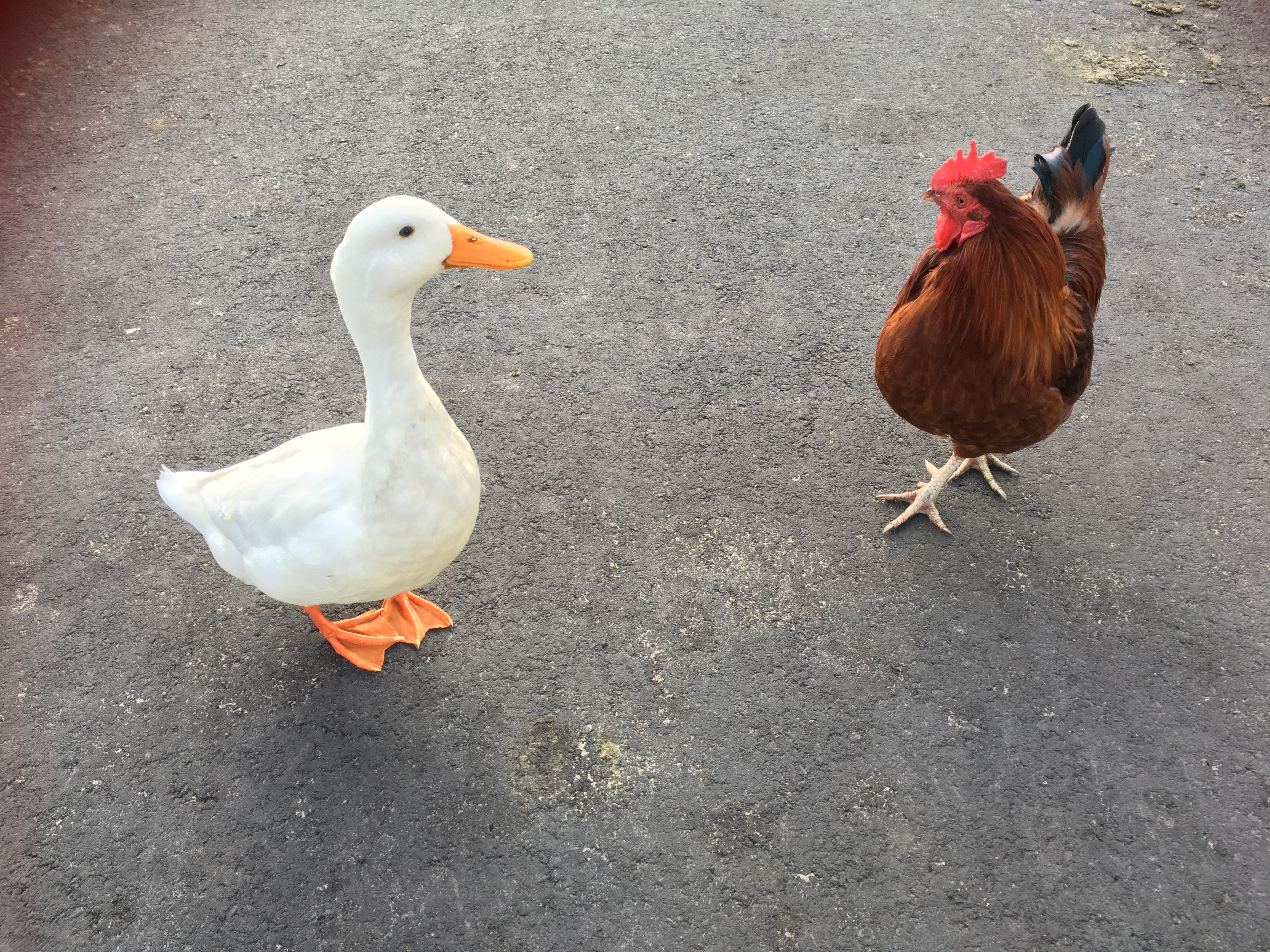
In the meantime, I wanted to share an image taken during one of my afternoon walks. I’ve included the caption I invented for it as I shared it with my friends. May we also recognise that there are other dwellers and travellers on this earth.

Upon observing a third species attempting to capture their meeting, the two species say to each other: ignore the third species. We’re still going to have our afternoon hangout, right?

May we travel with love and with wisdom.

second update of the day

Two updates in a day! Isn’t that something after months of not updating at all.

If I had to share everything that’s happened in the past year, I would be updating on the hour. But this update is about a one-hour workshop that I’ll be doing for FIBER. As I understand there are still spots available and when you sign-up or apply, you’re not just applying for a day workshop, but for a series of multidisciplinary workshops. If that tickles your curiosity, do go and check out the link.

I’ll be doing Day #1 workshop on worldbuilding and I’m still working on how to fit as much as I possibly can into that one hour slot. I went and read Alice Bucknell’s essay Ecological World-Building:From Science Fiction to Virtual Reality and then I asked Rhian Morris if I could attend Alice’s lecture (I can. Yay!). I have the date blocked on my calendar and am looking forward to it.

Anyway, talking about worldbuilding, I had to share a project I’ve been doing with a handful of young people (14-21 years old) and how working with these youngsters has inspired me and helped me refine and adjust my approach towards teaching/sharing worldbuilding tools. Each workshop I’ve given has also taught me a lessons on how to refine my approach so that it fits better with the people I’m working with.

With Envisioning Other Futures, I had a balance of Dutch-speaking and English-speaking students. My discord youngsters are bilingual who choose to write in English, and I’ve had one day workshops with writers whose only common language is English. Each group teaches me how to adapt and adjust so that the approach will be most useful to those attending.

Regardless of what discipline or background people come from, I think it’s important to find that sweet spot where participants let go of the rigidity of expectation and embrace their playful self. I think we’re best able to create when we allow ourselves to play in the worlds that we create. It’s also then, in that sense of joy that comes from creating together that we find surprising solutions to what might seem like insurmountable problems.

**I am also sharing a link to Rhian Morris’ site as I found myself quite fascinated by her immersive work. Do check it out and be inspired.

Preparations

In the lead-up to the second edition of the Other Futures Festival which will be held in Amsterdam from the 10th of April to the 12th of April, I will be leading Envisioning Other Futures, a creative writing workshop with the focus on science fiction. The application period has passed and the selection process has been completed. Names of accepted applicants will be released sometime in the coming week.

It’s been a while since I last led a workshop and with Envisioning Other Futures, I hope participating writers will feel free to write in either English or Dutch. I am looking forward to the stories that will come out of the workshop and to witnessing fresh voices emerge from the workshop.

I am happy that we made a choice for guest lecturers from different disciplines, who can offer participants insights that I hope will compel our writers to look deeper than the known tropes.

After what feels like a long period of being out of it, I find myself returning to one of the things I love the most. Writing. Sharing what I know and nurturing others. 2020 is shaping up to be a great year.  🙂

Eschacon

20151016eschaconintro

Eschacon starts today and I will be there together with awesome writers Zen Cho, Marieke Nijkamp, Corinne Duyvis, Bill Campbell and Aliette de Bodard.

Work and life go on. I’m very honored to join these writers in discussions. To be able to share what knowledge I have gained is a joy.

Loncon 3 Schedule

I’m a bit late with posting my schedule, but if you want to see me on panels at Worldcon, my schedule looks like this:

Friday, August 15
1:30pm
 
Content and Form: Writing SF/F in non-Western Modes
Capital Suite 8 (Level 3), 1:30pm – 3pm

Sofia Samatar recently suggested that SF genre writers and readers have “a tendency to focus on content rather than form”, even or especially when engaging with marginalised perspectives. Does our genre inevitably tend towards the form and structure of western, English-language stories, regardless of what cultural tradition(s) are reflected in the content? How can a non-western or non-Anglophone writer engage with science fiction and fantasy while also operating outside of the conventions of western-style storytelling? Is it possible for western writers to engage with non-western traditions in an authentic way and produce a story that a wider audience will recognize as science fiction or fantasy? What are some of the different forms offered by non-western cultures that need to be told?

4:30pm
 
Imagining Fantasy Lands: The Status Quo Does Not Need Worldbuilding
Capital Suite 11 (Level 3), 4:30pm – 6pm

Fantasy world-building sometimes comes under fire for its pedantic attention to detail at the expense of pacing or prose style. Do descriptive passages clog up the narrative needlessly, when reader imagination should be filling in the gaps? Where does that leave the landscapes and cultures that are less well represented in the Western genre: can world-building be a tool in subverting reader expectations that would otherwise default to pseudo-medieval Euro-esque? If fantasy is about defamiliarising the familiar, how important is material culture – buildings, furnishings, tools, the organisation of social and commercial space – in creating a fantasy world?

8pm
 
Translation-Wish, Translation-Obstacles
Capital Suite 6 (Level 3), 8pm – 9pm

Many of us have read work in our own languages that we would love to propose to Anglophone publishers.  But how to fund a rough translation of such work?  The Interstitial Arts Foundation is looking to create a new initiative to bring translators together with national and international funders to create a way to make something happen!

Saturday, August 16
1:30pm
 
The World at Worldcon: SF/F in South and South-East Asia
London Suite 2 (Level 0), 1:30pm – 3pm

South and South-East Asia include a huge span of nations, cultures and languages, so does it make any sense to talk of “Asian SF”? What are the traditions and touchstones of fantastical storytelling in South and South-East Asia? What is the state of genre there, and how have shared myths and a joint heritage of colonialism influenced it? A panel of writers and critics from India, Pakistan, Malaysia and The Philippines compare notes.

10pm
 
Reading: Rochita Loenen-Ruiz
Capital Suite 13 (Level 3), 10pm – 10:30pm
Sunday, August 17
12pm
 
Diversity Within Young Adult Science Fiction
Capital Suite 2 (Level 3), 12pm – 1:30pm

From Earthsea to Noughts and Crosses, The Summer Prince to Akata Witch, children and teens need to see books with characters that represent the diverse world they live in, whether they are dystopian romance or fantasy adventure. Organisations like We Need Diverse Books are helping to promote diversity in children’s literature, but what actions can we take – as readers, writers, publishers, and book-buyers – to help them in their goals? And who are the great authors of the past few years we should be catching up on?

Please do feel free to say hi if you see me. 🙂

Sci Fi Writing Salon

(Copied from the FB page where you can register for this workshop.)

“If we want to see women of color safe, happy, healthy and in power in the future, we must write/create worlds that are worthy of us.” – adrienne maree brown.

On Saturday July 12 poetry platform RE:Definition, feminist collective Redmond and Amsterdam’s American Book Center are hosting a sci fi writing salon with adrienne maree brown (co-editor of “Octavia’s Brood: Science Fiction from Social Justice Movements) and Rochita Loenen-Ruiz (Octavia Butler scholar).

— Event info —
Doors open: 14.45h
Writing salon: From 15.00h until 18.00h.
Location: ABC Treehouse* (address: Voetboogstraat 11, 1012 XK A’dam)
Entrance: Free!
Reservations: Due to limited seating, reservations are required. To do so, please go to the Facebook Event page mention the number of seats (max. 3) you’d like to reserve.
What to bring: Something to write on and something to write with.

* ABC Treehouse is around the corner from sushi spot Tokyo Café at Spuiplein. When facing Tokyo Café, walk to the right; Voetboogstraat is the first street to your left.

— Links —
adrienne maree brown – http://adriennemareebrown.net/
Octavia’s Brood – http://www.octaviasbrood.com/
Rochita Loenen-Ruiz – https://rcloenenruiz.com/
Redmond – http://www.redmondamsterdam.com/
RE:Definition – http://www.wedefineus.wordpress.com
American Book Center – http://www.abc.nl

Afrofuturism and Beyond

Posting about two events related to each other.

On Saturday, November 2, Radio Redmond will be holding an Afrofuturist Event during the Amsterdam Museumnacht at FOAM Fotografiemuseum. I’m pretty excited about my story being included on programme for this event. I want to express my thanks to the Radio Redmond crew and in particular to Hodan Warsame and Chandra Frank who made time for me (never mind that the storm got in the way of that plan, but just the making time is a huge thing).

On November 9 (also a Saturday), I’ll be in Amsterdam again. This time at the American Book Center’s Treehouse for a book presentation of Mothership: Tales from Afrofuturism and Beyond. Our editor/publisher Bill Campbell will be there as well as ToC-mate Tade Thompson. Hodan Warsame will be moderating the q & a, and there will be books available.

Thanks go out to the American Book Center staff, in particular to Tiemen Zwaan. If you’re in Amsterdam, do drop by the book presentation. 🙂

I’ve been reminded that I still have a slew of things to finish before heading out to WFC, among them sending emails and checking in. I’m looking forward to this con. Here’s to meeting up with old friends and making new ones.