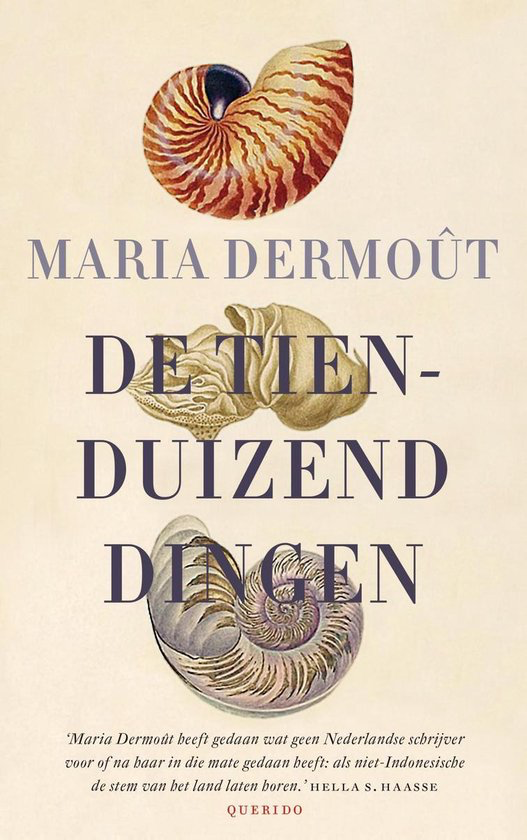
On reading Maria Dermout’s Tien Duizend Dingen

There is a house on an island and there is a garden around the house and in that garden are the graves of three little girls.

I read Maria Dermout’s De Tien Duizend Dingen in Dutch, so the above sentence is as close as I can get to summing up the opening of this Dermout’s beautifully immersive novel.

What captivated me the most about this novel was the intentional use of language and how through language Maria Dermout pulls the reader into the rhythm of a time and a place. It’s beautifully evocative and not only does the writer make us see the house, but we also see the garden, the leviathan who lives near the edge of the water that is in the garden, and then we are made aware of the graves and the possible ghosts of the three dead girls.

There is also the history of a place and of the first Mevrouw Kleyntjes who lived in this house and the second Mevrouw Kleyntjes who still lives in this house. There is the history of these women and the stories of the lives of the people who have interacted with and lived in relation to the house and around them is the history of place.

Somewhere halfway through De Tien Duizend Dingen, I sent a message to the friend who told me about this book. I told her that it made me think of Virginia Woolf. It’s been quite a long time since I read Virginia Woolf, but I remember a similar mesmerising almost hypnotic use of language in The Waves.

We are immersed in the world Maria Dermout writes about. We are transported to a period in time when the then Dutch East Indies (now Indonesia) is heading towards–an upheaval that will lead to a complete social-political change. Through the manner of telling, we can feel the simmering undertone of imminent change. Something is about to happen. What is about to happen is faintly present at the opening of the novel, but as the novel progresses, so does the sense of danger and precariousness–it is enough to make us recognise that at this point in time, the people in this place are no longer willing to simply accept the authority of Dutch masters. In this world, the woman, the house, the garden and its ghosts are relics of a past that will soon be nothing more than a dream.

De Tien Duizend Dingen was published in 1955 by Querido publishing house. It’s also available in English as The Ten Thousand Things.

What I have read and what I am reading

Now that I’ve regained enough focus to read whole novels, I find myself missing the conversations I used to have with my sister. A lot of our conversations used to revolve around books we’d read and what we thought about the story or how the writer managed to do something well or not well enough. I think my sister was the original bookworm in our family and I simply followed in her footsteps because whatever my sister read, I had to read too. Anyway, I’ve started reading the books I downloaded onto my reader and I thought I would write a little bit about the one I’ve just started reading as well as the one that I just finished reading. I thought I’d switch between fiction and non-fiction. Non-fiction often takes me longer as I like to reflect on what I’ve just read.

Fiction Read:

I’ve just finished Tade Thompson’s excellent Far From the Light of Heaven. I’m pretty sure Tade has written and published a bunch of novels since this one, but I just got around to reading again and the title of Tade’s excellent murder mystery called to me. It took me a week and a half to finish reading (this is my current reading speed for novels) but I never once lost track of the thread of the story. I’m also glad that I decided to get a tablet because it’s made it easier for me to just open a book and read when I’m on the train or when I remember that I am in the midst of reading a book.

I understand the importance of titles now because for some reason, that title just kept jumping out at me each time I clicked on my reader and I decided that once I had enough focus I would read that novel first. Far From the Light of Heaven makes use of elements of space opera and science fiction but at the heart of it, Far From the Light of Heaven is a murder mystery. The stakes are high and I liked how the characters feel real. I have to admit a fondness for Shell Campion’s Uncle Larry. I could relate to that feeling of wanting to protect someone younger who you consider part of your family. I found myself quite intrigued by the Lambers as a race and I want to know more about them. Reading this book, I also had to think about conversations around AI and the use of AI. I like how Tade doesn’t take sides on that, but tries to show how AI can be useful but also how it has its vulnerabilities and can be subverted in a way that it becomes a danger. I don’t know if this was intentional, but it felt very much so.

One of the things I loved about this novel is how we get to see how what happens on and to Ragtime affects the world the characters live in. It’s a reminder of how actions taken reverberate in the world. The question becomes this: do those actions lead to understanding that brings lasting change or do those actions lead to polarisation and division in the society around us? I may very well be putting my own interpretation on it, but this is something I thought about when I got to that part. Another memorable scene for me is the communal rite of grief/processing trauma.

I won’t say anymore as I might spoil the book for those who haven’t read it yet, but if you enjoy murder mysteries that are more than just murder mysteries, this might be just the book for you. Highly recommended.

I have a rather lengthy TBR list and I think I would like to try and write about as many of them as I can. I’m pretty sure there are things I’ve read in the past three years and a half that I forgot to write about.

Current Non-Fiction reads:

As I tend to dip into multiple non-fiction books at one time, I might write about my impressions from those books every now and then.

I’ve started on Karen Barad’s Meeting the Universe Halfway. I don’t even know who recommended this book or why I decided to buy it, but I’m pretty sure the person who recommended it made an impression on me. Anyway, I’ve just started reading it and there’s a line in the preface that just resonates so much with me. In the preface, the author writes about entanglements and how to be entangled is not simply being intertwined but it’s more than that. It’s a really great preface and if you’re interested in quantum physics, it does look like an engaging read.

A recent book I’ve recommended and gifted to fellow community workers is Aminata Cairo’s Holding Space. Aminata was one of the guest facilitators for LIMBO and the workshop she gave was joyful and beautiful and one that opened up space for stories to be shared and told. In this book, Aminata talks not just about holding space, but shares her own journey towards holding space. It’s a book that calls for reading and re-reading and for dipping back into when you feel the need.

Just yesterday, I had a lovely conversation with a friend who shared this line with me from a conversation she had with an older Dutchwoman. In that conversation, the Dutchwoman spoke of her husband, not as passed away or dead, but as someone who had stepped out of this timeline. I rather liked that phrase and it makes me think that entries like these are like missives sent to where my sister now lives–in a timeline that is outside of this timeline. It’s a lovely, lovely thought.

What are you reading now and what from those readings do you choose to keep with you?
Talking about good things

2014 is turning out to be quite a busy period. Aside from familial things (including my eldest son breaking his leg and needing lots of support), I’ve been busily working on the En novel. Sometimes, I look at this work and worry about it being too different. When those moments arise, I remember Audre Lorde talking about the work being greater than the fear and I push on and persevere. This is a story I must write and so I’ll write it to the best of my abilities.

Via my good friend, Aliette de Bodard, I found out about this lovely review of “Of Alternate Adventures and Memory”. I’m quite blown away to have my story mentioned alongside Sofia Samatar’s “Selkie Stories are for Losers”. I loved Sofia’s story, so it’s an honor to be mentioned in the same breath as her. Thank you, Ana Grilo.

I want to keep on writing stories that will move readers. Stories that will make readers think and look differently at the world around them. Stories that will challenge readers to step outside the box and move beyond their comfort zones. I also want to continue to encourage other writers to keep on being courageous. No one else can tell your stories the way you do.

I won’t be at many conventions this year, but I’ve been invited and agreed to be one of the guests at Fantasticon 2014. My thanks to Jesper Rugard for inviting me and to Trish Sullivan who kindly put my name forward. I’ve heard that it’s a great con and I’m looking forward to meeting new people and making new friends. 

While I was offline, the second part of A Poetics of Struggle was published on Strange Horizons. If you haven’t read it yet, it’s here. There’s still a lot more to say about struggle and the field of sf, but I’ll leave it there for the moment as the next column will be about something completely different.

For today’s final bit of news, the ToC for Steampunk World edited by Sarah Hans has been announced. I think Sarah Hans has done a wonderful job of putting together an anthology which is true to the word “World”. I look forward to reading the stories and hope that readers enjoy reading them too.

Recent Updates

The latest Movements column has gone up on Strange Horizons and is titled: On Escapist Literature and Being Dangerous. Born out of one of the many discussions we had at Nine Worlds, I hope that it speaks to readers and sparks more conversation around the subjects of diversity and inclusivity. I also hope that it gives aspiring writers the courage to keep trying.

Over at the book blog, we’ve published a new review by my Big Sis Weng. Today’s review is of Kari Sperring’s The Grass King’s Concubine. This was one of the few paper books I was able to send my sister. Most of the other books are in ebook format. As usual, most of our reviews are from books purchased/owned by us. We may grab something from netgalley, if publishers let us, but we do like choosing our own books and I don’t dictate to my sister.

I’m working quite intensively on a longer piece of fiction. This will be even longer than Dancing in the Shadow of the Once from the Bloodchildren anthology. Dancing clocked in at a little bit over 8,000 words. This one is racing towards 15,000 and looks like it’ll be going past that. I’m excited, scared and happy. I don’t know what to call it except science fiction. 🙂


reviews, publications and super-secret projects

Over at Chie and Weng Read Books, I review Sabrina Vourvoulias’s excellent first novel, Ink. I didn’t have time to post about this when it went up, but last week we also reviewed J.M. Sidorova’s The Age of Ice. We also have an interview with the author on the blog, so do check it out if you feel so inclined.

We See a Different Frontier, published by The Future Fire and edited by Djibril Al-Ayad and Fabio Fernandes is now out. It’s been getting some interesting reviews, including this one where my story gets called the “most vengeful” story of the lot. I’m quite flattered by that description actually. I mean, heads go flying in this story, so if people called it tame, I would be really worried.

Right now, I am reading the print proofs for What Fates Impose. I’m quite blown away by the work of my toc-mates and it’s quite a blast to find myself in an anthology with people whose work I admire. I am also quite impressed by Alliteration Ink, our editor Nayad Monroe and our publisher, Steven Saus.

Over the course of this summer break, I’ve written tons of words. I’m very close to finishing draft on a super-secret project and will post more on that soon, including snippets. Yes, I’m superstitious like that so that’s as much as I’m going to say about it before it’s finished.