Workshop Prep

Yesterday, I had a lovely moment of shared thinking as Hodan and I went through the lesson plan and necessary preparations for the upcoming workshop. I love the dynamic that arises from working together with a partner on a project–what kinds of thoughts emerge from the conversations we have as we look over the outline together, and what kinds of things I didn’t think about but which my partner thinks about when they look at what I’ve proposed for the workshop setting. This feeling of comraderie, of being more than just two people working together, makes bringing this project into the world feel very organic and warm and I hope this warmth will carry over into the workshop space.

It feels like we are creating this space with room to breathe and I find myself in anticipation of what that space will look like. In putting together inspirational readings for the workshop, I thought of Kate Rushin’s “The Bridge Poem” from This Bridge Called my Back. It’s one of the works that I want to share with workshop participants and in particular, the final lines in which she writes:

The bridge I must be

Is the bridge to my own power

I must translate

My own fears

My own weaknesses

I must be the bridge to nowhere

but my true self

And then

I will be useful.

(from This Bridge Called My Back, writings by Radical Women of Color edited by Cherrie Moraga and Gloria Anzualda)

More than sharing the building blocks of story, more than mastering elements of craft, it’s becoming the bridge to our own true self that allows us to tell stories that will linger in the minds of those who hear or read it.

Be well and be blessed.

Lesson Plan preparation

In preparing the lesson plan for three intensive workshop days, I’m putting in the work that I’ve thought about and used in various iterations leading up to these series. I think about this as I finally arrange the lesson plans in the order that I have in mind.

When I first told Hodan Warsame that I wanted to create a space for BIPOC people to write and engage with story, I didn’t know at the time that it would lead to me creating a different way of giving a workshop. But it has led me here and I find myself feeling grateful for the opportunity to share this with the participants who will come to the workshop.

I think about the initial response in the small groups where I’ve tried out some of the things that are going into this workshop and I can’t help but feel excited (although I will admit it is also scary). The thing is, until the workshop happens, there’s really no way of knowing how a particular group will respond and how certain exercises will work. Will the time we’ve planned for each activity be enough? Will it be too much? Have I paced the rhythm of the workshop right so participants don’t fall asleep? Will we be able to shape the space in such a way that it feels welcoming and inviting?

And then, I also have to face up to my own unpredictable stage fright. I know I have to be prepared and so I’m writing as much detail as I can because I am aware that I have moments when I suddenly freeze and my brain just blanks. Not something you want to happen when you’re doing a workshop as that tends to lead to awkward silences or to me just mumbling about unrelated stuff or rifling through my mental notebook.

But I’m learning too to remind myself that it’s okay to have those uncomfortable and awkward moments and it’s okay to tell participants that ‘my brain got stranded for a bit’. In my sharing with the guerrilla writers, as I talk about my own struggles with my work, I realised that doing this, being open about how I don’t know or how I am uncertain or unsure about how to say things also helps fledgling writers as it removes the ‘mystery’ often associated with writing.

I may be a bit farther in the journey, I may have written and done a lot of things, but it doesn’t mean that I am the expert. I think of it this way: my role is to share what I know. But the experts are the participants. Because each one comes to the workshop with their life experience, with their personal history, with the sound and rhythm of their own language, their songs, their dance, with the embodiment of culture, they are the experts. But what I can do is share what I know and gently encourage them to launch out on their own journey. If we can built a support network while we’re at it, that would be fantastic. At the very least, I want to take this opportunity to let participants know that they’re not alone in their journey.

I’m smiling as I think of how we had lesson plan preparation included in curriculum at the conservatory. Back then, I really didn’t know what they would be useful for. Now, I’m putting that knowledge to good use. I can’t help but think of this line right now: Everything you need, you already have with you or you will acquire it during the journey. (I think my son who loves doing those quest games would appreciate that line. 😆)

If you’re reading this, I wish you inspiration as you continue on the journey.

An invitation . . .

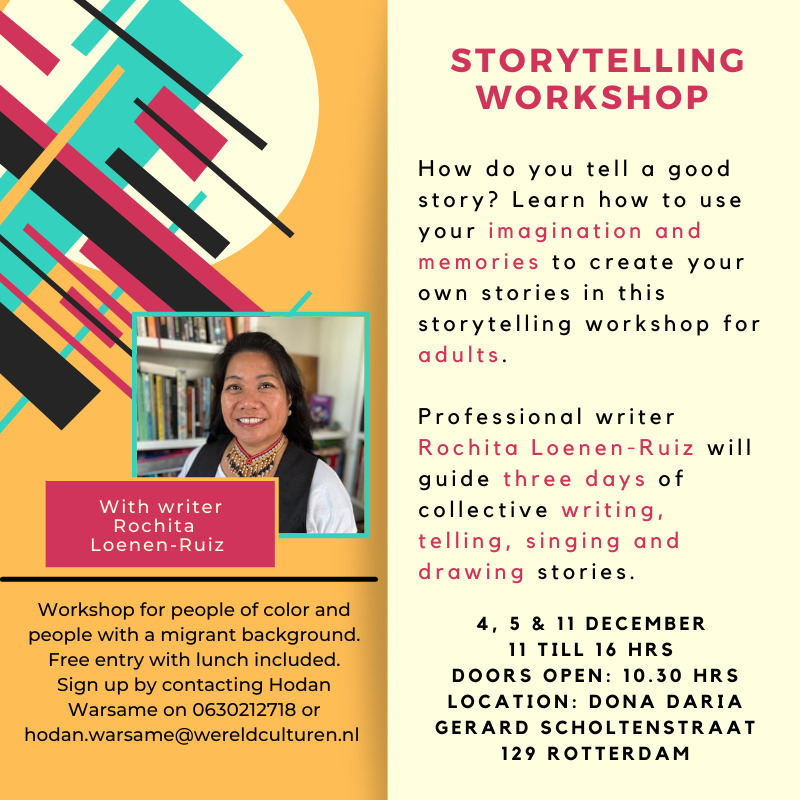
Posting the flyer for a mixed media story creation workshop that I’ve been working on and developing with the migrant BIPOC community in mind. Thanks to the lobbying efforts of Hodan Warsame, we will be able to share this workshop with the people we had in mind when we launched our efforts a year ago. This is a project that’s come about through the Wereldmuseum Rotterdam and in collaboration with Dona Daria. There are still places available, so do send your application to Hodan. All that’s needed is an email or a text message. I do want to emphasise that this iteration is specifically for the migrant and BIPOC community.

After Other Futures

Other Futures Festival was a wonderful, colourful, thought-provoking and inspiring event. I’m glad I was able to attend both days and go to a number of sessions. While we had to leave by 11 pm (or else we wouldn’t make it to the parking garage on time), the sessions I was able to go to blew my mind in lots of good ways.

I want to take the time to write about my impressions, but my mind tends to fire off dozens of things on the day after an event. So, I’ll start by reflecting a bit on the Hybrid workshop which I presented together with Ellen van Neerven and which we prepared together with Rafeif Ismail.

It felt rather serendipitous that the day of the workshop happened to be the day of the climate march in Amsterdam. Our discussion centred around environmental racism, who is most affected by it, and how groups and people most affected by climate change don’t have a seat at the table where decisions are being made. The issues emerging from environmental racism are multiple and it’s clear that something radical needs to happen. Whether leadership is ready to take radical steps and whether wealthy countries and wealthy communities are ready to be part of radical change is a big question mark.

The workshop itself was an intimate gathering with a small number of participants in conversation with each other. Ellen joined us online from Australia and the collective work done within the space and within the time that we had felt somehow magical. For the making part itself, I thought of using the liwliwan as a template from which to launch the doing part of the workshop. This paired with the idea of blurring the boundary between forms worked as I imagined it could work. I’m thinking about what I would like to do with this experience and how I want to experiment with creating sessions for collective story and story building. Would it then be something like a spontaneous play? Would it be in the form of a performance? I rather like the idea of sitting down together in a circle, with our musical instruments close to hand–a drum, a xylophone, a Kalimba, a rhythm egg–these combined together to form a background rhythm for the speculative and visionary stories that emerge from those seated in the circle.

What would you call that kind of doing or making? Would more people be willing to take part in such a creative making?

If this making involved a bigger group of participants, would it be possible to create this sense of connecting and understanding and coming to conversation and dialogue regardless of what side we sit on when it comes to politics and social issues?

I loved working with Ellen and Rafeif on this workshop and I wonder what it would be like if we could be present in the same space with the three of us being joined by other participants. What kinds of stories and conversations would we have? What kinds of worlds would we dream up?

Earlier this week, someone asked me what I thought would happen if the existing systems and institutions fell apart (as they’re inevitably bound to do). It’s a question I can’t answer, but I think that if we can create spaces and means for connecting and feeling connected, if we can shake off alienation which has been imposed on us, we can survive such a scenario without tearing each other apart.

In any case, I am thankful for spaces like Other Futures which provoke me to think deeper and reach for more understanding.

One of the things I enjoyed the most was the hybrid performances hosted by and coming from Kubra and Simon. I loved this exploration and celebration of queerness and of being trans. It felt so affirming and joyful and celebratory. And I am a fan of Miss BB whose joyful celebration of self made me want to shout: hurrah! Yes! More please.

Ah. I was so sorry to leave when we had to as I know there was going to be dancing as well. How many spaces are there in the world where one has the permission and the space to just be? To simply express your multi-selved you and not be looked at strangely? These kinds of spaces are precious and to my mind must be preserved just as we preserve spaces in the world which are sacred and precious because of what resides there.

I think of how we humans must change radically if we want to leave a good world for the next generation. Someone mentioned Ego during the Hybrid_Date circle talk and I think it’s a word we need to think about.

If someone is reading this blogpost, I want you to think about a number of things. Think about the things in your life that keep you from being present in the moment. Think about those things that give rise to alienation. Sometimes the change can be as simple as installing a filter on social media, dropping the habit of recording each moment as a thing to post on social media or share on your instagram or twitter. Take time to just be present in the moment, to reside within your body where it is in that space in time, to be silent in your head.

It can be as simple as looking at a familiar stranger and saying: we have passed each other a lot or lived on the same street for so long, so I want to introduce myself to you and I want to ask you about yourself. How is your day and how are you doing? It’s a risk because whether conversation happens or not depends on the person in front of you. But think about it this way: you make the choice to try and forge a connection. It may not happen right away, but these steps towards connection will inevitably bear fruit.

the writer’s notebook

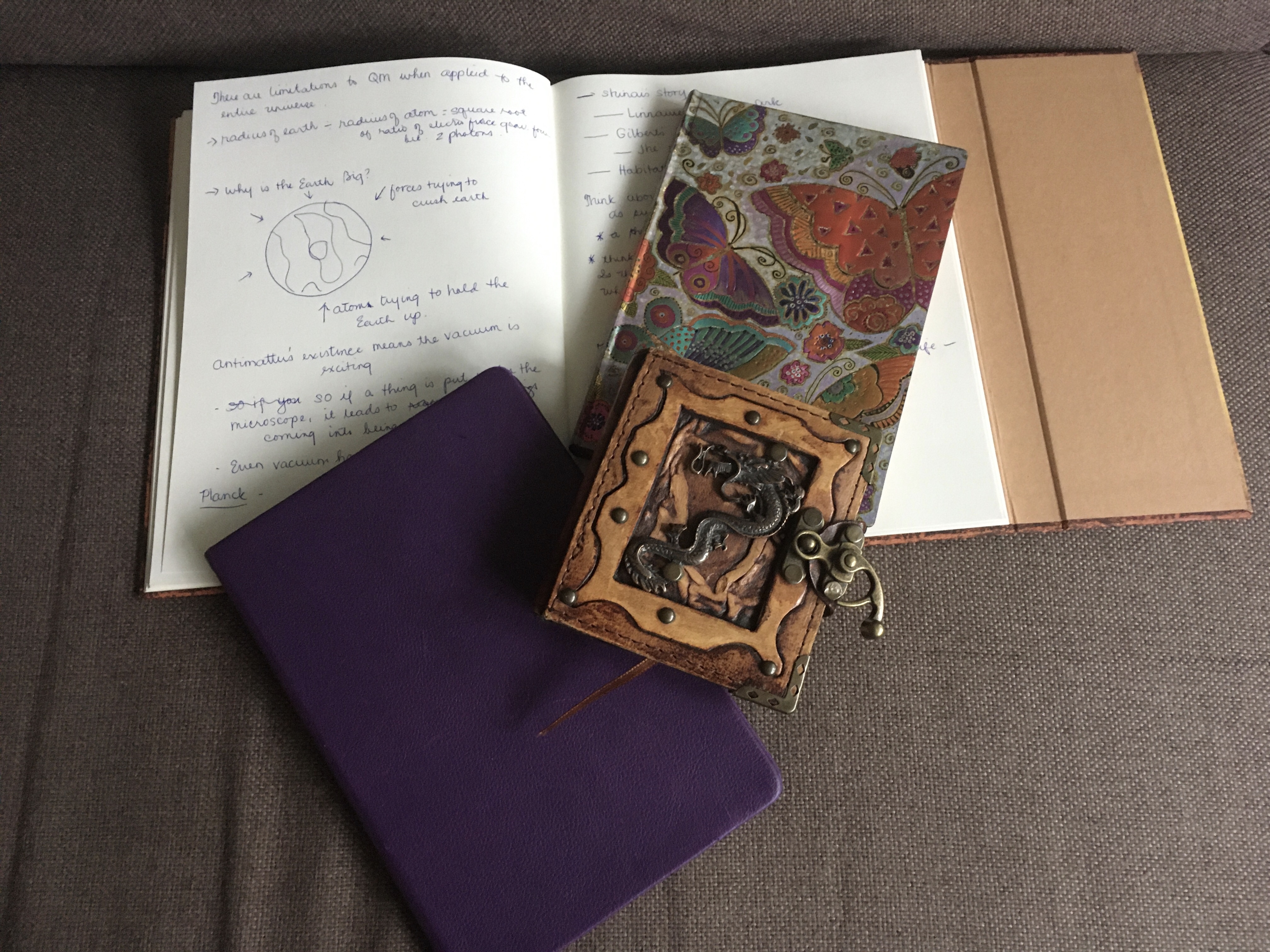
I’ve returned to making use of my physical notebooks–to writing down notes and thoughts longhand, and to thinking through projects, as well as taking notes from lectures or books that I’ve been attending or reading. My favourites are unlined notebooks with thick paper and while a lot of it is note-taking and recording of thoughts and possible scenarios, I also unabashedly include mundane lists for daily tasks or groceries or things to remember. I also like to draw diagrams because visuals help me a lot and that act of capturing something in a drawing even if I’m not great at it, helps me as I process through to what I want to say or write about.

I shared this process with the nibling during our once-a-week scheduled convo and as the nibling is a budding artist, I decided to send them a couple of journals like mine as I totally get how attention can drift when you’re listening to a lecture online and sometimes diagramming the lectures or drawing a weird head speaking the lecturer’s words will help make things more interesting.

I also showed them some of my awkward attempts at visualising stuff from inside my head which was funny and fun to do. As I said to them, I have all these images in my head, but I’m not good at drawing, so I write because I want to get them out of my head onto the page.

Anyway, the notebook is a hodgepodge. It’s not neat or academic. It’s more of a collection of all the things that catch my attention–things I obsess about–subjects I hunt down as I try to figure out what it is my brain is obsessing about.

I’m thinking again about Jeremy Kamal talking about how we may think we’re obsessed with the apple until we find ourselves obsessed by a fire hydrant or a firetruck and then as we track these obsessions we realise that what we’re really obsessed with is the color red.

It’s a thought I’ve taken with me in my process and the truth in those words is reflected in the search and the resulting pieces. For instance, in a recently completed piece, I thought I was obsessed with black holes, when in fact, what I was obsessed with was grief and saying goodbye. This is something that had me sitting back a bit as it’s something I still struggle with although it is true that time takes the sharp edges away.

What is personal to us or what comes from that place where our emotions reside can be scary, but as Kiini Ibura Salam in her book, Finding Your Voice, says it can also be the place where some of our strongest work comes from (I am saying it as I understood it). I am thinking of this as I work on various pieces and the notebooks help a lot as I find that creating diagrams of my thoughts or simply just wrestling with ideas using actual pen and paper does help me find some resolution or some direction when it comes to what I am working on.

I find myself thinking too about the instrument to body connection and what it represents or what it means for makers–writers, visual artists–all of us who make things. Perhaps, it’s this connection–the slowing down of process, the taking time to reflect and think and be in the moment with the work in progress that has made me feel less anxious and more capable of believing in what it is that I want to bring into the world.

During one of the lectures I recently attended, the speaker spoke of how what’s important isn’t having or finding all the answers, but rather finding the questions that we want to ask. This speaks too to what Jeremy Kamal has said about finding what it is you’re obsessed with.

As we enter the fall season, I’ve started working together with various makers. Writers and artists. Thinkers and creators whose work excites me and makes me see how the boundaries between the worlds of making are more porous than we imagine them to be. There is a lot waiting to be discovered and a lot of questions waiting to be asked. For the time I have been given and the opportunities that arise, I am truly grateful.

To you who are on the journey, don’t be afraid to ask questions. As has been said: curiosity is the mother of invention.

Some of my most recent notebooks. The smallest one fits easily in any purse, the purple one is already full, the open one is the current notebook but I am close to the end of it, so I have a new one waiting for when the current one is full.

mindset and some messy thoughts

A number of initiatives I’ve been involved with have led me to reflect on the communal and collaborative nature of creative work.

Think about it. Art doesn’t truly come alive or serve its purpose without the interaction with the viewer. The written word, fiction or non-fiction, doesn’t gain power until readers interact with it. The worlds that we imagine and bring into being don’t come alive until readers or viewers respond or react to those worlds.

How much of the work that we do is individual and how much of what we create is the product of collaboration–whether conscious or unconscious. We talk about stories with our peers, we discuss our works in progress, we brainstorm, we go away to write it down, we come back with our drafts to brainstorm some more before we finally go and put our name under it and send it away. One name may appear under that story, but before that the work goes through a process that is communal and collaborative.

For us who engage with story, we may think that stories are born inside our heads, but what comes to us also emerges from our histories which are interwoven with the histories of others. They come from all the connections and experiences we’ve had in life and the stories that we tell speak to that longing for connectedness.

I’m thinking of decolonial practice and I want to say here that decoloniality is different from decolonisation just as coloniality and the colonisation project are two different things. Walter Mignolo in this interview gives a clearer explanation of the difference which is far better than anything I could come up with, so if you’re reading this, I suggest that you go check out the interview. But in particular, I find myself struck by this point where he talks about decoloniality as a delinking from the overall structure of knowledge in order to engage in an epistemic reconstitution.

Mignolo elaborates further by talking about how we need to reconstitute our ways of thinking, languages, ways of life and being in the world. It’s a really great interview and one that pushes the reader to thought.

So, going back to story making and the workshop practice, I found myself thinking about polarisations and I wondered how much of that is born from a feeling of no longer being connected. How much of that comes from feeling alien in the communities we live in? How much of polarisation takes place because we feel unheard, unwanted, excluded and pushed away?

It makes me think of the tendency of hurt beings to crawl into their selves, to lick at the wounds and because of that hurt we lash out–whether it is as an act of anger or self-protectiveness, a determination that comes from: I am not heard anyway, so what should I care what you think about me…whatever space it comes from, it feels to me that this thought is something to reflect on.

What would happen if instead of focusing on individual story, we decided to gather as our ancestors did. What would happen if we decided to create spaces where we would give each other time to speak and tell each other what the world looks like to us. Would we meet? Would we find those spaces where we can breathe and recognise that we are still connected and the neighbour who lives next-door to you isn’t an alien, but is someone who (as Shylock says) bleeds when you cut them.

I remember thinking about this when I was still new to The Netherlands, how distances in a neighbourhood felt sharper because of the seasons. How in the winter months we hardly ever knew about what was going on with our next door neighbours because we were cloistered indoors (Granted I always felt the need to flee indoors to where it was warm and cozy, but it might have been different for those born in this country, I don’t know.) It felt startling to me because even if we didn’t hang out in the streets, there was never a day when we didn’t see our neighbours in the Philippines. We talked to each other over the fences, or when we encountered one another in the street…a big difference from here where the impulse is to dive into the warmth of your car or your home once cold weather strikes.

But, is it this kind of distance that creates polarisations? It feels to me like a cop-out to use the seasons as an excuse. Although, I find myself thinking that the extremes in weather and the urgency of climate change reflect the extremes in how people interact these days and that to me emphasises the urgent need for change.

Today, I live on the edge of a city and the neighbourhood we are in is one where messages are exchanged through WhatsApp. Where initiatives are made for neighbours to work together. I’ve had neighbours knock on my door asking where I got my blinds, for instance.

This post is quite messy–pretty much like my handwritten journal is messy. But messy thoughts are essential to process. Without that messiness, we can’t work towards solutions and messiness is necessary for us who are involved with making. Conversations, particularly when struggling with complex matters, become inevitably messy. It’s why listening and paying attention and thinking through are important.

In this age of social media, the trigger response has become our go to. We are quick with the retort, swift to condemn, immediate and hard in our judgement when perhaps thoughtfulness and listening would serve us better.

If we also understand that community includes not just humans, but also the leaves of grass, the algae in the sea, whales and porpoises, dung beetles, all those other creatures great and small. If instead of viewing the world as being there for us to occupy or to exploit, if we saw the world as this place we’re meant to nurture and protect, if we saw each other as fellow inhabitants and if we treated each other and the world as we wish to be treated, how would things change?

And so, the journey continues. Think messy thoughts. Embrace them. Be well.
History and myth-making

I’ve been thinking a lot about history and myth-making as I work on another piece. Edouard Glissant’s work inspires me a lot and it feels like the universe is working to bring various readings across my path that are in conversation with the work of Glissant.

Rolando Vazquez’s Vistas of Modernity enriches my engagement with Glissant’s work and vice versa and I can’t recommend Vistas of Modernity enough. While I was reading Vistas of Modernity, I found myself moving back to some passages from Glissant and then returning again to Vistas. In my head, it felt like there was this rich conversation going on between these two thinkers. There’s a lot to process and a lot to think about and I feel like rushing to make a post on it would not do any justice to the work. But definitely, anyone who’s interested or who is engaged in decolonial work would benefit a lot from looking up Glissant’s work and Vazquez’s Vistas of Modernity.

While reflecting on these two works, and while working on the new short piece, I found myself thinking about the relation between music and mathematics: about algorithms and improvisations: about waveforms and spacetime. A lot of times, I feel like a chicken scratching at the surface of concepts where comprehension lies just beyond my reach–like that word that you know is waiting to be uttered at the tip of your tongue, but you just can’t vocalise it yet.

The new piece is me working on concepts that intrigue me. It’s also influenced by the idea of history, re-membering (as Rolando writes it) and myth-making.

All these thoughts tumble together to inform the practice I am developing when it comes to the workshop practice. The idea of employing various mediums and ways of creating or re-membering or un-remembering history….these are things that I feel are key to the work and are necessary to what we want to achieve with the Invitation to Dreaming.

The hungry mind led me to Epistrophies: Jazz and the Literary Imagination by Brent Hayes Edwards. I’ve only cracked the book open, but in the introduction there’s a passage that captured my imagination. Here, the author writes that: “Oral history’s importance lies not in adherence to fact, but in its departure from it, as imagination, symbolism and desire emerge.”

I think on how we can sometimes get stranded or blocked by the idea of story not aligning with empirical data and I’ve been thinking too about how a lot of history is told from the viewpoint of the conqueror or the coloniser.

Anyway, this is because I find myself rather obsessed with the question of the use of speculative fiction in the work of decolonisation.

A beloved friend of mine spoke of this kind of writing as a form of exorcism and the more I think on it, the more I love how this resonates with the idea of myth-making and how important it is for us to recognise that the myths we create are not subordinate or less important but are rather of equal value and equal importance. Do we even need to explain why it is important to us? Do we even need to make everything comprehensible or transparent?

Glissant in Poetics of Relation writes this: “For more than two centuries whole populations have had to assert their identity in opposition to the processes of identification or annihilation triggered by these invaders. Whereas the Western nation is first of all an “opposite” for colonised peoples, identity will be primarily “opposed to” — that is a limitation from the very beginning. Decoloniality will have done its real work when it goes beyond this limit.”

I think then to myself that the capacity to think beyond data and to think outside the box, to imagine beyond what is presented as “these are the facts” are tools which help in the work of decoloniality. Myth-making, the de-linking of the personal and the empirical, the creation of tangents and speculations, the ability to think outside of time.

My mind works away and picks at process and about how to bring these ideas into the workshop practice. How to encourage new and aspiring artists to bring this kinds of concepts with them into their core work.

Again, I find myself thinking of points of origin and how starting from the self, meeting the artists at where they are in that moment is an essential part of the work. Histories, stories, songs and other creations which are personal to us are also linked to the wider world. Family stories are where myth-making starts. Family histories are part of our personal myth-makings too. Beyond the personal portraits, beyond the familial, we see the world as a backdrop. How is that family myth set within the world around it? How do we create myths that originate from our selves? What’s important is that these myths come from us. From creators whose voices have often been elided–the sound you miss or skip over–like jazz creators, we must improvise. We create and bounce off each other’s words and worlds, we mix and play to create myths that sound like and belong to the self. They don’t have to adhere to an existing narrative, they belong to their selves, just as we belong to our selves.

There is a lot to think and reflect on as I think of this and as I consider on how to bring that into my practice.

To you who are on the journey, sing your songs, write your myths, dance your dances.

She’d always known space had shape and form of its own. It wasn’t always visible, but it was there. Now, its patterns and undulations were visible to her. She could see it curving around to accommodate her sire; could see it flowing and moving to accommodate static instruments, to accommodate her/self/; and now, she could see too how it lent itself to shadows that took on a form of their own as they came to stand beside her sire. 

-From To the Tune of the Wild Ones-

rounding off the sessions and looking to the future

Summer break is upon us and so I rounded off the writing sessions with a promise that we would return to them once the summer holidays are over and the new school year begins.

Right before the break, I invited a group of kids (the youngest was 8, the oldest was 14) for a short writing session. I had initially done this to accommodate a request to include an 11 year old in the writing sessions but considering the age gap, I thought it would be better to try and see if we could gather together a group of younger kids and see what happens.

We did a one hour orientation session on zoom and I found myself quite inspired and mind-blown by the work the kids did in that short hour. For this session, I decided to conduct the class in Dutch. My reasoning being this: while the children are all bilingual, English is not an automatic second language for everyone. Also, as I said to the kids: we live in The Netherlands, you go to school in The Netherlands, and so everyone in the session understands Dutch.

I did provide the children with the option of writing either in Dutch or in English (whichever feels most comfortable). It surprised me to observe how kids switched between both languages, although there were at least two who opted to go for Dutch. After the class, I asked the kids if this was something they’d like to do again and to my surprise, they all said yes. (A part of me wishes I could read one or two more languages, so this might be my next personal project.)

I’m taking time to think and reflect through the lessons learned during the period when we were having the sessions. I’ve also purchased a number of books which I hope will help me as I move forward. One of the books I’ve recommended to my older youngsters is Kiini Ibura Salaam’s “Finding your Voice”. It’s a collection of essays that I recommend no matter where you are on the journey.

As the busy season is coming to a close (I’m rounding up sessions with another student tomorrow), I find myself reaching for works I’ve had on my reading list. I’m reading Edouard Glissant’s Poetics of Relation and find myself in wonder. I have been nudging a very dear friend with text messages of: you should read this because this is just wonderful. I’m grateful to people who’ve pointed me in the direction of work done by thinkers I otherwise would not have known of. I’m eyeing another Glissant book on amazon, but will finish this one first or I might find myself switching from one to another without ever finishing anything.

Another book I recently purchased is The Anti-Racist Writing Workshop: How to Decolonize the Creative Writing Classroom by Felicia Rose Chavez. This book was recommended by Vida Cruz and so I look forward to reading it and absorbing it in preparation for the next season.

Reflecting on the past few months, I’ve been thinking of how developing a workshop is also part of process. I’ve been richly rewarded by the interactions had with the youngsters and as we continued along on the journey, I thought of this as us developing a practice together. We move from one stage to the next, learning more and more about our own process of creativity.

For the last session with the youngsters, I asked them to create visual images depicting their process. I asked them to use pen and paper instead of the computer. The resulting sharing was really fun.

We recognise each other in our process, how we become enthusiastic about an idea, proceed to work it out, think we suck, go back to working on the idea, procrastinate, work on it some more, and then at the end wonder if we made the right choices. It’s a recognisable cycle and we had a good laugh about that.

After the summer, I am planning a longer and more outlined trajectory of how to proceed from the point where we stopped. I know the kids enjoy the meetings. They tell me that they enjoy the writing too. But for the next trajectory, I want to incorporate a number of practices–to encourage the kids to embrace and try other disciplines as well. I believe that being multidisciplinary enriches the work.

I also think that something has changed in my perception of myself and my work. I’ve stopped thinking of myself as just a writer. I can’t explain it. Somehow, it feels like stepping outside a box into an unknown space where anything and everything is possible and while there is this sense of ‘I don’t know yet’, it also makes me feel lighter and joyful. Less burdened with a certain expectation.

To those who journey into the world, exploring what is new and unknown, embracing the act of creation, may you always see beyond the leaf.

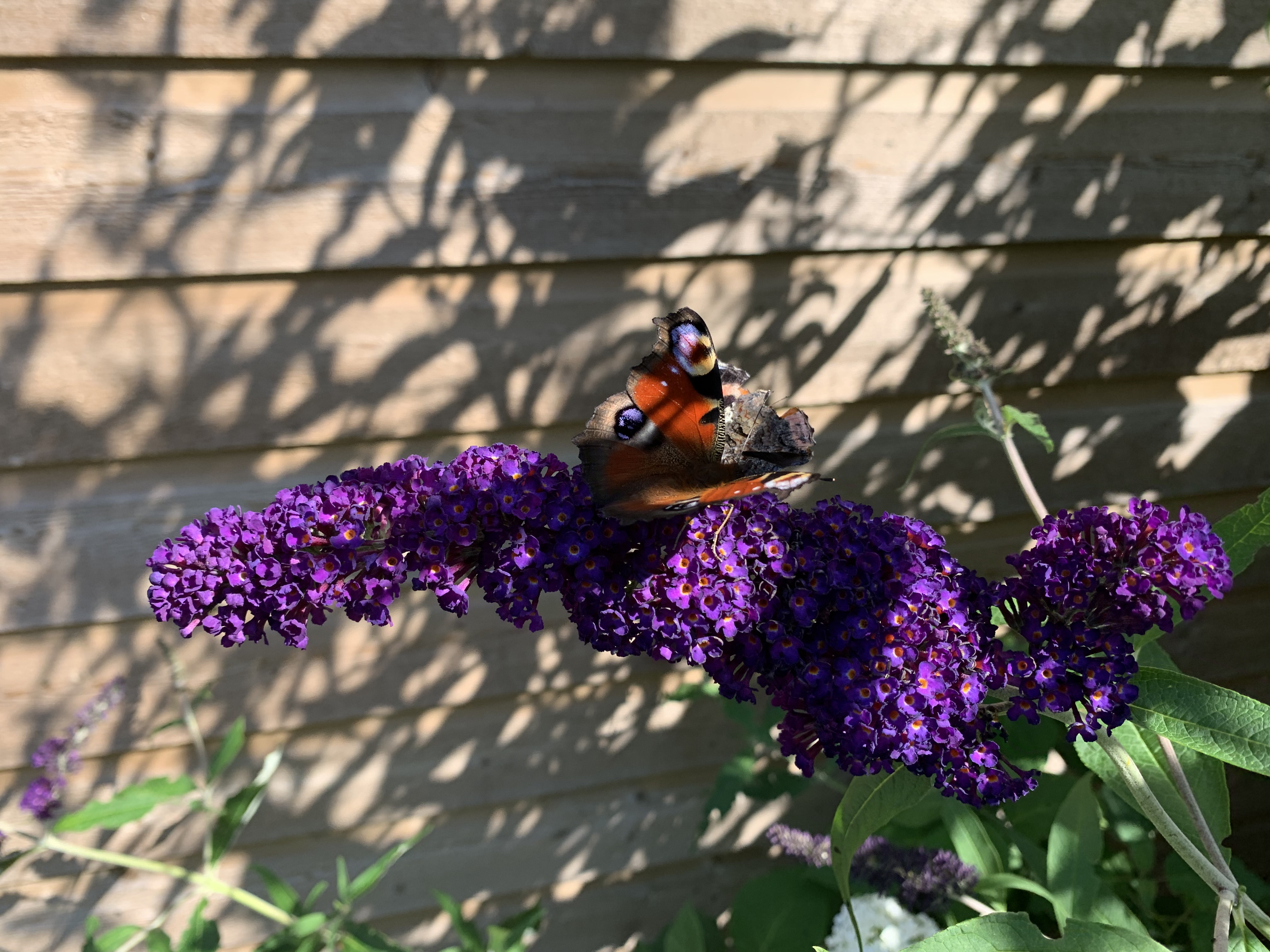
(image copyright by PvanderP, used with permission. Purple flowers with sun and shadow and a butterfly perched on the bloom.)

some ambitious dreaming

I’ve been working on our project proposal for the dreaming sessions which would lead to more writing sessions. This is a project that’s flowed forth from a dream I shared with one of my friends sometime before Covid sent us all into lockdown. At that time, I didn’t see how to make that dream become something real. I just didn’t know how to at that time because I was emerging from having retreated away from the world and was just moving tentatively towards engaging with the world again.

So I told this friend who is also a dreamer like me, about my desire to create something inviting for BIPOC writers, thinkers and creatives. I didn’t know what form it would take, but during the pandemic period, when I realised how dreaming was essential to youngsters, I started the writing sessions. When my fellow visionary got back in touch with me, I had already worked out some of the things I wanted to do with a face to face version of the writing sessions.

As I work on the draft for this project, I think about my own history with dreaming and the written word.

My love for writing started long ago, when I was little girl in the mountains who had run out of books to read. Before I thought of writing stories for myself, I remember lying in bed next to my sister long after lights out. I remember the stories we spun for each other in the dark. I remember holding hands when our stories got scary, and falling asleep when they got a bit boring, and dreaming on inside my mind long after my sister had fallen asleep.

Books were magical things created by people far far beyond my line of sight. When I was a child, I didn’t know it was possible for someone like me to one day have stories included in books.

I think of those whose names I don’t yet know–those who I will meet on this journey. I think of those who dream and who are scared to reach out for the pen, I think of the numerous stories, the numerous words, the recollections and the dreaming that are waiting to be brought into the world. I want to say: I can’t wait to meet you. I can’t wait to read your work.

Preparing for the next session

I’m doing very small forays onto twitter these days. Just very brief jumps in and out to see if there are interesting articles or links being shared. If friends have sent messages, I also want to at least send a quick reply.

This morning, I checked in and saw this link shared by Anna Sulan Masing. (Click on her name to visit her website) As I read the linked article, I realised that I’ve missed out on a lot of conversations in the years that I was off the internets. (It was needful for me and my boys and I didn’t have the spoons or the headspace for anything else other than survival for a while.) I found myself clicking and following some threads and so I now have lots to think about as I reflect on my workshop/dreaming practice.

The thing is, I’m less and less inclined to think of what we’re doing as workshopping. As I said to the kids, we are fellow travellers on a journey where I am simply an older person who might have more experience in a certain craft but it doesn’t mean I’m the authority. Because, as I tell the kids in the writing sessions, we are learning together. So, I hope I can inspire and encourage them to continue to dream on the page just as they inspire me to keep on doing the work that I do.

I like calling our meetings writing sessions instead of writing workshops because sessions reminds me of jam sessions where musicians meet and jam together. Maybe we riff off of each other’s work, maybe we borrow a note and improvise from there, but it’s still jamming.

Moving forward on that energy, I thought of how the language and the landscape around the writing sessions would ideally be shaped by the youngsters and the writers who create and share their art in those spaces. This is still a work in progress and so I am also eager to learn from others who are farther along and who have engaged different ways of doing or sharing craft with fellow artists.

There was a funny moment when my high school son (who refuses to leave the sessions even if he claims he can’t write) asked if it would be okay to use swear words in a story. This resulted in a lively discussion in which we agreed that profanity is allowed, but not if it offends or hurts anyone in the group. I love these kids. They’re kind and open with each other and they have clear sight. I’m honoured to be included and to accompany them on a part of their journey.

I’m thinking of what to do next as we move forward. Do we stay with the seeing practice for a while? What step do we take next? I’m still undecided, but I feel certain that further reflection on process will reveal that step to me. More importantly, I want to make sure that I don’t impose a voice on these young people. It’s important to me that they discover their own sound, that they learn to trust in that sound and be true to their selves when they are writing.