I don’t know how to answer
when people ask me how I am.
How am I supposed to be?
I am still alive.
I breathe.
I ache.
I move through the motions of being.
Words taste like ashes in my mouth.
I am here.
In the land of the living.
I don’t know how to answer
when people ask me how I am.
How am I supposed to be?
I am still alive.
I breathe.
I ache.
I move through the motions of being.
Words taste like ashes in my mouth.
I am here.
In the land of the living.
One of the messages sent to me says that the funeral was as beautiful as one can call such a sorrowful event beautiful.
After the death, there is no real time for grieving. An undertaker must be summoned, papers must be looked into, one must decided how the announcement of one’s bereavement will look like. The mind is so occupied with the order of work–one realizes this is for the last goodbye.
I didn’t want a sorrowful burial. Rather, I wanted my sons to remember the joyful moments. That we were still able to have these years together–to know the man that was their father–to be able to know what it’s like to be accepted without complaint. To say goodbye to someone who accepted every aspect of who I am–who loved his sons unreservedly.
It was a beautiful fall day. The sun came out, the weather was mild, more than 200 people showed up. My heart overflows with thanks for the messages coming from all over the world, for the chain of support that reminds me that I am not alone, that we are lifted up on the hands of those we don’t see as well as those we see.
My beloved friend calls me and tells me of the stream of support. I want to weep. Faces pass by us–old friends, new friends, neighbours who have become dearer, loved ones who become more precious–they have come to bear testimony.
My sons and I stand beside their father’s grave. I look up at the sky and watch the clouds and the changing colors of the trees. I am thankful even as I mourn.
My sons have lost their father. My mind is still trying to catch up with reality.
There are no words for grief.
My dear friend and partner and the father of my sons is no longer with us.
He had a cardiac arrest on the 17th and was admitted to the ICU at LUMC after being reanimated. However, too much time had passed between and he did not wake up from his coma. Today, he was released from life support. He went swiftly and quietly.
Our boys were able to say their goodbyes to their father yesterday and I believe he heard them and carried their words and their wishes with him as he crossed the river from this life into the next.
The love and the warmth of friends, loved ones and kadkadua has lifted me and given me such strength these past few days. Today, I am humbled to find out about the extent of support being extended to me and my sons. I am deeply deeply grateful. My heart is filled with thanks for the kindness and warmth extended to me and my sons.
His body will be buried on the 27th of October. His spirit lives on with us.
Writer and storyteller, Rebecca Mabanglo-Mayor, shared a link on her blog to a speech given by Ursula K. Le Guin upon accepting the National Book Foundation’s Medal for Distinguished Contribution to American Letters. In this speech, Le Guin speaks not only of the need for visionary writers, but she also speaks of the need to discern between the production of a market commodity and the practice of an art.
At the end of her speech, Le Guin says that the name of our reward is not profit, it is freedom.
I think of freedom as I reflect and go through the notes and the memories that I have from New York and Janis Ian’s masterclass in artistry. Le Guin’s words resonate with the lessons learned from my time with Janis.
In New York, Laura and I talked about Janis’s commitment not only to her art, but also to taking hold of the business aspect of her art practice. It was an aspect that she brought up a number of times and listening to Le Guin talk of freedom, serves as a reminder that whatever proceeds come from the exercise of one’s art–they all go back towards the artist being able to keep on practicing that art.
The practical truth of it is that we cannot exercise or develop our art when our energy is gone, when we are too tired or worn out, or when we our head is filled with worry. I think of how I would never have finished or published the stories I have if not for being given space and time to practice my art free from the stresses and the tensions of daily life. I am grateful to my fellow practitioners–to the artists and writers who have opened their homes to me and who have so generously given me flights of freedom.
Freedom.
To be able to practice our art in a space and time when we are free from thinking of anything else but that practice is a vital and precious good. The writer cannot live without writing, and practicing art means we must be able to center ourselves on the work most of all.
Which then leads me to a question Janis Ian asked repeatedly in various sessions:
“Who among you wants to be famous?”
In thinking on that question, we are forced to recognize that fame does not equate into freedom, fame is not the same as success. Indeed the boundary between fame and notoriety is so thin that it’s easy to cross over without realizing it. Rather than fame, I value more the freedom to practice my art, and the knowledge that I have remained true to my vision.
Because, as Janis Ian reminded us, no one else has the vision that we have; and while there are many things in this life that can be faked, talent and art can never be faked.
Even as she said these things, she reminded us too that talent is not enough. The artist must do the work–must master their craft. If talent is a spirited horse, craft is what will ensure that your talent will not run away with you. In the course of the week, Janis continued to emphasize the need for artists to grow and add to their skillset (what we also call our toolkit). As artists, we need to be constantly developing ourselves. Being equipped with a wide range of skills makes us capable of answering to the call of opportunity.
I think of these things and I think to myself–the sky is unlimited.
#
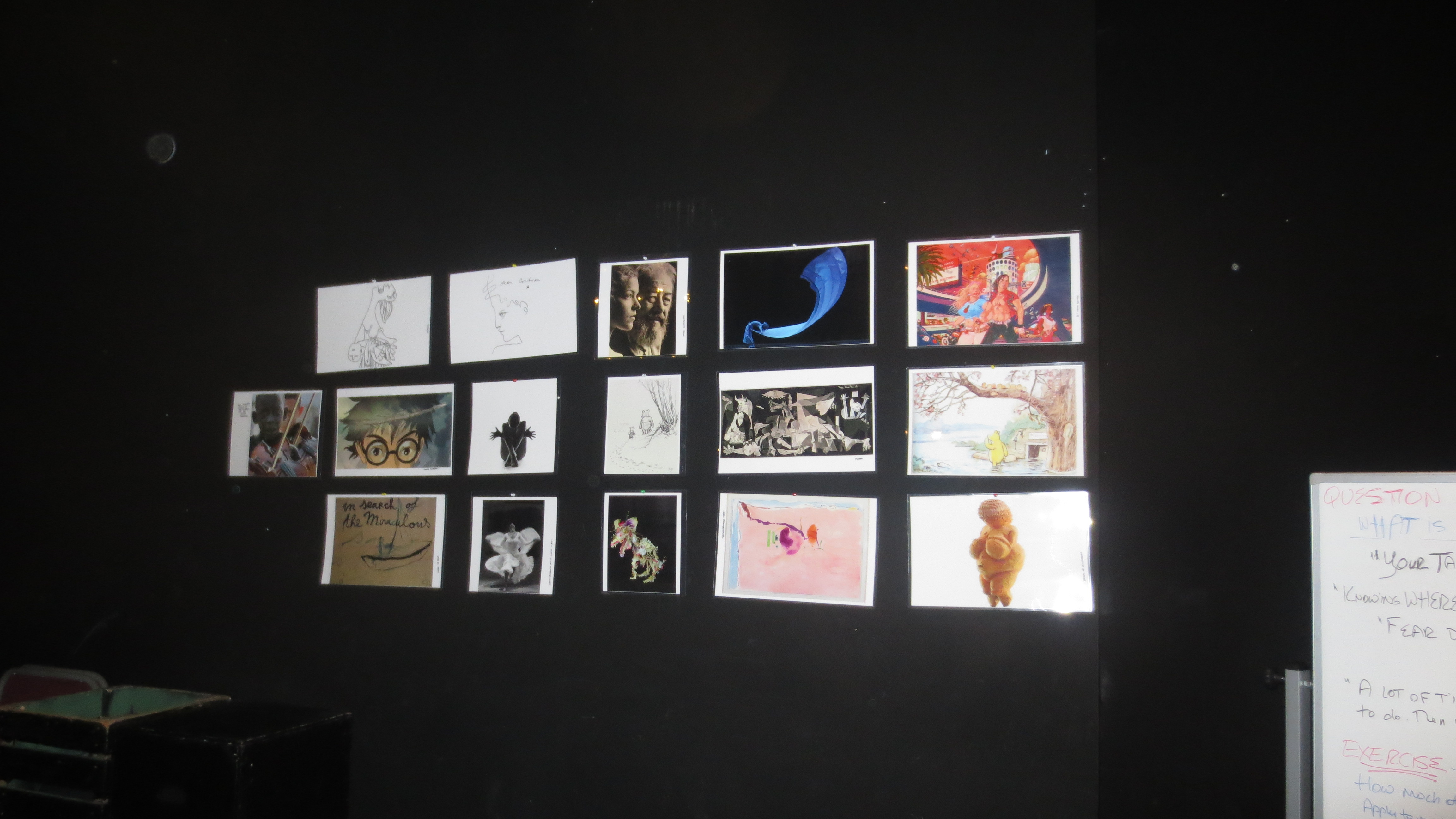
One of the interesting features of our week was what Janis called the Museum Wall. At the end of the week, we were asked to answer the question: What does all great art have in common? I’m sharing the image of the wall here. You answer the question.
For self-care reasons, I’ve requested that my name be removed from any publicity connected to The SEA is Ours. I’ve written the organizers to say that I will honor the perk that I offered in support of the fundraiser ( a criticque of a piece up to 8000 words ), but I have stated that I don’t want my name to appear on the page anywhere. I am making a note of it here, in case people wonder why my name has vanished from the fundraiser page and also to assure the person who took my perk that I will fulfill my word.
I wish the authors all the best and am thankful to the editors for their understanding.
Today, I decided to share an excerpt from the memoir I worked on when I started writing again. Rereading it, I realize just how clearly it describes what happened to me–the slow erosion of self, the gradual erasure and subsuming of who I was to the personhood of the man I married–because, as my mother told me: it is our duty as wives to submit to our husbands.
In time, that erosion of self led to a complete forgetting of who I was and what mattered to me.
During one of my first sessions with my therapist, she asked me if I could name anything that I liked doing before I married and moved to the Netherlands.
Tell me, she said. What are the things that you enjoy.
The only thing that I could name and that I could cling to was writing. It was as if I had forgotten the self who lived before I came to this country.
Before I came here, my world was filled with life and art and sound, music and dance and song and laughter; discussions and debates over the dining table; books and words and loud speculations about the future.
I learned to hide those things because Dutch folks don’t like loud voices, because the way we laughed at home is considered unseemly here, because grown up people do not dance, do not indulge in fancy–not in this small town where I live in.
Today, I am engaged in reclamation. I have colored my hair–not an atrocious color, but still scandalous enough and I am wearing my colorful clothes.
I call my eldest son, Kuya (Filipino for older brother). I laugh and dance with my youngest child. We chatter, we make noise and we don’t care if the world shakes with the sound of our cheerfulness.
This time’s visit to America was started off by me singing lines from “Seventeen” to the customs officer at the entry point to New York.
“So, what do you intend to do in New York?” he asked me.
And because I had been bottling up my excitement for so long, I did a fistpump, smiled wide and said: “I’m here to meet Janis Ian.”
When the border officer shook his head and failed to recognize her name, I decided to give him a song sample. ( I also said: You’re an American, how come you don’t know that this woman is one of the best American Folk Singers ever?)
Imagine me: standing in JFK, a row of tired and grumpy people standing behind me, and there I was, bursting into song.
The guy behind the counter shook his head (he didn’t recognize the song!). Still, he laughed (he’d been quite solemn), wished me a wonderful visit, and stamped my entry ticket.
As I walked away, I heard the lady who had been standing behind me give the officer a loud and cheerful greeting. I hope the officer was smiling still.
#
One of the things Janis Ian taught us during the week in New York, was that fear is a construct. Except for atavistic fear, every other kind of fear is something that we’ve learned and what can be learned can be unlearned.
When I was standing in that line, I thought of my first visit to the US when I could hardly say a word to the officer behind the counter and ended up getting detained and interrogated for about an hour. I felt the familiar tickle of stress and the teary urge to break down.
Then, I realized that I’d traveled a long way. Friends had offered me this chance, and I couldn’t possibly spoil it by giving way to stress and anxiety. So, instead of mumbling through the interview, I squared my shoulders, spoke up and followed through with the song routine because…well, the worst thing that could happen was that they would send me back home again. (Also, who cares what people in line thought of me. The likelihood of them seeing me again was so small.)
The week with Janis Ian was marked with so many instances where I had to face up to the constructed fears that stood in the way of me doing things.
Coming out of JFK, I felt a huge burst of confidence. I was in New York, standing on the edge of change.
#
To the artist, change is a constant. If we’re lucky, change means growth and development–a deepening of the work, a deepening in insight, growth in perception and understanding. Maturity not just in the work but in ourselves as human beings.
The following statement is in The Stella Adler Studio of Acting’s preamble:
Growth as an actor and growth as a human being are synonymous.
I would dare to exchange actor with artist and say: Growth as an artist and growth as a human being are synonymous. If we remain stagnant, if there is no growth, what does this say about our art? What does this say about us? What does this say about our practice?
Regardless of what field of discipline we occupy, our exercise of our art, our commitment to our work is what differentiates us and binds us together in a global community.
On twitter, I posted a question Janis Ian asked that I felt is very key to all of us who are engaged in the practice of art: “Whose bones are you standing on?”
There’s so much to unpack about that question. So much that can be said about ancestors, about the litany of names that have brought us here and continue to carry us through. We are one in a chain and I am grateful for the bones I’m standing on.
Check out the board below and think on these things.
Finding the words to talk about new adventures is often challenging. Here I am in New York City, I have met one of my musical idols, have met with women I love and admire, and have found myself engaged in conversations that challenge me, inspire me, and compel me to look at various interactions in my life with new eyes.
Janis Ian said to me that it seemed to her that I was at the start of something new. I can’t help but agree–whenever I come to America ( once for the CW workshop and now for Janis’s masterclass), I find myself at a point where I must make decisions that may seem tiny to some, but are the equivalent of life-changing to me.
I find myself thinking of the Robert Frost poem that my sister loves so much–that one about two roads diverging into a wood and I can’t help but think of how life brings each of us to these forks in the road. Do we take the left? Do we take the right? Do we take the road that’s safe and known, or do we take the one that’s less travelled? And as Frost has said: the road we choose will make all the difference.
Making a choice isn’t easy. I find myself wishing that it were, but I don’t think life is meant to be easy anyway. I came out of a loving home, a nest where I was sheltered as well as my parents could, but even when there, I had to make a choice on whether to stay cocooned and separated from the hardship of the world around me, or to engage and see and know and understand that the society we live in isn’t egalitarian.
There is a larger mass who grow up in the absence of that access to shelter, to good nutrition, to healthcare, to education and the numerous minutae that we take for granted. Things we consider as simply being, are often luxury. Take for instance how here in the West, we take running water for granted–back home, running water is a luxury that only the very wealthy have access to–and then it is only the super-rich who can be assured of that kind of luxury where they don’t have to worry about whether there will be water tomorrow or not. Having grown up with this absence, each time I turn on the tap, I remember how my mother would caution us and tell us to conserve and recycle water.
Luxury. To not have to worry that the tank will run out.
It’s easy to grow comfortable, to become complacent and inured to the hardship of the world. As long as it doesn’t touch us, we can rage, we can shout our anger, but we are still cocooned because that hardship is at a distance.
A white man can never fully comprehend the hardships a black man goes through. It’s easy for non-blacks to bagatelize the uncertainty of life as a black person. ( This is what happens when we say #alllivesmatter when black folks say #blacklivesmatter.)
Much as we want to believe that we live in a society where we are all equal, we do not and we need to make choices. Those choices won’t always be easy, they won’t be the road well-traveled, but choosing to walk that road, choosing to leave the comfort of the cocoon behind, choosing to open our eyes, step out of the box, engage fully, embrace the uncertain and the uncomfortable–these things, they do make a difference.
My Clarion West Writeathon report came in and I was pleasantly surprised to find out how much I’d raised. I’m releasing another bit of previously unpublished work today in honor of that.
I can be a Rock Star was written back in 2010–I suppose you could call it an experiment in black humor or the unreliable narrator. I really am never sure which one it was. I just wanted to go with the flow and find out where the music would lead and it led to this tale which is somewhat odd. I do hope you’ll enjoy the read.
It is an aswang story of sorts and was great fun to write.
I think the psyche is this wonderful untapped resource and truthfully the line between sanity and madness is quite quite thin. ;p
Thanks for sponsoring the Clarion West Writeathon writers. I hope you all enjoy this odd little offering.
You must be logged in to post a comment.