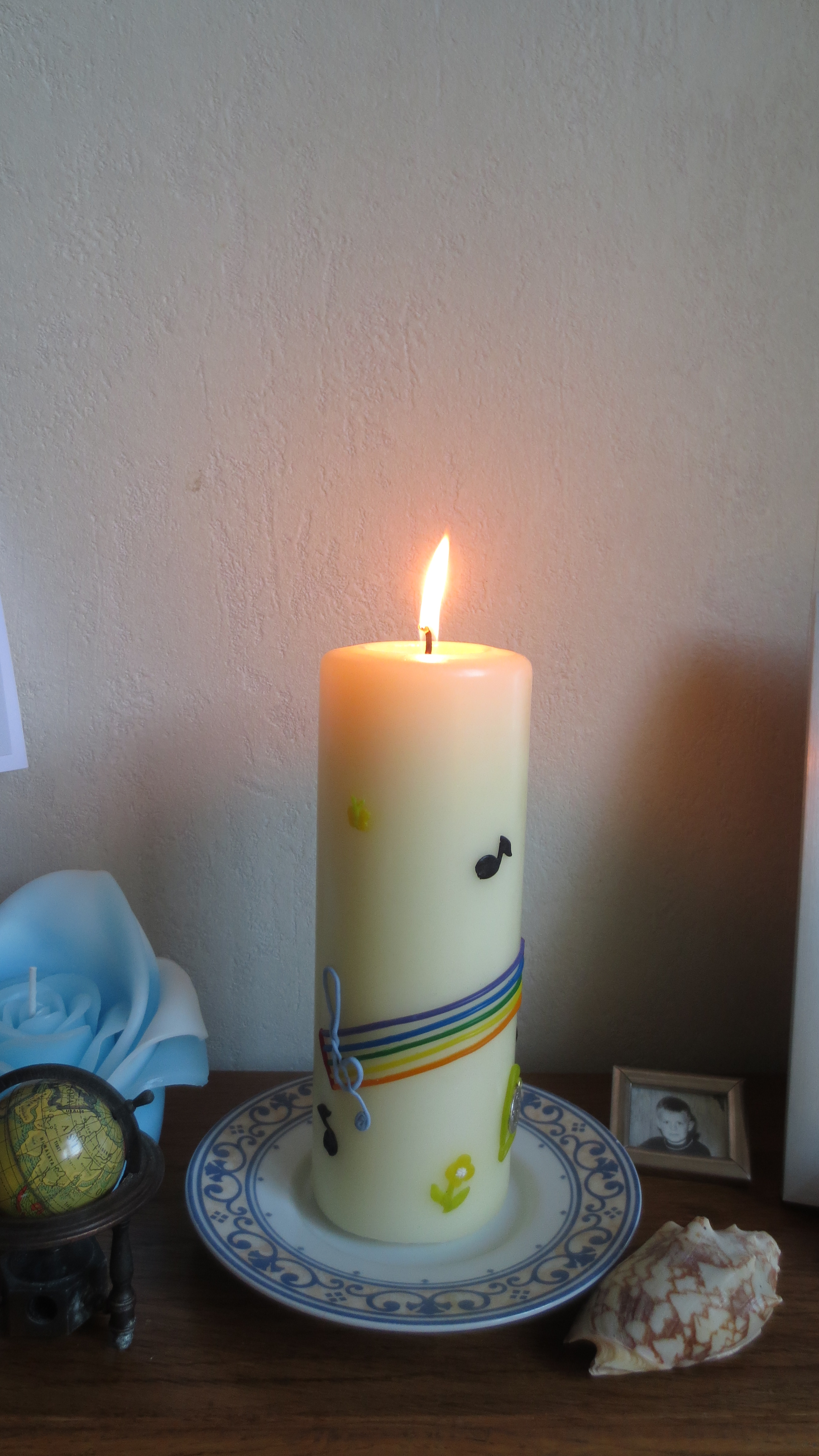
Once we were four

Loss is still too sharp, too fresh for me to write about remembrance. All through the day, we kept the candle lit. Because his presence is still here with us.

Yesterday, while waiting for the train, my youngest son said: “We used to be four waiting on this platform. Now, we are only three.”

Our favorite shops, the streets we walked, the museums we visited, the places we ate at–Once we were four. Now, we are three.

I watched my eldest son wrestle with a technical problem. What’s an HD cable again? The little things we take for granted take on gigantic proportions.

Who will build my legos with me? My youngest son asks.

Let’s go traveling, my eldest son says. He taps the floor with his foot restlessly. I understand the hidden message in his words.

If it were possible to leave this dream, if we could wake up in another place, in another time, would we find the one who has left us behind?

I am filled with an urge to bundle up my children and take them with me everywhere.

Instead, I remind them to go to bed early. I remind them there are classes in the morning. That each day is a fulfillment of the promises they made at their father’s deathbed.

You must be happy, I tell them. You must become the best you can be. This is what your father would want.

We hold each other when we cry. We hug each other and say: It’s okay to be sad. Our tears are like tiny lights that guide the footsteps of the dear departed.

We are surrounded by love. We are surrounded by light. We lighted the candle this morning, a reminder that these dark days will also pass. Time will come when our smiles and our laughter will no longer carry the echo of our grief.

Dia de los muertos

IMG_2538

Mijn Nederlander

Nederland

was koud

maar vol magie.

Op’t eerste gezicht

was ik

verliefd.

Lege

velden ontroerden

mij. Ik dacht,

Hier

zal ik

altijd blijven wonen.

Eerste impressies vervagen.

We vergeten.

Eerste

passie

wordt gewoon.

Steeds moet ik

onthouden

waarom ik

jou had gekozen.

van alle mensen

ter wereld

vond

ik

jou het

allerliefst, mijn nederlander.

*text from the announcement of our bereavement. My first and only poem written in Dutch using the hay(na)ku form. Today, we lighted a candle and said “See you later”. The departed do not leave us. They remain with us, in our hearts and in our memories. (The English of this text can be found in The Hay(na)ku Anthology, Vol. 2, edited by Jean Vengua and Mark Young. The Dutch version is better.)

Note to the departed

Dear Jan,

Where did you put the car keys? And where did you hide the key to the trailer we rented for garden work?

Send me a sign. I swear, I won’t freak out if you decide to show up in one of my dreams.

Love,

Me

For the record

For self-care reasons, I’ve requested that my name be removed from any publicity connected to The SEA is Ours. I’ve written the organizers to say that I will honor the perk that I offered in support of the fundraiser ( a criticque of a piece up to 8000 words ), but I have stated that I don’t want my name to appear on the page anywhere. I am making a note of it here, in case people wonder why my name has vanished from the fundraiser page and also to assure the person who took my perk that I will fulfill my word.

I wish the authors all the best and am thankful to the editors for their understanding.

Sometimes, you cannot speak

because the weight of grief is too heavy for words.

On the road to recovery

A lot of things have happened since my last post on this blog. I am slowly but surely regaining strength and energy again. Not as quickly as I want to, but there is progress. I consider it a gift that I have a wonderful mental health carer and that social services considers my situation one where I am in need of more support. Recovery would have been slower than it already has been otherwise.

These past weeks, I’ve been working hard on the extended story set in the world of the Body Cartographer. I had originally intended this story to be one novella, but it’s grown far beyond the minimum length. So far, I’ve completed work on part one which is comprised of 17700 words. An immersive and cathartic experience. I had to laugh a bit because just this month I attended an event at the American Book Center featuring Jeff VanderMeer, Ann VanderMeer and Thomas Olde Heuvelt.

Jeff talked about the process of novel writing and how when he’s immersed in a novel, he’s so engaged with it that even food becomes an afterthought. At one point–close to the end of part one, I had to stop because it was time to prepare dinner. I opened the fridge and stared at emptiness. I had forgotten to pick up groceries and so I had nothing to cook. Thankfully, eldest son offered to go for groceries and that evening we had french fries for dinner.

Then there was the time I wrote a scene replete with food goodness. After writing it, I was so hungry, but we only had Chicken Tonight. At least it was warm and there was steamed rice, but I would have rather had the dish I was writing about. It happens.

After finishing part one, we went off to grab ice-cream and cake, and when I came home, it was to find a message from Jaroslav Olsa, who is the Czech Republic ambassador to the Philippines. Harinuo’s Love Song, which appears in Alternative Alamat, was picked by PLAV’s team of editors for translation and inclusion in an upcoming edition. To say I’m gobsmacked is an understatement. I mean, I’ve been working towards resuming work on the translation project, but I never dreamed I’d have work getting translated into another language. How cool is that? 🙂

This afternoon, I did a bit of tweeting after I came home from speaking at the International Women’s Day celebration held by an organization I do volunteer work for. It was a lovely celebration. I spoke about the challenges we face as migrant women in the Netherlands and the effect of being uprooted. That we exist in a structured society that is meant to favor status quo but we are not without means and it is possible for us to think of strategies that will allow us to grow and to thrive in this environment.

I’m struck by how the conversations we have around the structural challenges migrants face, mirror the conversations we have around the structural challenges that marginalized writers face. It’s not exactly the same, but these two things speak to each other and strategies that work within one structure could also work within the other. The important thing is to see which ones work best and to find the support we need to thrive and take hold of our dreams.

It’s also been made clear to me that in conversations around race, we often fail to consider nuance. That race is not a black and white conversation. It’s more complicated than that.

This week has been full of things that I need to digest and I don’t doubt that some of it will find its way into story. For the next two days, I’ll be taking a break before immersing myself again in the writing.

I am thankful for friends and for loved ones, for the kadkadua who continue to walk with me and who remind me of what it is that matters most.

Salamat.

**PS. I think nonny is a really cute word. It might show up in one of my works someday. 😉

An open call

I realize that there has been quite a bit of dissatisfaction and discontent going around. I understand that people are fearful at the way they think the narrative is being shaped. I myself am deeply saddened to think that places that are supposed to be safe for me no longer feel safe.

I’m sending out this open call to white kadkadua and to white allies to please give us the time and the space we need to process through this and to create a space where we can share our stories and our feelings. I’m asking folks to respect our need to move at our own pace. We are conversing with each other and we are working towards solutions that work for us.

I and those who stand with me would be thankful if you would allow us the time we need.

Update: A PoC led space has been opened at the SAFE blog. A decision was made to open separate threads for affected PoC and affected non-PoC with an eye towards opening up the space for intersectional discussions. With regards to the RHB situation: in case my position on this has not yet been made clear. Harassment and abuse is harassment and abuse. We can’t do anything more beyond letting people know the truth.  

Our main concern is moving forward. All victims need to be supported and need to be heard regardless of race, creed or gender. Those interested in joining hands together to support victims, and those who are interested in building bridges of support are welcome to join the discussion. 

quick update

A quick post this time to signal-boost a new anthology series being put out by Aqueduct Press. The Year’s Illustrious Feminist Science Fiction and Fantasy is a reprint anthology that’s taking recommendations now. Please follow the links to the recommendation form.

Last week I published a fantastic Process Conversation with Kai Ashante Wilson. Kai is a fellow Butler scholar and I’m very pleased to feature him on the book blog.

Recent incidents have made me think of how important it is to be more mindful as well as vigilant. It’s so easy to fall into the trap of believing that our work is not valued and that we cannot make a difference, but if we reach out to those who are within our circle, it’s possible to create small movements that lead to wider change. I always want to reach for better and it makes me happy to see people growing into their full potential.

My own work is moving into more challenging arena. I acknowledge that it’s probably not all that accessible to readers who are used to narratives patterned after the dominant paradigm. It’s scary but I’ve always had this belief that if something is meant to be read or shared or published, then it will be regardless.

On a very surprised note, my father said to me this week that Song of the Body Cartographer is his most favorite of all the work that I’ve done. It was so not the story I expected him to praise. I am pleasantly surprised and feeling very encouraged as well.

A tribute

I was a little girl when my father first told me about Tita Inday. Not only was a she a linguistics professor at a big university abroad, but she had also created a word.

I don’t recall now what the word was, my father probably does, but what captured my imagination was the idea that someone could bring into being a word that had not previously existed. To my child self, this idea was completely magical and mind-boggling.
I met Tita Inday for the first time when I was in highschool. She was, a tiny woman—tinier than my highschool self. She was full of light and energy, overflowing with brilliance.

At a time in my life when I was filled with complete doubt as to whether there was even any point in writing, my aunt reminded me that bringing the work into being is the point. That publication doesn’t always happen, that things will never be easy because you are a Filipino writing in this language not your own, but you still have to persevere.

I write about her as I think about translations and language, about the mother tongue, about worlds and words that come into being because she would have loved this kind of conversation where we talk about what’s possible. What can we do with language? How far can we push words? What are the politics that lie behind the use of language?

I remember visiting with my aunt at her home in Calgary, this was right after Clarion West. She asked me questions about my work and shared her own work with me as well.

Through the years, we kept in touch, sometimes through email, sometimes through phone conversations and then through the occasional message sent through my father.The last message I sent her contained a compilation of essays I’d written in the past year and a half.

Tita Inday passed away on the 26th of July. My father said, she called while he was out. She was having problems with her heart.

It’s difficult to write about such losses. As if by writing about them, they become more real. But I wanted to pay tribute to her in this space. I think of the saying “it’s in the blood” and I can’t help but acknowledge that even though I am no linguist, this fascination with words…this engagement with language…it also comes from that moment when my father said: Your aunt invented a word.